Important Design28 May 2026 • 2:30 PM CEST • Paris
T
his spring, the Important Design sale is cast in a new light: curated by Ellie Peugeot, with exhibition design conceived in collaboration with Thierry Boutemy as an immersive journey into a dreamlike garden.
The sale opens with a unique dialogue between the Lalannes and the eighteenth century, revealing the enduring presence of a timeless elegance, shaped by nature and imagination. It then unfolds across more than a century of creation, from Art Nouveau to contemporary design, through nearly 200 works.
Iconic masterpieces, leading designers, exceptional private collections: from Charlotte Perriand to Jean Royère, from Alberto Giacometti to Pierre Chareau and Martin Szekely, each work or group of pieces composes a compelling narrative of Design and the evolution of forms and inspirations across eras and styles.
This spring, Sotheby’s welcomes Ellie Peugeot, who is curating and designing the scenography for the upcoming Important Design sale.
A self-taught interior architect specialising in the restoration of historic monuments in France and the United Kingdom, Ellie Peugeot is conceiving a serene and elegant scenography for the sale. In collaboration with Brussels-based floral designer Thierry Boutemy, she explores the delicate boundary between dream and reality through a poetic interplay of materials and atmospheres.
For us, she also took part in a design-inspired version of the famous Marcel Proust Questionnaire.
My favorite virtue: Integrity The quality I prefer in a man: Quiet confidence The quality I prefer in a woman: Warmth and authenticity What I most value in my friends: Reliability in small, ordinary moments My main fault: I organize everything, sometimes including what should be left alone My favorite occupation: Gardening, because it balances effort with surrender What is your idea of perfect happiness: A long table, at which are seated my favourite people, without their phones What would be my greatest misfortune: To lose curiosity and with it, everything that gives life its shape Who would you like to be: The version of myself that my children see The country I would like to live in: A free Iran My favorite color: Black, because it is never out of place My favorite flower: The Icelandic poppy - for its fragility and grace My favorite bird: The Starling, because they make unity look like freedom. I could watch them for hours, their movement a kind of beauty you can’t hold onto - as soon as you think you’ve understood it, it changes again My favorite poets: John Keats, Rumi, Sylvia Plath, Hafez My favorite composer: Bach, for order; or Satie, for restraint My favorite painters: Cy Twombly, Lucian Freud, Vilhelm Hammershøi, Giorgio Morandi, Gerhard Richter My real-life heroes: Those who endure without hardening, care without recognition, and rebuild without certainty My heroines of history: Cleopatra; she ruled with uncompromising vision in a male dominated world What I hate most of all: Snobbery The gift of nature I would like to have: Drawing freehand - the ability to commit to a line without hesitation How I would like to die: Quietly, but with nothing left unsaid Current state of mind: Caffeinated Faults that I find most forgivable: Laughing at the wrong moment My motto: I don’t have a motto - I am too wary of simplifying what isn’t simple My favourite designers: Impossible to pick one or two, but from the European greats - Josef Hoffmann, Jean-Michel Frank, Armand-Albert Rateau; and there are so many legendary British interior designers, like Christopher Gibbs, Robert Kime and Lulu Lytle, the latter I admire greatly for what she is doing to safeguard British craftsmanship. Most recently I have been championing Molly Alexander, a young antique dealer and interior designer who has just opened a shop on the Pimlico Road - she may have one of the greatest eyes of her generation
Tradition et Renouveau : le XVIIIe siècle et Les Lalanne
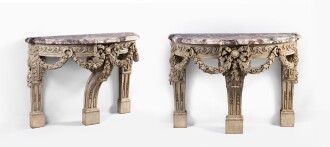
Bringing 18th-century furniture and objects into dialogue with the works of Claude Lalanne and François-Xavier Lalanne reveals a continuity of vision, in which nature, decoration, and imagination share a common language. Forms respond to one another across time with an obviousness that transcends eras.In the 18th century, under Louis XIV, Louis XV, and Louis XVI, the French art of living reached a peak of refinement. From Versailles to royal residences, from major manufactories to artists’ workshops, a world unfolded in which furniture and objects embodied a pursuit of perfection and total creation, an especially resonant echo of the Lalannes’ work.
Between the 18th century and the Lalannes, a shared way of thinking emerges: forms do not disappear; they transform and endure.
Pierre Chareau: From an Important French Private Collection
From 1920 onward, Pierre Chareau developed a new approach to furniture, informed by avantgarde research, particularly that of the De Stijl group and Cubist artists. His collaboration with metalworker Louis Dalbet opened up new constructive possibilities and led him toward a repertoire of furniture and lighting based on loadbearing metal structures. This approach gave rise to pieces with airy lines, where metal and wood interact to form true architectural compositions.
The desk presented here comes from the apartment of Raymond and Madeleine Dior, located at 3 square de l’Opéra in Paris, which Pierre Chareau partially designed in 1927. Raymond Dior, elder brother ofthe couturier Christian Dior, was then editor-inchief of the journal Le Crapouillot, while Madeleine Dior, daughter of a wealthy entrepreneur, was among the first female lawyers in France. It was at her initiative that Chareau was commissioned to design the living room and study. Our desk consists of a work surface extended by a retractable shelf and, on the right side, a set of shelves and a suspended compartment, combining fluid usability with formal elegance. It belongs to the continuum of research conducted by Chareau from 1926 onward, notably for his own use, then for Thérèse Bonney, Jean Dalsace, and Robert Mallet-Stevens, and precedes the model designed for Bernard Bijvoet. It can also be compared to the desk successfully presented at the Modern French Decorative Art exhibition in New York in 1928, alongside works by Jacques Lipchitz and Fernand Léger.
The principle of this load-bearing metal structure is also found in smaller pieces, such as the side table presented here: rigorous simplicity and sculptural presence are combined within a single object. Chareau approached lighting with the same synthetic vision. The combination of patinated metal structures and alabaster panels forming a screen became his signature, particularly in the “Masque” lamps, here in both their classic and sliding versions. Inspired by African art and Cubism, they express a new approach to lighting in which the fixture becomes a sculpture.
Acquired around thirty years ago by a French couple of collectors, this furniture and lighting ensemble harmoniously coexisted with the modern artworks that surrounded it. This rare group powerfully illustrates the innovative vision of Pierre Chareau, a major figure of the modern movement in France in the 1920s.
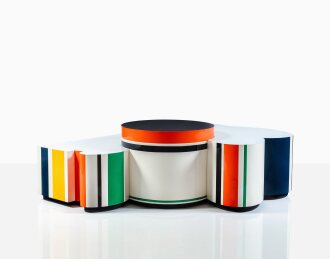
Throughout the 20th century and right up to the present day, many artists have crossed the traditionally established boundaries between fine art and decorative art. Furniture, as well as textiles, ceramics and lighting, thus become true fields of experimentation, where the artist transposes their visual language, their gesture and their vision. Everyday objects break free from their sole function to attain the status of artworks, embodying a sculptural, conceptual or narrative dimension.
In this approach, function is never denied; it may be repurposed, but above all it is poeticised and set against a backdrop of tension.
A table can become a manifesto, a chair an anthropomorphic presence, a light fixture a visual experience. Design is no longer conceived simply to meet a need: it becomes a medium in its own right, a direct extension of artistic practice.
The Important Design sale thus highlights major and iconic creations born of this fruitful dialogue between art and design. From Alphonse Mucha to Sonia Delaunay, from Alberto Giacometti to Robert Wilson, a constellation of artists emerges who have profoundly renewed our perspective on the object. We also rediscover works by Fernand Léger, Lucio Fontana, Pablo Picasso, Diego Giacometti, Friedensreich Hundertwasser, Philippe Hiquily, Guy de Rougemont, Richard Artschwager and Kaws in collaboration with Humberto and Fernando Campana.
Radical, poetic or surreal, these approaches reflect a freedom that is constantly being reinvented. They open up new perspectives where disciplines engage in dialogue and merge, redefining the traditional hierarchies between art and design.
Today regarded as must-haves, these works can be found in the homes of major collectors as well as in institutions around the world. They embody a vision of furniture as a space for expression, where the artist is no longer content to create simply to be looked at and used, but to be experienced.