A Collector’s Guide to the Cartier Crash
Explore the Cartier Crash's history, the London and Paris references collectors pursue, and why this groundbreaking design remains one of the world's most sought-after watches.

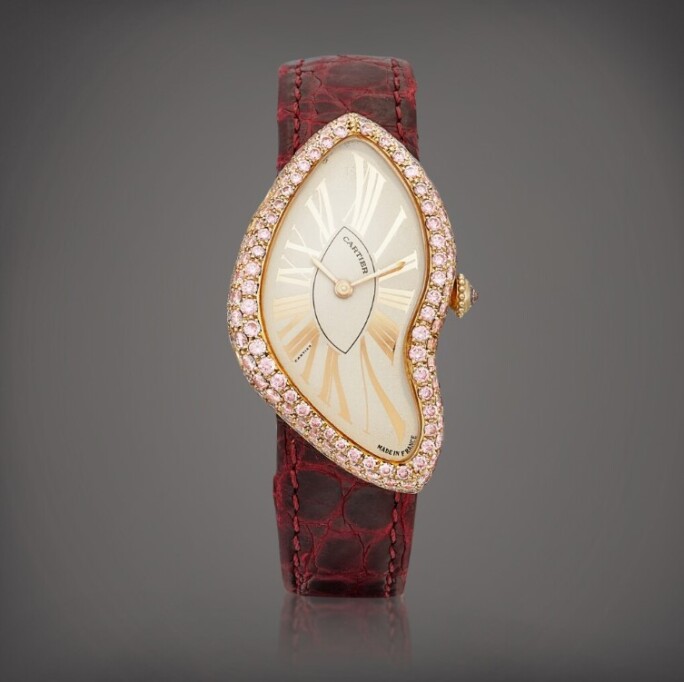
The Cartier Crash looks distorted by accident, but its asymmetry was deliberate. Introduced by Cartier London in 1967, the watch bends the familiar elements of a classical Cartier dial into an irregular case, stretching its Roman numerals along the contours of a form that seems to shift depending on the angle. It was a radical departure even for a Maison with a long history of unconventional shaped watches.
Its story is inseparable from London in the 1960s. Under Jean-Jacques Cartier, the London branch had considerable creative independence, while designer Rupert Emmerson worked closely with him on new forms. The Crash emerged from that environment rather than, as a popular myth suggests, from a Cartier watch damaged in a car accident. Later Paris editions and special commissions have expanded its story, but the original London design remains the foundation of what has become one of Cartier’s most significant watches.
| Feature | What to Know |
|---|
| Origins | The Cartier Crash was created by Cartier London in 1967 under Jean-Jacques Cartier, with designer Rupert Emmerson closely involved in its development. |
| Design | Its distorted case and stretched Roman numerals challenged conventional watch design while retaining elements of Cartier’s established visual language. |
| London Crash | Early London-produced examples have a direct connection to the model’s origins and rank among the rarest Crash watches. |
| Paris Crash | Cartier reintroduced the Crash in Paris in 1991 through a limited edition of 400 yellow gold watches. |
| Special Executions | Private commissions, NSO watches and gem-set versions extend the Crash beyond its better-known production references. |
| Auction Record | A rare Cartier London Crash from circa 1987 became the most expensive Cartier Crash sold at Sotheby's, achieving 15.6 million HKD, establishing a new market benchmark for the model. |
| Current Examples | A 1991 Crash ‘Paris’ and a possibly unique circa 2005 white gold and sapphire-set Reference 2774 are offered in Sotheby’s Important Watches sale in Hong Kong on September 18, 2026. |
The Cartier Crash emerged from the creative vision of Cartier London during the cultural transformation of the late 1960s. At a time when traditional Swiss watchmaking largely favored symmetry and restraint, Cartier's London workshop embraced experimentation, producing some of the maison's most unconventional creations. Alongside designs such as the Pebble, Oblique, and Asymétrique, the Crash introduced a silhouette unlike anything previously seen in luxury watchmaking.
Its origins have long fascinated collectors. The watch's flowing, distorted case is often compared to Salvador Dalí's surrealist paintings, particularly The Persistence of Memory, while one of the best-known stories suggests the design was inspired by a damaged Cartier Baignoire brought into the London boutique after a car accident. While the precise inspiration remains open to interpretation, these stories have become an integral part of the Cartier Crash's mythology, reinforcing its reputation as one of the most unconventional designs in watchmaking.
Nearly six decades later, the Cartier Crash remains one of Cartier's defining creations. Produced in limited numbers throughout its history and periodically reinterpreted through carefully considered editions, the Crash has evolved from an experimental London design into one of the most sought-after watches in the collector market. Its originality, rarity, and place within modern design history have secured its status as one of the defining icons of twentieth-century horology.
Few watches occupy the same place in both watchmaking and design history as the Cartier Crash. While many iconic timepieces are celebrated for mechanical innovation or sporting heritage, the Crash is valued for its originality. Its sculptural form has earned recognition beyond the world of horology, appearing in museums, design publications, and private collections while remaining one of Cartier's most recognizable creations.
Its rarity has only strengthened its position among collectors. Production has remained relatively limited throughout the model's history, with original London examples, Paris re-editions, and special-order executions produced in small numbers. Collectors also place a premium on watches with exceptional provenance, particularly complete sets accompanied by their original box, warranty papers, and certificates. Together, these factors continue to make the Cartier Crash one of the most sought-after watches on the secondary market.
Although the Cartier Crash has remained remarkably faithful to its original design, several references have become particularly significant to collectors. Each represents a different chapter in the model's evolution, from the earliest London-produced examples to limited re-editions and highly exclusive modern special orders.
The earliest Cartier London Crash watches are widely regarded as the most important examples of the model. Produced in very limited numbers following the design's introduction in 1967, these watches established the distinctive asymmetrical case that would become one of the defining silhouettes in modern watchmaking.
Collectors prize London-produced Crash watches for their historical importance, exceptional rarity, and direct connection to the model's origins. Produced in extremely small numbers, first-series examples are believed to number fewer than a dozen, making opportunities to acquire one exceptionally rare. A notable example, produced in 1970, realized 807K CHF in November 2021. Featuring the distinctive first-series "London" dial with softer script, the Roman numeral IV rather than the later IIII, matching 1970 London hallmarks on both the case and original "melted" deployant clasp, and Jacques Cartier's "JC" maker's mark, the watch exemplified the characteristics collectors seek in the earliest London Crash references.
In 1991, Cartier reintroduced the Crash through a limited Paris edition of just 400 pieces. Remaining faithful to the spirit of the original London design while adopting a slightly smaller case, the Paris re-edition introduced the Crash to a new generation of collectors. Signed "Paris" on both the dial and caseback, these watches have become one of the collection's most desirable modern references, bridging the experimental character of the original with the refinement of later production.
One notable example of the Cartier Crash Paris re-edition sold for $475K USD in May 2026. Produced as part of the limited series of 400 pieces, the watch remained faithful to the spirit of the original London Crash while introducing a slightly smaller 38.5 x 22.5 mm case that enhanced wearability without altering the collection's unmistakable asymmetrical silhouette. Signed "Paris" on both the dial and caseback, it was further distinguished by an 18k yellow gold deployant clasp incorporating the Crash's signature distorted motif, details that have become defining characteristics of the 1991 re-edition.
Another yellow gold Cartier Crash Paris re-edition demonstrated the appeal of early production examples when number 4 of the limited series of 400 realized 214K CHF in November 2022. Produced during the inaugural year of the Paris re-edition, the watch exemplifies why collectors continue to seek out these references, particularly examples from the earliest production run that preserve the defining characteristics of the 1991 series.
Another example from the 1991 series is currently offered in Sotheby’s Important Watches sale in Hong Kong on September 18, 2026. Numbered 290-91 from the limited edition of 400, the Cartier Crash ‘Paris’ is cased in 18k yellow gold and measures 38.5 × 22.5 mm. Its white dial and mechanical Calibre 160 reflect the defining specifications of the Paris production, offering a current point of comparison with the earlier examples that have appeared at auction.
Among contemporary Cartier Crash watches, New Special Order (NSO) examples occupy a particularly exclusive position. Reserved for Cartier's top clients, the NSO program allows select watches to be customized with unique details while preserving the Crash's unmistakable asymmetrical design. These bespoke commissions often incorporate unusual combinations of precious metals, gemstones, or dial elements that distinguish them from standard production, making each NSO watch a highly individual interpretation of one of Cartier's most iconic designs.
A striking example of the program appeared in June 2026 when a yellow gold Cartier Crash Reference WGCH0018 realized $410K USD. Produced around 2020, the watch retained the collection's signature silvered dial and elongated asymmetrical case but replaced the traditional blue sapphire cabochon with a vivid red cabochon-set crown created as part of the original special order. Measuring 43 × 24 mm and powered by Cartier's manual-winding Calibre 8970 MC, the watch demonstrates how subtle, factory-authorized modifications can transform an already rare Cartier Crash into a truly distinctive collector's piece.
While the Cartier Crash is best known for its sculptural case, Cartier has occasionally reinterpreted the design through exceptionally rare diamond-set editions. Rather than transforming the watch into something entirely different, these references preserve the Crash's unmistakable silhouette while elevating it through carefully considered gemstone settings. Produced in far smaller numbers than standard models, diamond-set Crash watches occupy a distinctive place within the collection, appealing to collectors who appreciate both Cartier's jewelry heritage and its most unconventional watch design.
One remarkable example is Cartier Crash Reference 2463, distinguished by its pink diamond-set case. The unusual use of colored diamonds enhances the watch's flowing asymmetrical form while remaining true to the original design. This exceptional reference realized 1.1M HKD in October 2023, illustrating the exceptional rarity of gem-set Crash models and the appeal of references that combine fine jewelry craftsmanship with one of Cartier's most recognizable watches.
An even more unusual interpretation is also offered in Sotheby’s Important Watches sale in Hong Kong on September 18, 2026. Dating to circa 2005, Reference 2774 is described as a possibly unique Crash with an 18k white gold case set with sapphires. The stones follow the curves of the case around a silvered dial, introducing vivid color to a design more commonly encountered in polished precious metal or diamond-set form. At 38 × 22.5 mm, the watch retains the proportions associated with this period of Crash production while presenting a markedly different expression of the model.
Although the Cartier Crash has historically been produced only in limited runs during select years, Cartier has occasionally created individually commissioned examples for its most important clients. These watches sit outside the standard production timeline, making them even rarer than the collection's already limited editions. Faithful to the original London Crash, they preserve the model's unmistakable silhouette while introducing a level of exclusivity that few Cartier watches can match.
An extraordinary example produced in 2007 illustrates this rarity. Created as a private commission during an off-production year, the 18k yellow gold watch was marked "1 of 1" on the caseback alongside its year of production, underscoring its status as a unique creation. Crafted at Cartier's watchmaking workshops in La Chaux-de-Fonds, it remained remarkably faithful to the original London design, featuring a silvered dial with Roman numerals, Cartier's hidden signature within the VII numeral, and the discreet "Swiss Made" designation at six o'clock. This exceptional commissioned Crash realized $228K USD in February 2025, highlighting the extraordinary appeal of bespoke Cartier creations that exist outside the maison's regular production history.
The benchmark for the Cartier Crash market was established by a yellow gold Cartier London Crash dating to circa 1987, which remains the most expensive Cartier Crash ever sold at auction, achieving 15.6 million HKD. Believed to be one of only three examples produced during a brief and little-documented revival of Crash production in the late 1980s, the watch occupies an exceptionally rare place within the model's history. Created by Cartier London, it retained the flowing asymmetrical case that defined the original 1967 design and was further distinguished by its original gold deployant buckle, making it one of the finest surviving examples of the Crash to appear publicly.
The record reflects more than rarity alone. London-produced Cartier Crash watches are widely regarded as the foundation of the collection, representing the period when the model was conceived and developed under the independent creative direction of Cartier London. Examples produced outside the original 1960s run are exceptionally uncommon, making this circa 1987 watch an important link between the earliest Crash models and the collection's later re-editions. Its record-setting result further cemented the Cartier Crash's reputation as one of the most significant and valuable designs in modern watchmaking.
Few watches have influenced modern design quite like the Cartier Crash. Since its introduction in 1967, the model has evolved from an unconventional creation produced by Cartier London into one of the most celebrated and collectible watches in the world. Original London examples, the 1991 Paris re-edition, New Special Order commissions, and unique client pieces each represent a different chapter in the Crash's story while remaining unmistakably connected to the original design.
What distinguishes the Cartier Crash is not only its rarity but its ability to transcend traditional watchmaking. Admired as a work of design as much as a timepiece, it continues to attract collectors who appreciate originality, craftsmanship, and the history behind one of Cartier's most recognizable creations. As new generations of collectors discover the Crash, its place among the defining watches of the twentieth century remains firmly established.
The Cartier Crash combines one of the most recognizable designs in watchmaking with extremely limited production, historical significance, and sustained collector demand. Original Cartier London examples are among the rarest, while Paris re-editions, New Special Order commissions, and unique client pieces have further strengthened the model's appeal on the secondary market.
The rarest Cartier Crash watches are generally original London-produced examples and bespoke commissions created outside Cartier's regular production schedule. Individually commissioned watches, New Special Order (NSO) executions, and exceptionally scarce London references are among the most sought-after by collectors.
The original Cartier London Crash debuted in 1967 and established the model's distinctive asymmetrical design. In 1991, Cartier introduced a limited Paris re-edition of 400 pieces that remained faithful to the original while featuring a slightly smaller case and "Paris" signatures on the dial and caseback.
NSO stands for New Special Order, Cartier's bespoke commissioning program for select clients. These watches retain the signature Crash design while incorporating factory-authorized custom details, such as unique gemstones, metals, or dial elements, making them considerably rarer than standard production models.
Yes. Cartier continues to produce the Crash in highly limited numbers, periodically introducing new interpretations while remaining faithful to the original asymmetrical design introduced in 1967.
The most expensive Cartier Crash ever sold at auction is a yellow gold Cartier London Crash dating to circa 1987, which achieved 15.6 million HKD. Believed to be one of only three examples produced during a brief revival of Crash production in the late 1980s, it remains the benchmark for the model.
Whether you're a seasoned collector or new to the world of fine watches, Sotheby’s offers a trusted, seamless way to buy and sell Cartier watches on the secondary market.
Trust our worldwide network of leading watch specialists from a globally renowned auction house established in 1744.