Geek Week is on at Sotheby’s New York, with a thrilling series of auctions taking place 14 - 15 July celebrating some of the greatest discoveries, inventions and achievements across natural history, science and space exploration.
From record-breaking dinosaur fossils and extraordinary meteorites, to iconic artifacts from the Apollo missions and groundbreaking scientific treasures, the sales showcase objects that have shaped our understanding of Earth and beyond. It’s not necessary to own one of these pieces of history to understand their significance. But there is certainly no more tangible way to find connection with the greatest minds in science and technology and the most meaningful phenomena of our natural world.
Sotheby’s specialists have chosen their standout lots from across the sales. Now’s the time to save (or bid on) your favorites before the hammer comes down.
The Broken Circuit Breaker Switch that Nearly Ended Apollo 11, and the Pen that Saved the Crew and the Mission
When this circuit breaker switch, which controlled the Engine Arm Switch, broke off the panel onboard Apollo 11, it nearly ended the lives of all the mission’s astronauts. Buzz Aldrin, thinking quickly, wedged a pen into the board to fashion a makeshift switch. Both pen and switch are now coming to auction, offering a unique opportunity to own a piece of NASA history and proof of American bravery and ingenuity.
Juvenile dinosaurs are extremely rare in the fossil record, making these two delicate specimens incredibly unique. These baby dinosaurs remain preserved within the original fossil-bearing rock in which they were discovered, with only the uppermost layer of bones exposed. To the upper left of the block, the remains of the eggshells are clearly visible, with additional fossil elements seen protruding from beneath, suggesting the existence of yet more material to be discovered. “It's an absolute miracle that they have been preserved this perfectly," says Cassandra Hatton, Vice Chairman, Worldwide Head, Science & Natural History.
Calcite var. Manganocalcite
Manganocalcite is an uncommon variety of calcite, known for its vibrant pink color. This specimen is an extraordinary example of manganocalcite from Inner Mongolia’s Huanggang Mine. The sprawling and complex arrangement of large, intersecting calcite blades form a pair of intergrown rosettes. The saturated rose-pink coloration, rarely seen from the species, is complemented by a satiny luster that accentuates their elegant, bladed form. The piece possesses a striking three-dimensional presence and is rich in depth, movement, and architectural balance. "Despite being from the earth, this magnificent specimen appears as if it could exist under the sea, showcasing the truly remarkable variety of what our natural world has to offer," says Matthew Hoffarth, Specialist, Head of Sale, Science & Natural History.
Buzz Aldrin's Gold Omega Speedmaster 3861
On 15 July, Sotheby's will offer a collection of pieces from the Buzz Aldrin Family Trust as part of our Space Exploration Auction. Included in the sale are a few watches from Buzz Aldrin's personal collection, but this one is a standout. This limited-edition Omega Speedmaster 3861 pink gold chronograph wristwatch is presented in like-new condition and is offered with its original Omega presentation box.
Unique Allosaurus Skull Display
Unlike the jaws and teeth of Tyrannosaurus and Ceratosaurus, which were designed to pierce deeply into flesh and bone, Allosaurus skulls and teeth were more similar to that of Great Whites and other sharks that rip and cut in a saw-like manner. Such menacing teeth are showcased in this unique lot, which was mounted on a custom armature that allows viewing from multiple angles and removal for ease of study. The well-preserved jaws comprise a total of 73 teeth, 36 of which are erupted above the gum line.
Nobel Prize Winner Richard P. Feynman’s Love Letters
This collection of 40 letters from Nobel-prize winning physicist Richard Feynman to his wife and childhood sweetheart Aline was written from Los Alamos while he worked on the Manhattan Project. These letters sum to 88 pages and are autographed by Feynman, who was renowned for his pioneering work in quantum physics (for which he won a Nobel prize). Nearly all letters are in their original envelopes with visible postmarks applied by the postal service and indicating when they were processed, and addressed in Feynman’s distinct double-lined capital letter script.
Seymchan Monolithic Centerpiece
This monumental slice of a stunning meteorite is one of the most important and visually compelling iron meteorites known. Discovered in 1967 in the Magadan region of the Russian Far East, the meteorite came to be known as Seymchan. This slice measures 23 inches (58.4 cm) in height and weighs over 10 kilograms, offering an expansive and uninterrupted view of its extraterrestrial crystalline architecture. The pattern is bold and clearly expressed across the surface, with large, well-defined lamellae. The natural borders, retaining areas of oxidation and fusion crust, provide a striking contrast to the polished interior and reinforce the sense of the object as a fragment of a once much larger mass.
Apollo 14 Command Module Pilot Stuart Roosa’s Lunar Mission-Worn Inflight Coverall Jacket and Trousers
Following the 1971 launch and completion of Translunar Injection, Command Module Pilot Stuart Roosa and the other Apollo 14 crew members changed out of their pressure garments into more comfortable Inflight Coverall Garments. Roosa would go on to wear these garments for the entire journey to the Moon. Notably, Roosa’s Jacket includes the original Beta Cloth NASA logo, mission emblem and name tag, which were often removed as mission souvenirs. Buzz Aldrin’s Inflight Coverall Jacket Assembly, sold at Sotheby's 26 July, 2022 was one of the few flown Apollo ICG pieces to have come to auction, and this uniform is the only flown complete Apollo Inflight jacket and trousers set to be offered.
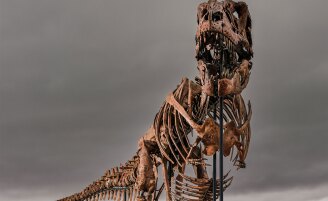
38-Foot-Long Tyrannosaurus Rex, One of the Largest Tyrannosaurus Rex Fossils Ever Found
This outstanding, exhibition-ready, mounted skeleton measures approximately 38 feet long and over 12 feet fall, cementing “Gus” as one of the largest T. rex ever found. Gus has an exceptionally well-preserved skull, with approximately 82% of the bones represented. Judging from the overall size and degree of bone development it can be determined that Gus’ skeleton belonged to a very large, robust, adult individual. The specimen was meticulously prepared to the highest standards, showcasing the fossils’ natural beauty and preserving important contextual information.
2009 Nobel Prize Medal in Physics Awarded to Willard Boyle
"The very website you're currently using owes a debt to Nobel Prize-winning physicist Willard S. Boyle” says Adam Stackhouse, Senior Specialist, Science & Natural History. The imaging semiconductor circuit—the CCD Sensor—he co-invented in 1969 with George Smith at Bell Labs, paved the way for digital imaging and led to things like the Hubble Space Telescope. “Their invention eventually led the way to the digital camera in your phone,” says Stackhouse.
Chart of Apollo 11 Lunar Landing Site
This chart, signed and inscribed by Buzz Aldrin and CAPCOM Charlie Duke, illustrates approximately half of Mare Tranquillitatis, a vast mare on the Moon's near side, with numerous large and small craters, including the ones Neil Armstrong and Buzz Aldrin used to navigate their lunar landing. The chart also features wrinkled ridges and highland areas to the west of the Apollo 11 landing site, which is located near the bottom center of the chart and marked near Charlie Duke’s inscription.
“Self Reflected” – 23k Gold Etching Depicting Neural Activity in the Human Brain
Combining advanced scientific visualization with innovative artistic techniques, this etching reveals intricate networks of neurons in the human brain with extraordinary precision. Created by neuroscientist and artist Dr. Greg Dunn in collaboration with physicist Dr. Brain Edwards, this work is both scientifically informed and visually striking. As light moves across the surface, the image transforms, creating a dynamic viewing experience that stands as a remarkable intersection of neuroscience and art.
Watson & Crick’s Original Cavendish Laboratory Model of DNA
In 1953, James Watson and Francis Crick made the monumental discovery of the double helix structure of DNA, explaining how genetic information is stored, copied and transmitted. One of approximately six known examples of their original Cavendish Laboratory DNA structure, this historic piece is being offered by the estate of biochemist Richard E. Dickerson. It came into Dickerson’s care when he inherited responsibility for laboratory materials at Caltech, where he studied DNA. Constructed from wire and metal components, the three-dimensional representation illustrates the double helix through two antiparallel strands twisting around a shared axis.




![View 1 of Lot 122: [Apollo Program]](https://sothebys-com.brightspotcdn.com/dims4/default/3550094/2147483647/strip/true/crop/1590x2000+0+0/resize/299x376!/quality/90/?url=https%3A%2F%2Fsothebys-md.brightspotcdn.com%2Fwebnative%2Fimages%2F6a%2Fde%2Faf6203ba4a849b5f95ea9c698b57%2Fn12212-d8hld-t2-03-a.jpg)
![View 1 of Lot 119: [Apollo 17]](https://sothebys-com.brightspotcdn.com/dims4/default/37d289b/2147483647/strip/true/crop/2000x1627+0+0/resize/330x268!/quality/90/?url=https%3A%2F%2Fsothebys-md.brightspotcdn.com%2Fwebnative%2Fimages%2Fad%2Fbf%2F3a28f6c345b69f309d83b2959c83%2Fn12212-djmlb-t3-01.jpg)
![View 1 of Lot 15: [Lunar Surveyor]](https://sothebys-com.brightspotcdn.com/dims4/default/0bf2515/2147483647/strip/true/crop/2000x2000+0+0/resize/330x330!/quality/90/?url=https%3A%2F%2Fsothebys-md.brightspotcdn.com%2Fwebnative%2Fimages%2F63%2Fb5%2Fd50f4ec54e588bde826bed474f20%2Fn12212-dhgcr-t2-03.jpg)

![View 1 of Lot 78: [Apollo 11]](https://sothebys-com.brightspotcdn.com/dims4/default/2eecbc2/2147483647/strip/true/crop/2000x2000+0+0/resize/330x330!/quality/90/?url=https%3A%2F%2Fsothebys-md.brightspotcdn.com%2Fwebnative%2Fimages%2F51%2Fba%2Fb10b53924cd9a01007be876bfe42%2Fn12212-djmkw-t3-01.jpg)


