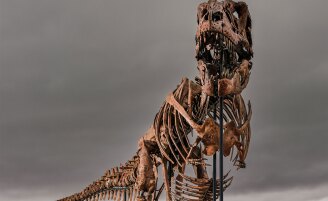
Gus, Apex, Sue and the Ceratosaur: Sotheby’s Most Thrilling—and Complete—Dinosaurs at Auction
Gus, Apex, Sue and the Ceratosaur: Sotheby’s Most Thrilling—and Complete—Dinosaurs at Auction
By
Lili Göksenin| Jul 16, 2026
On July 14, 2026, Gus the T. Rex sold for $50 million—breaking Apex's record by $5 million. Cassandra Hatton, Vice Chairman and Worldwide Head of Science and Natural History explains why Gus, Apex, Sue and the juvenile Ceratosaurus achieved such incredible results.
On July 14, 2026, Gus the T. Rex sold for $50 million—breaking Apex's record by $5 million. Cassandra Hatton, Vice Chairman and Worldwide Head of Science and Natural History explains why Gus, Apex, Sue and the juvenile Ceratosaurus achieved such incredible results.
I
n 1997, Sotheby’s held the first ever auction of a dinosaur. Affectionately nicknamed “Sue” (after Sue Hendrickson who first discovered Sue sticking out of the ground in the badlands of South Dakota), this fossil didn’t look like dinosaur fossils as we know them now, neatly assembled, three-dimensional and looking down on us in a museum atrium. Sue, a Tyrannosaurus Rex, was wearing jackets.
She was wearing what specialists call field jackets. When bones are discovered, digging them out individually on site would be dangerous and risk damaging the specimens. Instead, the rocks in which the fossils are embedded are carved out and then encased in field jackets fashioned from layers of burlap and plaster. So, in 1997, the T-Rex was displayed on huge tables, still in their jackets. At sale time, “people had to imagine what the dinosaur might look like or what it could look like,” says Cassandra Hatton, Sotheby’s Vice Chairman and Worldwide Head of Science and Natural History. “Nobody knew how complete it was, how big it was, how many of the bones were there.”
“If Sue were sold today? That's a $60 million plus dinosaur. No question at all.”
Cassandra Hatton, Sotheby’s Vice Chairman and Worldwide Head of Science and Natural History
Gus the T. Rex Crushes World Record for Dinosaur at Auction
Even so, the fossil sold for around $8 million after a few large corporations banded together to purchase the fossil for the Field Museum in Chicago. (The museum then did all the specialized work for removing the fossil from the jackets and assembling it.) “If Sue were sold today? That's a $60 million plus dinosaur,” says Hatton. “No question at all.”
The market for dinosaurs has shifted dramatically in the last 29 years. “In those days, nobody other than a museum even contemplated the possibility of owning a dinosaur,” says Hatton. This was partly because we simply had not discovered many. By the time Sue was found, only around 20 tyrannosaurus rex fossils had come out of the ground since they were first discovered in 1905. In the years that followed, paleontologists have nearly tripled that number.
"Apex" up close.
It’s important for any dinosaur enthusiast to know that these fossils are always missing parts; in fact, finding even half of a dinosaur is considered a major scientific discovery. Sue was so special because she was so complete: despite her gargantuan size (she’s 40.5 feet long and 13 feet tall at the hip), she is 90% complete by bone volume and 250 of her roughly 380 bones were found.
In the early days of paleontology, when finds were still exceedingly rare, dinosaur fossils were often built as composites: bones from different dinosaurs were mounted together in an attempt to demonstrate what a single individual might have looked like. While this practice is still sometimes in use, failing to disclose that a specimen is a composite is majorly frowned up. From a scientific perspective, not knowing that a skeleton is a composite can lead a researcher down an unnecessary rabbit hole. And when it comes to auction prices, there is a vast gulf in value between a composite and a single specimen; collectors in the know will pay a high premium for a specimen that is documented as being that of a single individual.
In 2024, Sotheby’s brought another virtually complete dinosaur to auction, this time a stegosaurus named “Apex.” Apex was not presented in field jackets, but rather, had been carefully cleaned, prepared, restored, and mounted for exhibition by an expert team. Standing at 11 feet tall and nearly 27 feet long from nose to tail, this herbivorous creature was a giant. Excavated from private land in Moffat County, Colorado, near the town of Dinosaur, Apex was a single specimen containing 254 bones (of an approximate 318)—missing elements were either 3d printed or sculpted.
Apex's spiked tail.
27 years after Sue, Apex sold for $45 million—a far cry from $8 million for Sue. “It's much more complex than just, oh, people think these are cool now,” says Hatton (though, that certainly doesn’t hurt). She has worked very hard to set high standards for documenting and selling fossils, establishing a process of legal documentation, and how the specimen is documented from discovery to sale.
When she is sourcing fossils, Hatton keeps museums in the back of her mind: “I fly out to the dig sites and meet with the teams who are doing the digging, prep, and mounting. The only way to truly do the documentation right is if you start doing it from day one. I'm making sure each dinosaur is documented to the standards that a museum would want.”
In 2025, Hatton offered yet another exhibition-ready mounted dinosaur to the market, this time a juvenile Ceratosaurus. Coming in at a relatively diminutive 6 foot 3 inches (and measuring approximately 10 feet 8 inches in length), this fine-boned specimen is one of only four Ceratosaurus ever found in the world, and the only juvenile amongst them. Juvenile dinosaurs are exceedingly rare, due to the fragility of their bones, which rarely survive the fossilization process, and to the fact that they were a favorite food of larger predators. Incredibly, this specimen retained not only all of the important diagnostic features of the genus, but a virtually complete skull, including even the most fragile bones.
The Ceratosaurus had that rare combination of extreme rarity, super high quality, and scientific importance, resulting in a final sale achievement of $30.5 million. It was a huge price for a small dinosaur, and made it the most valuable dinosaur pers square inch ever sold.
The very complete skull of the juvenile ceratosaurus. Matthew Sherman
No two dinosaurs are alike, even when comparing two specimens of the same genus and species. Potential buyers must ask themselves why do I want this specific dinosaur?How complete is it? What makes this particular specimen special? Is it of an especially high quality? Is it of an unusual size? Is it a rare color? “Every five year old knows that a T-Rex was scary,” says Hatton. “Why do we care about this specific one?”
“Every five year old knows that a T-Rex was scary. Why do we care about this specific one?”
Hatton
In July 2026, Hatton brought yet another fantastic find to auction. This time his name was Gus and, like Sue, he is a T-Rex. Gus is one of the largest T-Rex ever found with a body length of 38 feet, a skull length of 54 inches, a femur length of 50.39 inches, and rising to 12 ½ feet tall. A single specimen found in Harding County, South Dakota, Gus has 30 of the 32 rarely found and rarely mounted gastralia (belly ribs, which are technically osteoderms and thus not traditionally reckoned within the formal bone count).
The fossil is approximately 63% complete by bone count, with these bones representing 75-80% of the bone mass of the animal, placing it firmly among the most complete T rex ever found. Judging by his size and bone development, experts know that Gus was a very large and robust adult, and the fossilization is of an incredibly high quality with many of the most important and rarest bones preserved. He sold for $50 million after a spirit bidding battle.
“This result has been years in the making, and I’m thrilled to see that the hard work and dedication of Thomas Heitkamp and his team has been recognised," says Hatton. "Gus is not only an exceptional find, but a specimen that’s been excavated, documented, prepared, and cared for with real excellence. The market responds when great specimens are taken care of in the right way.”
"Gus is not only an exceptional find, but a specimen that’s been excavated, documented, prepared, and cared for with real excellence. The market responds when great specimens are taken care of in the right way.”