

The Dinosaur Specialist

One of the most complete Tyrannosaurus rex specimens ever found shows why not all bones carry equal weight.
By Cassandra Hatton
Vice Chairman, Worldwide Head, Science & Natural History
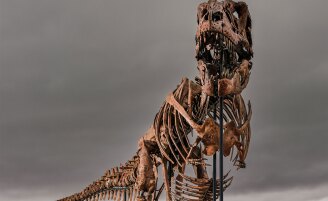
When I describe Gus, I start in very direct terms: he is one of the most important Tyrannosaurus rex specimens to come to market. He dates to more than 60 million years ago and is the third most complete T. rex known, after Sue, which Sotheby’s sold in 1997, and Stan, which sold in 2020. That places him immediately in a very small group, but what defines him goes beyond rank or percentage. With a specimen like this, importance is built from rarity, preservation and the specific information the bones retain.
Completeness, as a concept, can be deceptively blunt. It suggests a straightforward measure of quality, when in reality the question is far more nuanced: not simply how many bones are present, but which ones. A skull, a pelvis, a femur—these are fundamentally different from a rib or a toe. In paleontology, not all elements carry the same weight. That becomes clear with Gus, which preserves a furcula, or wishbone, almost never found in T. rex. It is a small element in physical terms, but scientifically it is significant because it contributes to how we understand the anatomy of the animal and its relationship to modern birds.
Preservation is where a specimen either retains its integrity or begins to lose it. Tyrannosaurus rex fossils are most often recovered from the Hell Creek Formation in the Northern Great Plains region in the U.S., where conditions are not always conducive to top clarity. By contrast, earlier Jurassic formations can yield well-preserved material, though they are far more difficult to excavate. Gus comes from Hell Creek, yet the bones are unusually well preserved and largely free from the distortions that so often complicate reconstruction. That clarity matters enormously, because it allows scientists to understand how the skeleton actually came together in life, rather than interpreting something compromised.

Moreover, Gus retains evidence of experience—pathologies that healed, fractures that rejoined. There is a place on the skull where you can see the impact of bite marks from another T. rex. Details like that tell us not only that Tyrannosaurus rex was capable of surviving significant trauma, but that these animals interacted, scavenged and, at times, fed on one another. You begin to see not just a species, but an individual that endured and adapted.
The story of how a specimen like this is recovered is inseparable from what it ultimately is. Gus was discovered in South Dakota, on land where fossils are known to surface and disappear again through exposure to the elements. Excavation in that context is painstaking and physical. It is done by eye—walking the land, identifying fragments at the surface and then gradually exposing what lies beneath. In this case, the excavation extended over multiple field seasons, followed by years of preparation in the laboratory.
Once a fossil is exposed, the urgency is immediate. The material is stabilized in the field with plaster jackets, before being removed for more careful work. In the laboratory, that process continues through consolidation, cleaning and reconstruction, all of which must be done slowly if the integrity of the specimen is to be preserved. A rushed or careless approach at this stage can compromise not only the appearance of the fossil, but the scientific information it holds.
For me, that is what defines a specimen like Gus. It is not only the fossil itself, but the accumulation of judgment behind it—how it is identified, recovered and ultimately brought together. What remains is not simply a skeleton, but a record that can still be read—and still has more to tell us.

The Modern Art Specialist

A late bronze bust by Alberto Giacometti of his brother Diego distills his lifelong pursuit of human presence.
By Lisa Dennison
Chairman, Americas
During my time at Sotheby’s, I’ve had the privilege of working with a number of defining sculptures by the great Swiss artist Alberto Giacometti. This season, we are proud to offer a selection of works from the Wingate Family Collection, of which “Buste d’homme (dit New York II)” is a prime example. What distinguishes the collection is not only its depth, but also that the Wingates were fervent collectors of objects of design made by Alberto’s brother Diego, the subject of this portrait.
In 1914, when he was just 13 years old, Alberto Giacometti created his first sculpture, a simple head modeled after Diego. More than a half-century later, it was again Diego’s face that proved the focus of his most profound meditations on human presence—“Buste d’homme (dit New York II)”—one of the last sculptures Alberto ever made. A testament to his quest toward an essential truth, this sculpture stands as a paean to his brother as well as the everyman.
New York had loomed large in Giacometti’s life for years, always from afar. Of his 400-odd exhibitions, more than a quarter took place in the United States, with the majority of his American solo shows occurring in New York. Yet his journey in 1965 marked his only visit to the U.S., despite long-standing relationships with American dealers and patrons, and with James Johnson Sweeney, who, in 1955, as director of the Solomon R. Guggenheim Museum in New York, hosted Giacometti’s first American museum exhibition—where I later spent 30 years as a curator. His 1965 retrospective at the Museum of Modern Art was therefore a long-awaited homecoming for Giacometti, who would pass away in January 1966, just months after returning to Europe.

At the end of the checklist for the MoMA retrospective, two identical handwritten entries appear: “Head. (1965). Plaster. Collection Alberto Giacometti.” These two plaster forms are known today as “Buste d’homme (dit New York I)” and “Buste d’homme (dit New York II).” Exhibited in the interstitial medium of plaster, these late additions evince the urgency of their existence, and constitute the only works selected by Giacometti himself in the final exhibition of his lifetime.
More than a model, Diego was Alberto’s closest lifelong companion: an assistant and devoted confidant, the presence against which he measured his vision of form, from the first youthful head to these late, distilled busts.
“New York II” is Giacometti’s final sculpture of Diego—a culmination, in the words of his friend Jean-Paul Sartre, of “a whole man, made of all men, worth all of them, and any one of them worth him” (Jean-Paul Sartre, “Les Mots,” Paris, 1963).
Still in its plaster state at the time of Giacometti’s death, in 1966, “New York II” was later cast in a bronze edition under the supervision of his widow, Annette, beginning in 1968.


