Into the Virunga: Rwanda’s Mountain Gorilla Treks Are East Africa’s Most Exclusive
Into the Virunga: Rwanda’s Mountain Gorilla Treks Are East Africa’s Most Exclusive
By
Julie Coe| May 26, 2026
At $1,500 per permit—about double the cost of Uganda’s—gorilla trekking in Volcanoes National Park funds a conservation legacy that traces directly back to Dian Fossey’s arrival in Virunga Massif six decades ago.
Photography by Dario Catellani
At $1,500 per permit—about double the cost of Uganda’s—gorilla trekking in Volcanoes National Park funds a conservation legacy that traces directly back to Dian Fossey’s arrival in Virunga Massif six decades ago.
Photography by Dario Catellani
Urusobe, a gorilla from the Kwisanga group, in Rwanda’s Volcanoes National Park.
I
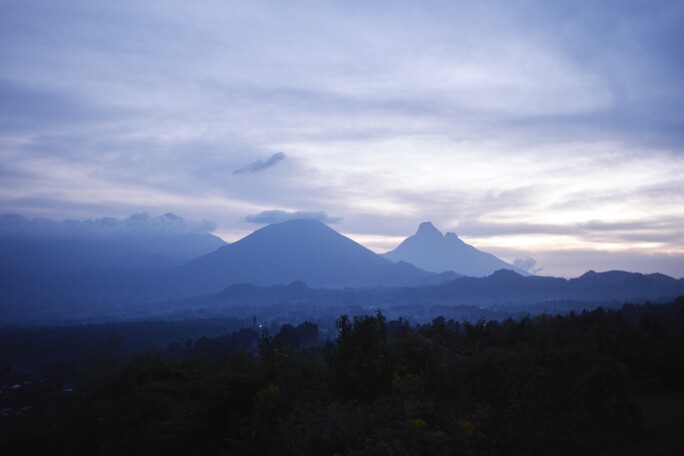
t’s a bit past dawn at Singita Volcanoes National Park, the resort in northern Rwanda, and through the picture windows, the early-morning clouds are slowly clearing from the towering peaks of Gahinga and Muhabura, two inactive volcanoes that punctuate the horizon. The roads to the eponymous park, nearby, are bustling with foot traffic: children in uniforms heading to school and people walking bicycles loaded with heavy sacks of local Kinigi potatoes. Bungalows with gabled roofs and colorful trim dot the wayside, interspersed among fields of starry-white pyrethrum flowers, which will eventually be dried to make insecticide.
At the park, visitors in sunhats and gaiters clomp off to their vehicles with guides and porters, each group out to find the mountain gorilla family they’ve been assigned that day. After a hike through bamboo forests, they’ll experience that electric moment when the majestic creatures suddenly appear, zipping through the leaves on all fours. For the most part, the gorillas knuckle-walk right past their human visitors without giving a second look—though some have been known to pat people on the head or even pull them by the leg.
Each family is led by a silverback, an adult male of about 12 years or older with the silver fur on his lower back. (Guides advise that if a silverback comes barreling straight at you, you should immediately shrink down and avoid eye contact.) The adult females, who are eight or older, have usually joined from another family. Babies ride on their mothers’ backs or scamper along on their own. You’d be forgiven for thinking that they’ve practiced their photo poses, the silverbacks strutting their stuff, the little ones curling up into cuddly furballs.
Aheza, also part of the Kwisanga family, carries baby Kwihangana on her back.
There are more than 40 families in the Virunga Massif, a cluster of volcanoes that stretches across the intersection of Rwanda, Uganda and the Democratic Republic of Congo (DRC). Tourists have the option of visiting gorillas in all three countries, but Rwanda is the most politically stable, having transformed in the three decades since the genocide. The “land of a thousand hills” also offers the most exclusive experience, with the $1,500 cost of its trekking permits nearly double that of Uganda’s, and almost quadruple that of the DRC’s. The high price allows Rwanda to issue about half the permits of Uganda, championing a lower- impact model of tourism while funding important community projects and conservation work. Rwanda, after all, is where the American primatologist, conservationist and “Gorillas in the Mist” author, Dian Fossey, first focused the world’s attention on the mountain gorillas’ plight. When she arrived in 1967, their total numbers had dwindled to around 250; today, thanks to the work she started, there are more than 1,000.
A silverback eating breakfast.
Contrary to Fossey’s time, many of the Virunga gorilla families are now habituated to human presence. Some are visited by tourists while others are monitored for scientific research. There are no tracking devices affixed to the animals themselves; instead, rangers stay close to the families throughout the day and pick up their trail again the next morning, radioing their locations over to the guides. (When gorillas find their way into Uganda or the DRC, rangers in those countries take over surveillance duties. For humans, the border crossing isn’t so simple.)
The juvenile female Urusobe, part of the Kwisanga family.
All treks include a full hour with a gorilla family but the format can vary widely from one excursion to another depending on where the animals are. It can involve a two-hour drive into the mountains, followed by a long hike into the forest, the porters clearing the way with machetes. Or it can simply entail meeting the gorillas at the park’s edge where they’re on the hunt for eucalyptus, a non-native species that’s been eradicated from the preserve. (It was first introduced to Rwanda by Belgian missionaries in the early 20th century.) A treat for the gorillas, eucalyptus also plays an important role in the local economy as a source of timber and charcoal. More problematically, it lures gorillas onto farmland.
In aerial imagery, the line where the park meets the surrounding farmland is strikingly clear: lush green on one side, a patchwork of potato fields, hoed into neat ridges, on the other. When the gorillas leave the park, they tend to rip out eucalyptus saplings or tear up shallow-planted potato seedlings. The tourists following them accidentally trample plantings as well. Farmers’ interests can quickly end up at odds with those of the gorillas. In fact, a percentage of each trekking fee goes to a fund for compensating for these kinds of losses. It’s one of the small but effective ways Rwanda has chosen to mitigate human-wildlife conflict. (Others include hiring former poachers as porters and building village water pipes so locals don’t enter the park looking for water.)
“Giving the babies Kinyarwanda names like Cyerekezo (‘vision’) and Izere (‘hope’) seems to speak to a collective dream for the gorillas’ future.”
Conservation is the lifeblood of the tourism industry in the Virunga area. Without gorillas, there are no tourists. The luxury hospitality brands in the area make conservation a key part of their operations, not because it sounds good in a marketing brochure but because it’s vital to their self-interest. And often, it’s part of the brands’ DNA to begin with.
Singita Volcanoes National Park sits on the site of a former dairy farm, and since 2018, the Singita brand’s conservation efforts have included planting nearly 350,000 trees while removing more than 20,000 eucalyptus plants—even though that means the gorillas no longer come onto the property as often as they once did. Spotted hyenas, serval cats, buffalo, elephants, duikers, bushbuck and the raucous hadada ibis all wander the reforested landscape.
The Virunga Massif, home to the majority of the world’s mountain gorillas, extends across the borders of Rwanda, Uganda and the Democratic Republic of Congo.
As Singita’s head of conservation, Inge Kotze, explains, though, much of its work in Rwanda is actually focused on humans, specifically the six villages adjacent to the volcanoes. Because youth unemployment is high, Singita supports scholarships and entrepreneurial projects, aiming to help young people turn their side hustles into full-time jobs. A Singita cooking school—in partnership with Prue Leith of “The Great British Bake Off” fame—trains 10 promising students a year, each of whom ends up with a job in the kitchen at Singita or a neighboring resort. Facilitating meaningful work is key to preventing poaching, hunting and other illicit moneymaking schemes that harm the gorillas and their habitat.
In the conservation briefing room in the resort’s Kwitonda Lodge, a glass cabinet holds the equipment of the late National Geographic photographer Robert M. Campbell, one of the first to photograph Fossey in the field. Geordi de Sousa Costa, of the design firm Cécile & Boyd, says place is the most important aspect when it comes to creating interiors. Cécile & Boyd has been with Singita since its inception in 1993, with carte blanche to distill a sense of place into each lodge. Singita’s buildings, which include a private four-bedroom villa called Kataza House, are constructed to look like they’re part of the land, with grass roofs and natural materials. There are the greens of the Virunga’s “Afro alpine” ecosystem and the oranges of volcanoes. Even the furniture takes on the shapes and colors of the gorillas. The goal, de Sousa Costa says, is “to match the extraordinary experience of conservation to the living experience.”
Resting in the forest.
A
t the Ellen DeGeneres Campus of the Dian Fossey Gorilla Fund, a re-creation of Fossey’s green corrugated-metal cabin takes up a large corner of the ground-floor exhibition space. It’s as simple as a child’s drawing of a house, with a white door and square windows, and it stands in contrast to the swooping, high-concept architecture of the campus itself, designed by Boston- and Kigali-based firm MASS. Inside, the one-room hut is arranged just as Fossey set it up, with a bed, a desk with a typewriter, maps, gorilla photos and woven mats. Letters she wrote home to her parents, now stored in a binder, tell of hard work and heartache.
Clockwise from top left: Pyrethrum flowers drying in the sun; the contours of Mount Sabyinyo; gorillas sitting in the undergrowth.
Fossey began her work with the gorillas in the DRC in January 1967, but within several months of her arrival, armed conflict in the area caused her to move to Rwanda. She found a spot between the peaks of Karisimbi and Bisoke and called her camp Karisoke, a portmanteau of the two. Campbell showed up the next year to photograph Fossey at work as she slowly embedded herself with the gorillas. His January 1970 National Geographic cover shows her with two orphans she’d named Coco and Pucker, carrying one on her hip like a human child.
Beyond focusing purely on research, Fossey engaged in “active conservation,” as she put it. She destroyed poachers’ traps, chased off grazing livestock encroaching on the gorillas’ habitats, and even threatened the poachers themselves. Though she’s lauded today as the gorillas’ savior, her aggressive tactics at the time gained her no shortage of enemies. When she was found murdered in her cabin in December 1985, there were any number of suspects, and the case is considered unsolved. (A recent Le Monde article, based on an interview with French investigator Fabrice Martinez, who surveyed the crime scene 40 years ago, hinted that a clump of hair found on her corpse might still be filed away somewhere and that DNA testing could reopen the trail.)
Clockwise from top left: A motorbike passes a eucalyptus grove; a porter with a machete; a silverback surveying the scene.
Fossey developed deep attachments to all the gorillas she worked with, growing to know and love each as an individual. Describing her feelings on the death of her beloved Digit, who was killed by poachers, she wrote, “There are times when one cannot accept facts for fear of shattering one’s being. As I listened to [the] news, all of Digit’s life, since my first meeting with him as a playful little ball of black fluff ten years earlier, passed through my mind. From that moment on, I came to live within an insulated part of myself.”
A juvenile gorilla snacking.
The affectionate names Fossey gave the gorillas, like Poppy, Effie, Uncle Bert and Cantsbee, became an important part of the culture around their conservation. Since 2005, the Rwandan government has taken on the naming duties, hosting a yearly ceremony called “Kwita Izina,” which means “to give a name” in the Rwandan language, Kinyarwanda. It’s an hours-long televised event, full of music and dance, where celebrities like Naomi Campbell, Idris Elba and Uzo Aduba christen each year’s new brood. Giving the babies Kinyarwanda names like Cyerekezo (“vision”), Higa (“commitment”) and Izere (“hope”) seems to speak to a collective dream for the gorillas’ future. Last year, a descendant of Effie’s was part of the group—he’s called Amahitamo (“choice”), signifying the active determination required to protect the gorillas. Four generations after Fossey first met Amahitamo’s great-grandmother, his family is still going strong.
Sotheby’s Magazine
About the Author
Julie Coe
Julie Coe is the editorial director at Sotheby’s Magazine. She has previously held editorial roles at WSJ. Magazine, Architectural Digest and Departures.