Kiki Kogelnik Editions: Pop Art, Power, and the Reinvention of the Female Image
Kiki Kogelnik Editions: Pop Art, Power, and the Reinvention of the Female Image
By
Alexandra LeBlanc| Jun 1, 2026
Learn how Kiki Kogelnik transformed the visual language of advertising into thought-provoking Pop Art editions that continue to resonate with collectors and contemporary audiences.
Learn how Kiki Kogelnik transformed the visual language of advertising into thought-provoking Pop Art editions that continue to resonate with collectors and contemporary audiences.
Kiki Kogelnik brought a distinctive voice to Pop Art. Born in Austria and later based in New York, she entered the American art world at a moment when commercial imagery was becoming increasingly influential. Advertising and popular media played a growing role in everyday life, shaping cultural expectations and influencing how people understood themselves. While many of her contemporaries embraced this new visual landscape, Kogelnik often approached it with a more questioning eye. She adopted the bold graphic language of popular culture but used it to examine how women were represented within it.
Her work remains compelling because it combines immediate visual appeal with deeper social commentary. At first glance, Kogelnik's compositions feel familiar. At first glance, Kogelnik's compositions feel familiar, drawing upon the polished imagery of advertising campaigns and fashion editorials. Yet the longer one spends with the work, the more complex it becomes. Rather than reinforcing conventional ideals of femininity, Kogelnik frequently challenged them. Her women appear self-assured and aware of their own visibility, occupying the picture plane on their own terms. The result is a body of work that feels both unmistakably Pop and remarkably independent from many of the movement's dominant narratives.
This perspective is one of the reasons Kiki Kogelnik editions continue to resonate with collectors today. Her screenprints preserve the energy that made Pop Art so influential while revealing the critical thinking that distinguished her practice from that of many of her peers. Editions such as Bathing in Green, Sunkist, Venetian Blinds, War Baby, and Desire provide a direct connection to to many of the artist's signature themes. Produced as signed and numbered editions, these works demonstrate how Kogelnik transformed the visual language of advertising into something far more nuanced. They invite viewers to look beyond the surface and reflect on the power images hold within contemporary culture.
Kiki Kogelnik Editions Key Takeaways
Category
What to Know
Why Editions Matter
Kogelnik editions offer collectors access to her most recognizable Pop Art language, especially her bold depictions of women, fashion, and consumer culture.
Market Demand
Interest has grown as collectors, institutions, and scholars continue reassessing the role of women artists within Pop Art and postwar contemporary art.
Types of Editions
Screenprints are especially important, often featuring highly graphic compositions, vivid color, stylized female figures, and hand-signed, numbered formats.
Collector Appeal
Kogelnik editions combine visual impact, feminist critique, strong design sensibility, and a direct connection to the artist’s most enduring themes.
Why Kiki Kogelnik Editions Matter in Today’s Art Market
Kiki Kogelnik occupies a unique place within the history of Pop Art. She worked alongside many of the movement's most recognizable artists, yet her work often moved in a different direction. Rather than simply embracing the imagery that surrounded her, Kogelnik examined it closely. She drew inspiration from fashion photography, advertising, and the growing influence of mass media, then transformed those familiar visual references into works that questioned the assumptions behind them. This ability to engage with popular culture while maintaining a critical perspective remains one of the defining qualities of her art.
While Kogelnik's paintings, sculptures, and cut-out figures are essential to understanding her broader practice, editions have become one of the most accessible ways for collectors to engage with her work. Screenprinting proved particularly well suited to her artistic vision. The medium allowed her to amplify the bold outlines and vivid color that characterize her imagery while preserving the clarity of her ideas. Although her works borrow elements from commercial design, they never feel detached or impersonal. Each composition reveals Kogelnik's distinctive perspective and her ability to turn familiar imagery into something unexpectedly thought-provoking.
This is especially relevant today as collectors increasingly seek artists whose work expands established art historical narratives. Growing institutional attention has encouraged a deeper appreciation of women artists whose contributions were often overlooked during the height of the Pop Art movement. Kogelnik has emerged as an important figure within this broader reassessment. Her editions capture the visual energy that made Pop Art influential while also addressing questions that continue to resonate with contemporary audiences. They reward close looking, offering far more than their striking surfaces initially suggest.
Kiki Kogelnik Bathing in Green
The Female Figure as a Radical Pop Art Subject
The female figure sits at the center of many of Kogelnik's most recognizable editioned works. During a period when advertising and popular media often reduced women to idealized images, Kogelnik approached the subject from a very different perspective. Her figures may appear fashionable and glamorous, but they rarely feel passive. Instead, they occupy a space between representation and critique, inviting viewers to question the visual conventions that shaped perceptions of femininity throughout the twentieth century.
Bathing in Green, a 1978 screenprint currently offered on Sotheby's Buy Now marketplace, captures this dynamic particularly well. The composition depicts a woman drying the back of her neck with a beach towel as she walks toward the viewer. Her eyes remain closed, creating a sense of calm self-awareness that contrasts with the bold graphic treatment of the figure itself. Published by Jackie Fine Arts in New York and printed by Studio Heinrici, the work was issued as a hand-signed and numbered screenprint in an edition of 200, with artist's proofs aside from the edition.
At first glance, the image evokes the carefree atmosphere of a summer scene. Yet Kogelnik's treatment of the figure complicates that reading. The body is simplified into broad areas of color and sharply defined contours, recalling the visual language of advertising and commercial illustration. Rather than celebrating those conventions, however, Kogelnik exposes them. Bathing in Green becomes less a depiction of leisure and more an examination of how women are transformed into images, filtered through the expectations and visual codes of contemporary culture.
Kiki Kogelnik Sunkist
How Kogelnik Reworked the Language of Advertising
Fashion plays an important role throughout Kiki Kogelnik's editioned work, but not in the way viewers might initially expect. Clothing, hairstyles, and carefully constructed poses appear frequently in her prints, creating an immediate visual connection to the worlds of advertising and fashion photography. Yet Kogelnik was never simply interested in style for its own sake. She understood that fashion imagery shapes perceptions of identity and influences how women are expected to present themselves in public life. Her prints often use these familiar visual cues as a starting point for a more critical conversation.
Sunkist, a 1981 screenprint currently offered on Sotheby's Buy Now marketplace, demonstrates this approach particularly well. The work depicts a woman reclining in an animal-print swimsuit, drawing on imagery that feels instantly recognizable from magazines and commercial advertising of the period. At first glance, the composition appears elegant and self-contained. The figure seems perfectly at ease within the scene, reflecting the polished ideals often associated with leisure and beauty culture.
A closer look reveals that Kogelnik is doing something more complex. Rather than presenting the figure as an object of admiration, she creates a subtle sense of distance between the viewer and the image. The woman retains a degree of independence that resists easy interpretation, encouraging viewers to question the assumptions that often accompany such imagery. Produced as a signed and numbered screenprint in an edition of 200, with artist's proofs aside from the edition, Sunkist exemplifies Kogelnik's ability to transform familiar visual conventions into works that remain thoughtful and relevant decades after they were created.
Kiki Kogelnik Venetian Blinds
Venetian Blinds and the Performance of Looking
One of Kogelnik's recurring interests was the relationship between the viewer and the image. Her figures often appear conscious of their own visibility, creating a subtle tension that runs throughout much of her work. Although they are placed within carefully constructed settings, they rarely disappear into those environments. Instead, they seem to maintain a sense of independence, reminding viewers that they are looking at a representation rather than a passive subject.
Venetian Blinds, a 1980 screenprint currently offered on Sotheby's Buy Now marketplace, explores this idea through a deceptively simple composition. A woman wearing a patterned yellow-and-black dress stands against a striped blue wall, her body angled slightly as though posing for a photograph. The image immediately recalls the visual language of fashion photography, where clothing, setting, and gesture work together to shape perception. Yet Kogelnik introduces just enough ambiguity to prevent the scene from feeling entirely comfortable or straightforward.
The striped background creates a sense of visual movement that draws attention to the figure, while her posture suggests an awareness of being observed. Rather than presenting a conventional fashion image, Kogelnik invites viewers to think about the act of looking itself. Who controls the image? Who is being observed? And how does the presence of the viewer shape what is being seen? Published by Jackie Fine Arts and printed by Studio Heinrici, Venetian Blinds reflects Kogelnik's ability to transform familiar visual conventions into works that encourage closer examination and continued reflection.
Kiki Kogelnik War Baby
War Baby and the Power of the Female Gaze
Throughout Kogelnik's work, the female figure is rarely presented as a passive subject. Even when she draws from the visual language of fashion photography or commercial imagery, her figures often retain a sense of authority that resists easy interpretation. They seem aware of the viewer's presence, creating a dynamic that feels markedly different from the advertising images that inspired much of her work.
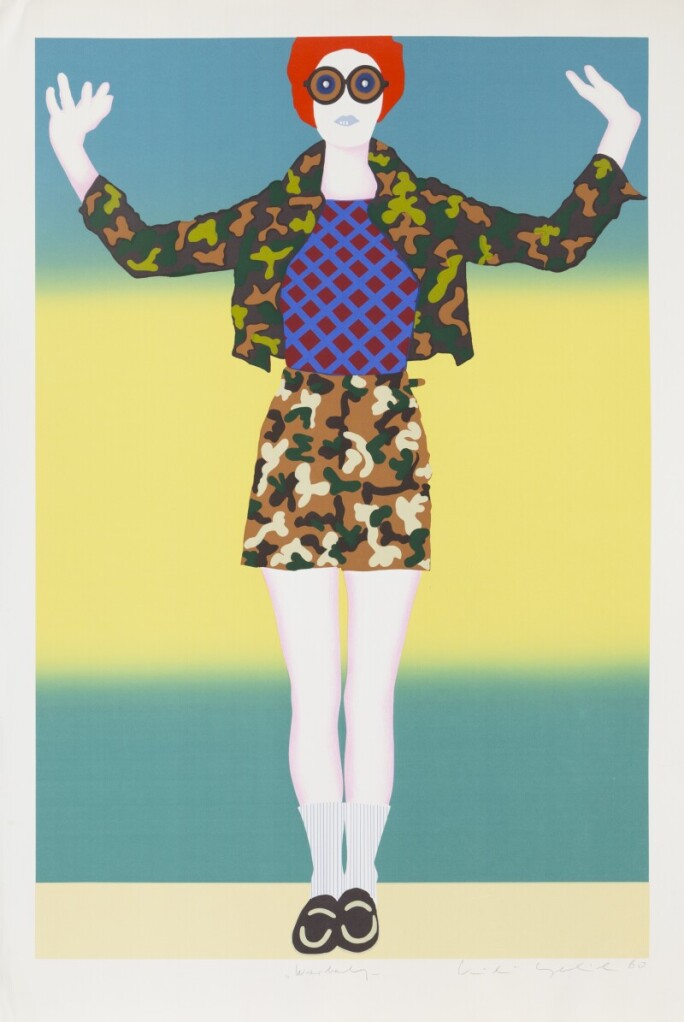
War Baby, a 1980 screenprint currently offered on Sotheby's Buy Now marketplace, is a particularly striking example. The composition centers on a woman dressed in boldly patterned clothing who meets the viewer's gaze directly. There is little ambiguity in her presence. Rather than inviting passive observation, she confronts it. The effect is immediate, transforming what might otherwise resemble a fashion image into something far more psychologically charged.
The title adds another dimension to the work. The phrase "War Baby" introduces ideas that extend beyond the figure herself, suggesting histories, experiences, and cultural forces that remain unseen within the composition. This tension between image and title encourages a more thoughtful reading of the work. As viewers, we are asked to look beyond surface appearance and consider what may lie beneath it.
This shift in perspective is central to Kogelnik's achievement. The woman in War Baby is not simply the subject of the image. She becomes an active participant in the exchange between artwork and viewer. Within the broader context of Pop Art, where images were often designed for rapid consumption, that distinction is significant. Kogelnik slows the viewing process down, using the directness of the figure's gaze to encourage reflection rather than passive observation.
Kiki Kogelnik Desire
Desire, Language, and the Psychology of Consumption
Words occupy a unique place in Kogelnik's work. Like many Pop artists, she understood the power of language within modern visual culture. Advertising relies on carefully chosen words to shape perception, create aspiration, and encourage consumption. Kogelnik often borrowed that language, but she rarely used it at face value. Instead, text becomes another element of the composition, inviting viewers to consider the messages that surround them every day.
Desire, a 1981 screenprint currently offered on Sotheby's Buy Now marketplace, offers one of the clearest examples of this approach. The work depicts a woman wearing a vivid green coat, her hands raised toward her head as she opens her mouth in an expression that feels difficult to define. Behind her, the word "DESIRE" stretches across the wall, immediately drawing attention to itself. The text functions almost like a headline or advertising slogan, framing the viewer's interpretation of the figure while also raising questions about the source of that desire and the expectations attached to it.
What makes the work particularly compelling is the tension between image and language. The word appears direct and unambiguous, yet the figure resists such a straightforward reading. Her expression remains open to interpretation, creating uncertainty where advertising typically seeks clarity. Kogelnik uses this ambiguity to her advantage. Rather than telling viewers what to want, she encourages them to reflect on how desire itself is constructed.
This interest in the mechanics of persuasion appears throughout Kogelnik's work, especially in prints that draw upon the visual conventions of fashion and commercial imagery. In Desire, however, the relationship between image and message becomes impossible to ignore. The work demonstrates Kogelnik's ability to transform familiar cultural language into something more reflective, encouraging viewers to think critically about the forces that shape attraction, aspiration, and personal identity.
Why Screenprints Became Central to Kogelnik's Practice
Screenprinting was ideally suited to Kiki Kogelnik's artistic vision. The medium allowed her to amplify the bold outlines and vivid color that became hallmarks of her work while preserving the clarity of her imagery. Rather than treating printmaking as a secondary medium, Kogelnik embraced its possibilities, using the screenprint process to create works that feel immediate and distinctly modern.
The production details of her editions also contribute to their appeal among collectors. Works such as Bathing in Green, Sunkist, Venetian Blinds, War Baby, and Desire were published by Jackie Fine Arts and printed by Studio Heinrici in New York. Each was issued as a signed and numbered edition of 200, with artist's proofs aside from the edition. These consistent production standards provide collectors with confidence while reinforcing the importance of these prints within Kogelnik's broader body of work.
Why Collectors Choose Kiki Kogelnik Editions
A Distinct Voice Within Pop Art
Kogelnik editions appeal to collectors who want a work connected to Pop Art but not limited to the movement's most familiar narratives. While her work draws from the imagery of popular culture, she consistently approached those subjects from her own perspective. This independence gives her editions a unique place within the broader history of postwar art and continues to distinguish her from many of her contemporaries.
A Powerful Reinterpretation of the Female Image
The female figure remains central to many of Kogelnik's most compelling works. Her subjects possess a sense of presence that separates them from the idealized images often found in commercial advertising. Rather than presenting women as passive symbols, Kogelnik created figures that engage viewers directly and encourage closer consideration. Collectors are drawn to this complexity because it gives the work a lasting relevance that extends beyond its original moment.
Accessible Entry Points into an Important Career
Kogelnik's editioned works provide a meaningful way to collect the artist. Signed and numbered screenprints allow buyers to engage directly with her visual language through works that are authentic, limited, and closely connected to her most important themes. For collectors interested in Pop Art, feminist art, or postwar works on paper, these editions offer a compelling combination of historical significance and accessibility.
Works That Feel Contemporary
Although many of Kogelnik's best-known screenprints were created in the late 1970s and early 1980s, they continue to resonate with contemporary audiences. Her examination of image-making and media influence remains highly relevant in a world increasingly shaped by visual culture. This enduring relevance allows her work to speak across generations while maintaining its original power.
The Future of Kiki Kogelnik Editions
Kiki Kogelnik's editions occupy a distinctive place within today's collecting landscape. Their bold visual language makes them immediately recognizable, while the ideas embedded within the works encourage deeper engagement. As scholarship surrounding her career continues to expand, collectors are increasingly recognizing the originality of her contribution to Pop Art and the ways her work broadened the movement's visual and conceptual boundaries.
More importantly, these prints stand on their own merits. They are not simply alternatives to unique works. They represent some of the clearest expressions of Kogelnik's artistic vision, revealing how she transformed familiar imagery into something thoughtful and enduring. For collectors, that quality continues to make Kogelnik's editions especially compelling within the broader field of postwar and contemporary prints.
Frequently Asked Questions About Kiki Kogelnik Editions
What are Kiki Kogelnik editions?
Kiki Kogelnik editions are limited-edition artworks, often screenprints, produced in defined quantities and typically signed and numbered by the artist. These works translate her distinctive Pop Art language into collectible formats that feature bold color, graphic composition, and recurring themes related to women, fashion, advertising, and consumer culture.
Why are Kiki Kogelnik editions important?
Kogelnik editions are important because they offer access to the central ideas of her practice. They reflect her role as a pioneering Austrian-American Pop artist who challenged the way women were represented in mass media, advertising, and popular culture. Her screenprints are especially valued for their strong visual impact and their connection to feminist readings of Pop Art.
What makes Kiki Kogelnik’s screenprints collectible?
Kogelnik’s screenprints are collectible because they combine strong graphic design, vivid Pop Art color, recognizable subject matter, and clear art historical significance. Collectors also value details such as signature, numbering, edition size, publisher, printer, and condition. Works that strongly feature Kogelnik’s female figures and critique of advertising tend to be especially appealing.
How did Kiki Kogelnik challenge traditional depictions of women?
Kogelnik challenged traditional depictions of women by using the visual language of advertising and fashion while refusing to present women as passive objects. Her figures are stylized and glamorous, but they often appear self-possessed, confrontational, or psychologically charged. This makes her work an important counterpoint to the male-dominated Pop Art movement.
Are Kiki Kogelnik editions a good entry point for new collectors?
Yes. Kiki Kogelnik editions can be a strong entry point for collectors interested in Pop Art, women artists, feminist art, and postwar works on paper. They offer an accessible way to engage with her practice while still carrying the authenticity, rarity, and visual strength collectors seek in editioned works.
What themes appear most often in Kiki Kogelnik editions?
Kogelnik editions often explore the female figure, fashion, advertising, beauty culture, consumer desire, and the construction of identity through images. Her use of bright color, flattened form, stylized bodies, and graphic composition makes these themes visually immediate while also encouraging deeper reflection.
Why is interest in Kiki Kogelnik growing?
Interest in Kiki Kogelnik is growing as collectors and institutions continue to reassess the history of Pop Art and recognize the importance of women artists who expanded the movement’s boundaries. Her work feels especially relevant today because it addresses questions of representation, gender, media, and visual culture that remain central to contemporary life.
Buy and Sell Kiki Kogelnik Editions with Sotheby’s
Whether you are beginning a contemporary art collection or expanding an established one, Sotheby’s offers a trusted, seamless way to buy and sell Kiki Kogelnik editions on the secondary market.
Why Choose Sotheby’s?
Expertly Vetted Selection Explore sought-after Kiki Kogelnik screenprints featuring her iconic female figures, fashion-inspired imagery, and bold Pop Art compositions. Prices often start around $8,500, with rarer and highly desirable editions achieving significantly higher values.
Exclusive Global Access
Shop Kogelnik editions through Sotheby’s global auctions and Buy Now marketplace, backed by a worldwide network of collectors, consignors, advisors, and specialists in contemporary and Pop Art.
Flexible Ways to Buy
Bid online, participate in live sales, or purchase instantly through Buy Now. You may also work directly with a Sotheby’s contemporary art specialist for tailored guidance.
Exceptional Value
Every Kiki Kogelnik edition is authenticated and reviewed by Sotheby’s experts to ensure quality, condition, and accurate market pricing. Many works are offered below primary-market or gallery levels.
Constantly Evolving Inventory
Discover Kiki Kogelnik editions sourced from private collections, estates, and consignments, with new works added regularly across Sotheby’s auctions and Buy Now marketplace.