Sotheby’s Magazine – The Opening Bid

Sotheby’s Magazine – The Opening Bid

News and notes from the worlds of art, books, culture, design, fashion, food, philanthropy and travel.

Edited by Julie Coe
News and notes from the worlds of art, books, culture, design, fashion, food, philanthropy and travel.

Edited by Julie Coe

View Finder

True to Nature | Set across the grounds of London’s Kew Gardens, Henry Moore’s sculptures have returned to the environment they belong to: the open air. On view through January 2027, “Henry Moore: Monumental Nature,” the largest-ever outdoor exhibition of the artist’s works, reflects his insistence that sculpture be encountered against landscape and horizon. “He always preferred showing work out of doors,” says Sebastiano Barassi of the Henry Moore Foundation.

Henry Moore carving “Reclining Figure,” 1959‑64, in elm wood, a material he favored as Dutch elm disease spread across Britain. Photo: Errol Jackson.

From the 1930s, Moore developed a sculptural language attuned to landscape—reclining figures that echo hills, pierced forms that admit sky. After World War II, as sculpture moved decisively into the public realm, he became one of its most influential advocates, shaping the institutional model later formalized in places such as Yorkshire Sculpture Park and Storm King Art Center.

Moore’s 1973 sculpture “Hill Arches.” Photo: Henry Moore Archive.

At Kew, some 30 monumental works populate the 326-acre site, their surfaces activated by shifting light. Moore, Barassi notes, did not think of landscape narrowly: “He sought to create a conversation with anything that was part of the natural world—including clouds and the sky.”

The accompanying catalog sharpens that exchange, with essays by Kew botanists tracing Moore’s affinities with specific natural forms—particularly trees, whose structures and growth patterns closely parallel his sculptural thinking—where shape is found as much as made. kew.org —James Haldane


Style Sheet

Photo: © Yoann & Marco.

All the Angles | Jewelry designer Valérie Messika brings an architectural precision to her new Moderniste collection, which marks 20 years of the Messika brand’s existence. The robust offering of bracelets, rings, necklaces and earrings is an ode to gold—in pink, white and yellow tones. It’s also generous with diamonds, whose chiseled facets are echoed in the pieces’ rigorous silhouettes. Messika Moderniste yellow gold diamond bracelet, $9,330; messika.com


Obsessions

Photo: Christopher Horwood.

Marquetry Marvels | London-based interiors specialist Artichoke, which champions craftsmanship and historical appreciation, demonstrates the allure of modern-day applications of marquetry. Working with Wales-based firm Aryma, Artichoke’s team outfitted a client’s entire guest bedroom in a scene taken from a neighborhood park. They designed the rustic tableau, done in American red cherry, with sprightly touches, such as insects representing each of the client’s grandchildren. artichoke-ltd.com


Fresh Takes

A 1966 Celine scarf, inspired by the U.S. Postal Service. Courtesy of Celine.

The French Connection | France was a powerful political ally to the American revolutionaries, helping their fledgling nation take wing. As the U.S. prepares to observe its 250th birthday, one French organization wants to celebrate this bond by emphasizing a different kind of French contribution: that certain je ne sais quoi. “Hidden Treasures, 250 Years of Franco-American Luxury Stories” highlights the members of the Comité Colbert, an elite association of mostly French luxury houses. Running May 26-31 at The Shed in New York City, the show explores the two-way flow of cultural influences—how jazz and Hollywood resonated in France, how French designer goods developed cult status in the U.S. One chic example: Céline Vipiana, the founder of fashion house Celine, created the U.S. Mail scarf in 1966, stamping a diaphanous Parisian accessory with some down-home American industriousness. theshed.org


Design Forward

Sonia Delaunay’s 1975 “Les jeux d’enfants” tapestry from Boccara Gallery. Courtesy of Boccara Gallery.

On the Move | Nomad, the itinerant art and design fair, arrives in the Hamptons this summer for its first U.S. foray. Held at the Watermill Center in the town of Water Mill, the June 25-28 presentation will take inspiration from the visionary approach of the center’s late founder, playwright and director Robert Wilson, and other famous East End artists, such as the Abstract Expressionists who gathered there at mid-century. The fair’s co-founder, Nicolas Bellavance-Lecompte, sees it as an opportunity to bring the international perspective of the Nomad project to a cultural sphere rich in regional influences. nomad-circle.com

The Watermill Center will host the Hamptons edition of Nomad. Photo: Maria Baranova, courtesy of the Watermill Center.

Greater Good

From Vine to Violin | Having taken up violin at 10, Stefan-Peter Greiner built his first instrument by 14—an early start that informs his commitment to nurturing young talent. Now with workshops in Zurich and London, he is among the luthiers commissioned by Musique & Vin au Clos Vougeot, the Burgundy-based association behind the annual festival of music and wine, to create instruments for the next generation of musicians.

Luthier Stefan-Peter Greiner refining a cello’s front plate in his workshop. Photo: Ray Palo.

Musique & Vin’s Instrumental Fund, established more than 15 years ago, has enabled the creation of dozens of stringed instruments, now forming a collection loaned to young musicians during their studies and early careers. In 2024, Greiner was invited to craft a quartet—conceived as a unified whole—comprising two violins, a viola and a cello, now played by the Magenta Quartet, a Paris-based ensemble formed in 2021.

He sees a ready parallel with winemaking. “They use something that nature gives them—grapes,” he says. “With me you have the wood. In each case, you create something that humans can experience with their senses.” To lend the instruments a spirit of unity, all were made from wood taken from the same trees—maple for the backs and spruce for the tables.

For Greiner, the association’s mission resonates. “They could buy one Stradivari and support one musician—but that would not help the landscape of musicians.” His emphasis is instead on giving young players the means to remain independent.

Taking place June 20-28, the festival’s 18th edition brings together chamber and symphonic performances and tastings from leading Burgundy domaines and culminates in a gala at the Château du Clos de Vougeot, with a live Sotheby’s auction in support of the Instrumental Fund. musiqueetvin-closvougeot.com –J.H.


Grand Tour

Meandering the Med | The ultimate summer destination, the Mediterranean provides a wealth of locations for a superb seaside stay. Here are some of the newest options.

From left: Gran Hotel Margalida; Luura Paros Cliff; Le Sirenuse Mare. Courtesy of Annua Signature Hotels; courtesy of Luura; photo: Stefan Giftthaler.

Gran Hotel Margalida Mallorca sees some strong openings this summer, including a Mandarin Oriental. The 29-room Grand Hotel Margalida, on the Spanish island’s west coast, is a more boutique offering, perched above the ocean among orchards and vines.

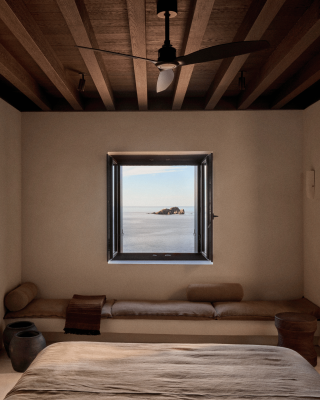
Luura Paros Cliff An almost monastic minimalism reigns at Paros Cliff, the first property from Luura. The adults-only hotel is done in Greek village style, its wabi-sabi sensibility and low-slung furnishings warmed by the bright Cycladic sunshine streaming through the windows.

Le Sirenuse Mare For its 75th birthday, the Amalfi Coast institution Le Sirenuse has a new beach club. Set in Marina del Cantone, the 27,000-square-foot space features a shop, a restaurant and two bars—one named for artist Rose Wylie, whose 2020 “Pineapple” sculpture stands nearby.

From left: Villa Timeo; W Sardinia — Poltu Quatu; Zannier Île de Bendor. Photo: Salva Lopez, courtesy of Belmond; courtesy of W Sardinia — Poltu Quatu; courtesy of Zannier Île de Bendor.

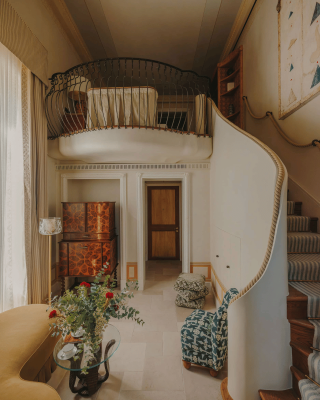
Villa Timeo Belmond has added a 21-room mansion to its Sicilian outpost, Grand Hotel Timeo. With views over Naxos Bay and the Taormina amphitheater, the 19th-century house has fresh interiors by designer Laura Gonzalez, inspired by the old homes of the Sicilian nobility.

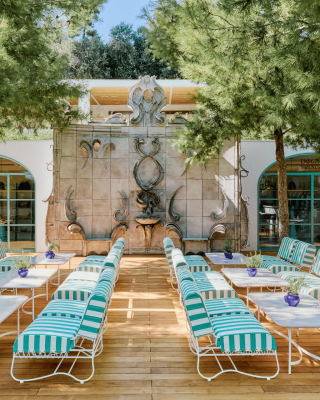
W Sardinia - Poltu Quatu Tucked below craggy cliffs, the W Sardinia - Poltu Quatu brings a relaxed but refined boho attitude to the Italian island. Stucco arches and red-tile roofs surround a central pool while, inside, wavy silhouettes on rugs and lighting enhance the playful spirit.

Zannier Île de Bendor Bendor, an island just off France’s Côte d’Azur, was developed into a laid-back resort in the 1950s by Paul Ricard, creator of the pastis brand of the same name. Zannier has spent the past five years restoring three properties here, combining them into a 93-room compound.


New Collectibles

The Monde sofa ($13,550) and L’éclat coffee table ($9,850). Photos: Billal Taright.
Pieces from the Assembler I collection, including the Noailles screen ($10,200) and Courbe side table ($5,250).

State of Grace | Over the years, interiors maven and EyeSwoon founder Athena Calderone has morphed from a Brooklyn brownstone whisperer into a champion of old-world Tribeca drama. Her new collection, Assembler I, speaks to the latter phase, in which she’s paired her home’s dusky paneling and soaring ceilings with suitably venerable touches. Available exclusively through the Future Perfect, the 14 pieces of Assembler I bring together nickel accents, dark woods and glossy finishes to conjure a moody Manhattan update on French deco styles. thefutureperfect.com


Away Game

One of the reimagined guest rooms at The Savoy in London. Photo: Jack Hardy.

Deco Deluxe | This summer, vintage glamour takes center stage on the bank of the Thames at The Savoy. Known for its historic ties to the London theater scene, the luxury hotel is unveiling revived guest rooms and suites inspired by Parisian art deco. Embracing the movement’s sweeping lines and curved forms, the team at design firm GA ensured that no two rooms are alike, adopting a contemporary approach informed by the legacies of Émile-Jacques Ruhlmann and Jean Dunand. The Savoy’s signature shade of green is set against geometric details across headboards, mirrors, polished finishes and beyond, for a fitting touch of drama. thesavoylondon.com –Amanda Randone


Treasure Hunt

Courtesy of Bulgari.

Wrap Star | Bulgari’s new Serpenti Aeterna watch sparkles with a combination of sapphire, amethyst, topaz, emerald, aquamarine, peridot and other colorful gemstones. Price on request; bulgari.com.


Screen Time

Soft Power | There’s a point in the film “Brunello: The Gracious Visionary,” opening in North American theaters July 24, when Brunello Cucinelli recounts the “aha” moment that changed the course of his life forever. After overhearing his father—a lifelong farmer—agonize over the daily indignities suffered at his new factory job, the younger Cucinelli sets forth this resolution: “I’d like to try to live and work for human dignity.”

What follows is a rags-to-riches plotline: the founding of Cucinelli’s namesake cashmere company, which has since grown into a thriving $1.6 billion business; his benevolent self-appointment as the patron saint of Solomeo, the small medieval hamlet in Italy’s Umbria region where the company is based and Cucinelli has invested millions toward restoration and enrichment; and his personal mission to spread far and wide the gospel of what he calls “humanistic capitalism.”

Brunello Cucinelli playing the card game scopa. Photo: Stefano Schirato.

Such an inspirational trajectory merits the biopic treatment, and the story is told partly as a scripted narrative with actors reenacting key moments, and partly as a documentary through interviews with figures from Cucinelli’s life. Sometimes the two styles seem to merge, as when he wanders through bucolic scenes of his childhood, gazing tenderly upon the actors playing his boyhood self and his family.

Directed by Oscar-winning filmmaker Giuseppe Tornatore of “Cinema Paradiso” fame, the film uses Cucinelli’s fondness for the Italian card game scopa as a metaphor for the calculated risks and turning points that have defined his career, while also spotlighting other personal landmarks—chief among them a beloved local bar he affectionately calls his “university of the soul.” But it’s the verdant Italian countryside that features just as prominently—and perhaps most poignantly—as a reminder of what bounty can come from humble beginnings.–Laura Neilson

Sotheby's Magazine

More from Sotheby's

Sell with Sotheby's

Sell with Sotheby's


Wondering what your item could be worth?

Share a few details and photos to receive a complimentary online estimate.

Request an Estimate
Hand holding iphone with Sotheby's estimate tool showing

Stay informed with Sotheby’s top stories, videos, events & news.

Receive the best from Sotheby’s delivered to your inbox.

By subscribing you are agreeing to Sotheby’s Privacy Policy. You can unsubscribe from Sotheby’s emails at any time by clicking the “Manage your Subscriptions” link in any of your emails.

arrow Created with Sketch. Back To Top