7 Unmissable Artworks in the Modern Evening and Day Sales You Should Save Now
The Modern and Contemporary season at the Breuer will conclude next week. These are the works you need to know.


B eginning on Tuesday 19 May, the Breuer in New York will host Sotheby’s Modern Evening and Day Auctions. Starting at 7:00 PM EDT, the Evening Sales will feature works from the A New Vista: The David and Shoshanna Wingate Collection, masterpieces from A Night in May: The Adele & Enrico Donati Collection, and many more. On Wednesday 20 May, our Modern Day Auctions begin at 10:00 AM EDT.
Interested in learning more and bidding in the sales? See below for the highlights you absolutely shouldn’t miss.

Pablo Picasso’s Arlequin (Buste) is a striking portrait featuring one of the artist's most enduring motifs. Created in the Spring of 1909, just two years after Picasso had established himself with Les Demoiselles d’Avignon, the work stands at a pivotal moment poised on the threshold of one of modern art’s defining breakthroughs: the emergence of Cubism.
Picasso here depicts one of his most legendary motifs, the harlequin, and distills it through the radical early Cubist lens informed by the innovations of Paul Cézanne. A masterwork of PIcasso’s early Cubist period, Arlequin (Buste) has remained in the collection of Surrealist artist Enrico Donati and his wife, Adele, for nearly seventy years
Executed in mid‑June 1888 during Van Gogh’s first summer in Arles, La Moisson en Provence occupies a central position within his Provençal oeuvre. The work depicts the vast plains of La Crau at harvest time, with scattered farm buildings, laborers, and the abbey of Montmajour anchoring the landscape. It belongs to a tightly‑focused campaign carried out over several days, when Van Gogh worked continuously in the fields northeast of Arles while preparing the oil painting Le Moisson.
Constructed through a layered process of watercolor, gouache, pen and ink and charcoal, the work reflects Van Gogh’s effort to integrate line and color into a unified pictorial language shaped by his engagement with Japanese prints. Only eleven watercolors can be traced to Van Gogh’s Arles period, the great majority of which are held in museum collections.
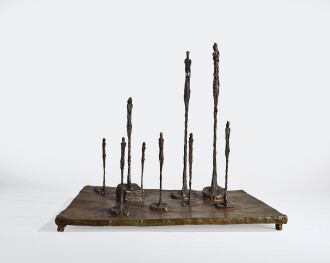
Alberto Giacometti considered La Clairière (Composition avec neuf figures), conceived in the spring of 1950, among his most successful works. One of three multi‑figural sculptures made during this period, it presents nine slender female figures of varying heights arranged across a rectangular base. These figures exemplify one of the prime motifs of Giacometti’s oeuvre: that of the tall, slender female figure.
While La Clairière recalls Giacometti’s earlier Surrealist embrace of chance, its elongated figures anticipate the Femmes de Venise of the mid‑1950s. The clustered women evoke solitude, distance, and presence in space—qualities central to the artist’s lifelong investigation of perception. As Giacometti reflected, the sculpture was not an illustration of a place but “a composition… which I was vaguely looking for.” In bringing these figures together, he transformed isolation into a shared, resonant encounter.
In Still Life with Coffee Pot and Flower, Roy Richtenstein transforms a seemingly straightforward study into a reflection on visual representation. A stylized coffee pot, rendered in bold black contour juxtaposes a flower pot with vivid red blooms. The work was originally owned by the art dealer Leo Castelli, whose support was instrumental in shaping Lichtenstein' s career and the trajectory of Pop Art. It later entered the collection of David and Shoshanna Wingate, where it has remained since 1975.
Diego Giacometti’s Feuilles Aux Oiseaux et Aux Grenouilles beautifully demonstrates the sculptor's ability to unite functional design with artistic imagination. Decorated with delicately rendered foliage, birds and frogs, the table pushes back on the strict rationalism that characterized much of twentieth century design and illustrates Giacometti's enduring contribution to art and design.
In 1958, one of the most prolific years of his career, René Magritte produced over two dozen oil paintings and numerous gouaches, surpassing his output in any single year thereafter. Among these works is Le Compotier, a composition that typifies Magritte’s signature subversion of quotidian objects and distills this leitmotif to its most elemental form. As the pear and compotier merge, this destabilizing image feels at once familiar and unsettling.
Beginning in the 1940s, fruits appeared increasingly in Magritte’s work, alternating between monumental, imposing presences and delicate, suspended forms, with the apple emerging as a particularly recurring and resonant subject, as seen in the oil version of this composition. In this later gouache, Magritte subtly replaces the apple with a pear, but preserves the polished, bright green surface of its predecessor. The modest substitution underscores both his proclivity to nuance as well as his quiet delight in transformation.
Following his marriage to Jacqueline Roque in 1961, Pablo Picasso settled at Mas Notre-Dame-de-Vie in Mougins, where he entered one of the most introspective periods of his career. Painted in March 1965, when the artist was 83, Buste d’homme barbu belongs to a series of portraits through which Picasso confronted questions of identity and mortality.
Throughout the 1960s, Picasso returned to archetypal male figures inspired by the Old Masters, such as Velázquez and Rembrandt, but the anonymous busts and heads from this period reveal a more personal reflection. The figure here is depicted with layered brushwork, both in oil and in Ripolin, animated by shades of gray, white, teal and black, where the visible movement of paint preserves the immediacy of Picasso’s hand.