Ahead of John Chamberlain’s centennial next year, his widow and stepdaughter offer a rare visit to the Long Island compound they shared with the maverick artist, shedding new light on his life and work.
Photography by Bastian Achard
Ahead of John Chamberlain’s centennial next year, his widow and stepdaughter offer a rare visit to the Long Island compound they shared with the maverick artist, shedding new light on his life and work.
Photography by Bastian Achard
The cover of the May/June 2026 issue of Sotheby’s Magazine, featuring the late artist John Chamberlain’s work space as he left it, in his studio on Shelter Island, at the east of end of New York’s Long Island.
Y
ou’d be forgiven for associating John Chamberlain’s work solely with macho toughness. His mammoth metal sculptures forged from car parts are as impactful as any American art from the past century, after all. But Chamberlain also had a softer side. He began sculpting in foam in the 1960s—joking later that the pieces didn’t sell, even when he offered them to a swingers’ club—and made enormous, fluffy couches, or “barges,” in the ’70s and ’80s.
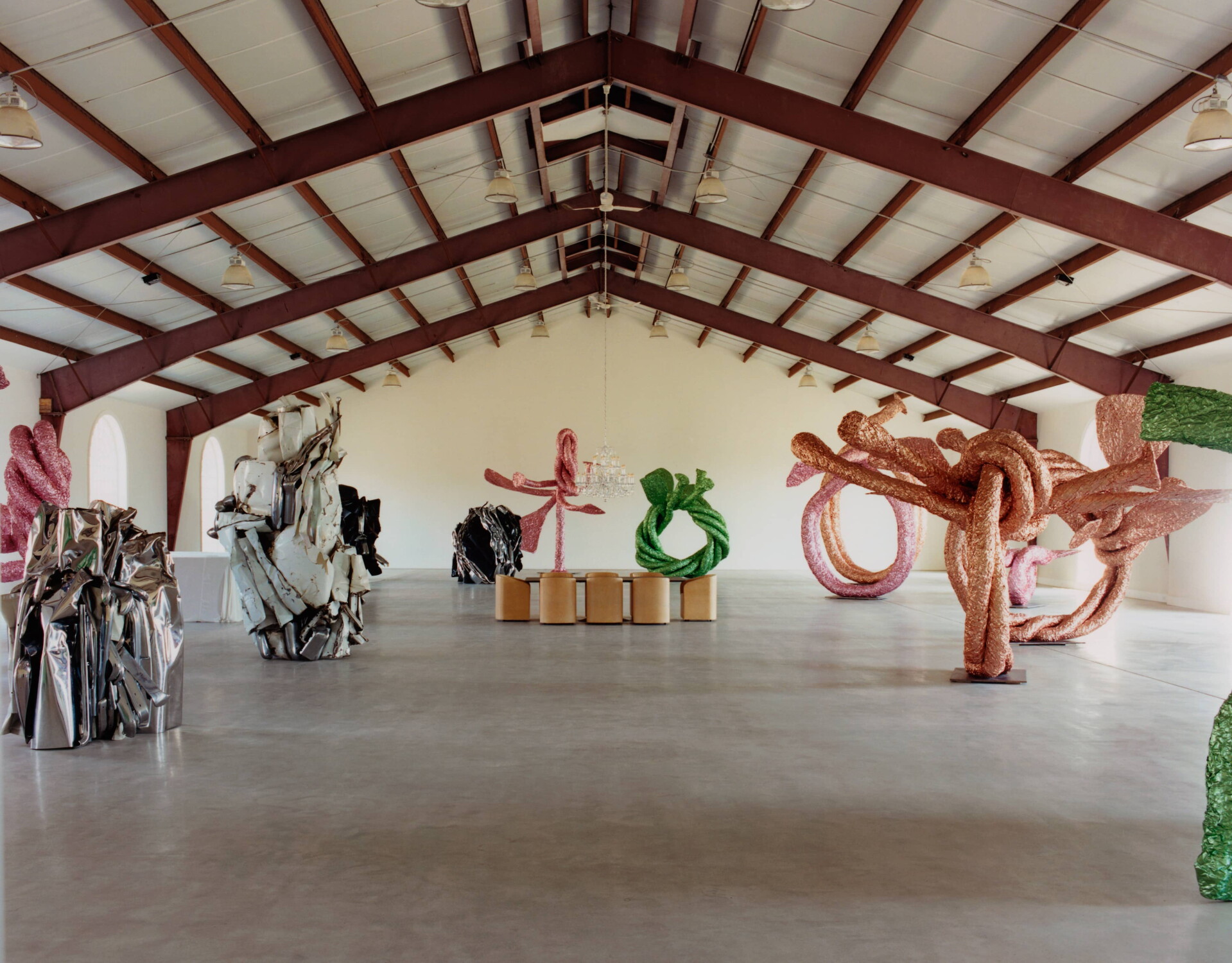
One vast Chamberlain couch sits in the middle of a converted stable in Shelter Island, New York, that houses a permanent exhibition of the artist’s work. The barge is a soft, welcoming presence in the soaring space, which shows some of the most indelible pieces from Chamberlain’s career, from the manipulated-car sculptures he began making in the 1950s to his swooping, crumpled aluminum foil pieces from the ’80s. Chamberlain’s widow, Prudence Fairweather, and his stepdaughter Alexandra Fairweather bought and converted this horse farm—where young Alexandra once took riding lessons—after the artist’s death in 2011. (“It was like the Ritz for horses,” says Prudence.) Today, it’s part of an impressive group of Shelter Island properties, including one of Chamberlain’s studios, maintained by the Fairweather women. They’re intent on making these spaces as lively and dynamic as possible.
Examples of Chamberlain’s monumental foil works.
Chamberlain’s barges, crafted from lumps of urethane foam with a loose cover, are as much a part of the artist’s lore as his hardier metal work. He first made furniture for his own SoHo loft when he was a starving artist with no running water or electricity—and the couches went on to become coveted pieces, owned by institutions such as Dia Beacon and the Andy Warhol Museum. He once recalled that, while installing his first retrospective, in 1971 at the Guggenheim New York, he spent his days welding and his nights sleeping on the barge he made for the Frank Lloyd Wright building. Today, collectors and art lovers brag about their intimate rendezvous on barges. Power couple artist Leo Villareal and art consultant Yvonne Force Villareal met on a barge at A/D Gallery and still treasure the one in their New York home, saying it’s the perfect place for trysts and tears.
Prudence (left) and Alexandra Fairweather with John Chamberlain’s 2008 work “CHAMPAGNEWIZARD.”
Alexandra is putting the stable’s voluminous barge to good use with a new video series called “On the Couch,” available on Spotify, Apple Podcasts and YouTube, where she interviews creatives like Misha Kahn and Daniel Arsham. “I think Chamberlain would be really excited about it,” says Alexandra, who was five years old when her mother married the artist. The women also invite guests to off-the-record dinners at the long banquet table at the stable, which they say the bon vivant artist would have loved. Chamberlain often cooked—usually spaghetti—for visitors to his studio, who included heavyweights like Larry Gagosian. For a while, he owned a restaurant in Shelter Island Heights, called Chamberlain’s, where he married Prudence in 1995. Its hand-painted sign still hangs in his studio. An insatiable creator, Chamberlain even made ceramic plates, which grace the dinner table now.
At the dinners the Fairweathers host in the stable, they serve sushi and whiskey, in homage to a dream restaurant concept Chamberlain wanted to create in Shelter Island. Prudence says, “I think he was always trying to recreate what he experienced at Max’s Kansas City—with all the artists and musicians; it was such a cool place.” In the 1960s and ’70s in New York, Chamberlain cavorted at Max’s with artists like Donald Judd, Dan Flavin and the Warhol Factory superstars.
Chamberlain’s foil works displayed by the window in his photography studio.
P
rudence and Alexandra are busier than ever with Chamberlain’s centennial, a celebration of his birth in 1927, looming next year. In 2026, there are exhibits planned at Galerie Karsten Greve in Cologne and the Parrish Art Museum in the Hamptons. A large foil work will be installed in front of the Bridgehampton Museum. A building devoted to Chamberlain will be part of the soon-to-open Amsterdam museum Zamu, a Marfa-esque compound from Belgian collector Ernest Mourmans. And two metal “Baby Tycoon” sculptures will be displayed at Marcel, the new restaurant at Sotheby’s Breuer building. Per Skarstedt, who’s showing some small Chamberlain sculptures this spring at his namesake gallery in Paris, says the works “reward close looking in a way the monumental pieces simply can’t.”
The Dia Art Foundation, which has supported Chamberlain’s work since the 1970s and celebrated him this year at its spring benefit on May 16, will be hosting an extensive exhibition of his work, opening this June at its galleries in Beacon, New York. Min Sun Jeon, Dia Beacon’s assistant curator, says that Chamberlain’s “ability to balance improvisation with rigor continues to inform contemporary practice, situating him as a critical figure in ongoing conversations around materiality and process.”
Alexandra (left) and Prudence Fairweather, custodians of the Chamberlain legacy, in the artist’s studio, with a “Wheel” sculpture and “PEAUDESOIEMUSIC,” 2011, left, and “C’ESTZESTY,” 2011, right.
Chamberlain’s stable and studio are still among the best places to see—and smell—the breadth of the artist’s work. In the stable building, which has been renovated to function as a private museum space, you can sniff the honey Chamberlain poured on “Golden Smell,” a 1973 aluminum sculpture. At the time he made it, Chamberlain was really into scents and developed 100 of them to make into artwork-cum-perfumes. One was called “The Third Floor of LACMA,” and another was “11,000 Feet in the Air in New Mexico.”
Clockwise from top left: the sign from Chamberlain’s, a restaurant the artist once ran on Shelter Island; “Tonk #8-88,” 1988; two of Chamberlain’s miniature aluminum foil works at his kitchen table; an undated photo of Chamberlain; the artist’s trimaran; ceramic dishware that he created in 1990; “WOMEN’S VOICES,” 2005; his desk chair.
Chamberlain had already lived nine lives—and had three wives—by the time he started courting Prudence, who was Flavin’s studio manager from 1991 until he died in 1996. Born in Indiana to humble beginnings, Chamberlain was raised mostly by his grandmother following his parents’ divorce. After a stint in the navy, he attended beauty school and worked as a hairdresser (he later said his first 3-D sculptures were hairstyles) before attending art school at the buzzing Black Mountain College in North Carolina.
Although he lived and worked all over the place—from New York City to New Mexico to Florida to Connecticut to Belgium, where he maintained a massive studio later in his life—home was the East End of Long Island, and specifically, once he met Prudence, Shelter Island. The area was the birthplace of his most enduring technique: When staying at painter Larry Rivers’ house in Southampton in 1957, he was inspired to create “Shortstop,” his first sculpture made from a car carcass. But he resisted too-literal interpretations about an automotive narrative, insisting that the metal was just a pliable material like any other—and one that happened to be cheap. In the same way he manipulated cars into tactile shapes, he twisted foil into coils and photographed people to look more like wavy lines than humans.
Prudence loves these portraits, which are on display in a small, wood-paneled room at the stable but have not been exhibited much outside of Europe. Chamberlain could not have dreamed up more dogged preservationists of his estate than the Fairweathers, who live and breathe his art. When he passed, they were advised by other artists’ foundations not to shift anything in the multi-level studio that was custom-built in 2000 across the street from their house on Shelter Island. “You feel his soul when you’re in the space,” says Alexandra. “We want to keep it like a time capsule in a way.”
The Fairweathers are constantly toeing the line between preservation and renewal. Kathleen Hart, a vice president and specialist in contemporary art at Sotheby’s, says that Chamberlain “has already secured his legacy as one of the preeminent sculptors of his generation.” Now, she says, “his future will be bolstered by renewed interest in his legacy via continued scholarship and exhibitions that deepen appreciation for the range of his materials and artistic practices.”
An inside look at Chamberlain’s studio.
A
lexandra, along with her sister Phoebe and Chamberlain’s sons Angus and Duncan from a previous marriage (another son, Jesse, died in 1999) and their own children, grew up very much underfoot in the artist’s studios. With Chamberlain’s beloved jazz playing—maybe Dinah Washington or John Coltrane—and assistants welding steel, the feeling was controlled chaos. Even today, nothing is precious: Amid the sculptures, which can fetch up to seven figures at auction, are piles of Tonka trucks that inspired his “Tonk” series, and the kitchen feels fully lived-in with photographs tacked up and dishes crammed into shelves. Chamberlain built an elaborate indoor pool because he had a vision for a ceramic sculpture he wanted to place at the bottom. But there’s no sculpture today, because the Fairweathers host the family’s children’s birthdays and an annual Christmas party there.
“You feel his soul when you’re in the space. We want to keep it like a time capsule.”
Alexandra Fairweather
Across the street from the studio is the home Prudence and Chamberlain lived in together, a stone jewel box of a waterfront beach house. Fifteen years after Chamberlain’s passing, it’s more feminine than the nearby studio, with just-so antiques and shimmering wood floors amid the tasteful “Baby Tycoons.” Prudence’s family goes back to the first European settlers of the island in the 17th century, and Chamberlain grew to love it there after decades coming out east. In the 1950s and ’60s, when he was friends with artists like Willem de Kooning, Roy Lichtenstein and Andy Warhol, says Prudence, “there was a group of New York artists that would always be out here in the summer—he was always part of that group.” Before coming to Shelter Island, Chamberlain lived in Elaine de Kooning’s former home in East Hampton.
Off the dock at this house is where Chamberlain indulged in a hobby that Prudence calls his “obsession and addiction”—sailing. When finding a house, a dock for his boat was a prerequisite. It was sailing that bonded Chamberlain with his friend, the architect Frank Gehry. Prudence says the two men fueled each other’s imaginations. She sees Chamberlain’s influence in Gehry’s shift toward more fluid, sail-like shapes, as in the Walt Disney Concert Hall in Los Angeles and the Guggenheim in Bilbao, Spain.
C
hamberlain’s work continues to inspire artists in other disciplines, like fashion designers Mary-Kate and Ashley Olsen, who installed a Chamberlain wall piece at their The Row store in London, and designer Rick Owens, who first discovered Chamberlain as an art student in Los Angeles and now collects his work. Through projects like “On the Couch” and the book “Living with Chamberlain,” which features collectors’ stories, the Fairweathers hope to show the ways in which the artist’s work still impacts culture. Alexandra is particularly interested in the intersection between Chamberlain’s work and technology founders: “They’re pushing boundaries, they’re not defined by social constructs, they’re authentic.”
“He could be as good as gold, or it could be a complete disaster.”
Prudence Fairweather
Sometimes, in Chamberlain’s day, that authenticity could breed awkward social situations. Prudence says that taking him to dinner could feel like traveling with a two-year-old: “He could be as good as gold, or it could be a complete disaster.” One time, a Los Angeles collector invited them over and Chamberlain walked right up to one of his own large wall pieces. “Don’t you have a cleaning lady?” he asked the collector, pointing out the dust. The collector lost it. “Nobody touches our Chamberlain—even Chamberlain,” he said. The artist stormed out.
The dock where Chamberlain kept his sailboat.
Prudence says that Chamberlain was happiest working in Shelter Island, even though he kept studios in Belgium and Florida until the end of his life. She sees the Shelter Island influence in the sculptures that he made there, such as nature-inflected works like “The Forest.” While Prudence thinks that the place did have an effect on him, she says: “He was the kind of guy that no matter where he was, he would have made art.”