Joan Miró Editions: The Art of Inventing a New Universe
Discover how Joan Miró transformed printmaking into a laboratory of imagination, creating editions that continue to captivate collectors.

Joan Miró approached art as an act of discovery. Throughout his career, he sought to create images that felt liberated from conventional ways of seeing, transforming familiar subjects into signs, symbols, and forms that seemed to belong to an entirely new visual universe. A figure might dissolve into a constellation of marks. A bird could become a floating emblem suspended in space. Even the simplest line carries a sense of possibility, as though it is still in the process of becoming something else.
Although Miró emerged alongside the Surrealists, his artistic language ultimately became uniquely his own. Rather than illustrating dreams or recording reality, he developed a way of working that blurred the boundary between the two. His compositions feel spontaneous, yet they are carefully balanced. They appear playful, yet they often contain remarkable sophistication. This tension between freedom and control became one of the defining characteristics of his art and helped establish him as one of the most influential artists of the twentieth century.
Editions occupied a central place within that achievement. Miró embraced printmaking as a space for continual experimentation, using it to test new relationships between color, line, and form while reaching audiences far beyond the traditional boundaries of painting. Working closely with master printers over several decades, he helped expand the creative possibilities of the medium itself. The result is a body of editioned work that stands among the most innovative in modern art.
This creative restlessness is one reason Joan Miró editions continue to attract collectors today. Whether encountered through a vibrant lithograph, an ambitious portfolio, or a rare print series, these works reveal an artist who never stopped inventing. They offer direct access to a visual language that remains as fresh and surprising today as it was when it first emerged.
| Category | What to Know |
|---|---|
| Why Editions Matter | Miró's editions provide direct access to the symbols, forms, and experimental techniques that defined his artistic career. |
| Market Demand | Collectors continue to seek lithographs, etchings, aquatints, illustrated books, and major portfolios spanning his mature practice. |
| Types of Editions | Lithographs are particularly important, though Miró also produced influential etchings, woodcuts, aquatints, and artist books. |
| Collector Appeal | Strong visual identity, significant art historical importance, and a direct connection to one of modern art's most original artistic voices. |
Joan Miró occupies a distinctive position within twentieth-century art because he approached image-making as a process of continual reinvention. While many artists developed recognizable styles, Miró spent decades refining a visual language built from symbols, signs, and forms that seem to exist somewhere between abstraction and representation. His compositions often feel spontaneous, yet they are the result of careful experimentation. This balance between freedom and control helped make Miró one of the most influential artists of the modern era and continues to distinguish his work from that of his contemporaries.
Printmaking became one of the primary ways Miró pursued this experimentation. Rather than using editions to reproduce existing paintings, he treated lithography, etching, aquatint, and woodcut as creative mediums in their own right. Working closely with master printers and publishers, he continually explored new approaches to color, texture, and mark-making. Many of his most important editions introduced ideas that would later appear elsewhere in his practice, while others remain unique to print. As a result, Miró's editions provide an unusually direct record of his artistic development and his willingness to challenge conventional boundaries between mediums.
For collectors, this gives Miró editions a significance that extends well beyond accessibility. They are not secondary expressions of a larger body of work, but essential components of it. Through printmaking, Miró developed many of the symbols and visual inventions that became central to his artistic identity, creating works that remain remarkably fresh and inventive decades after they were produced. Their continued relevance reflects not only Miró's importance within modern art, but also the enduring power of an artist who never stopped searching for new ways to transform the visible world.
One of Joan Miró's most significant achievements was his ability to transform recognizable subjects into images that feel both deeply personal and universally accessible. Early in his career, he drew inspiration from the landscapes and rural traditions of his native Catalonia. As his artistic language evolved, however, these references became increasingly distilled. What began as observations of the visible world gradually gave way to a system of symbols that communicated through suggestion rather than direct description.
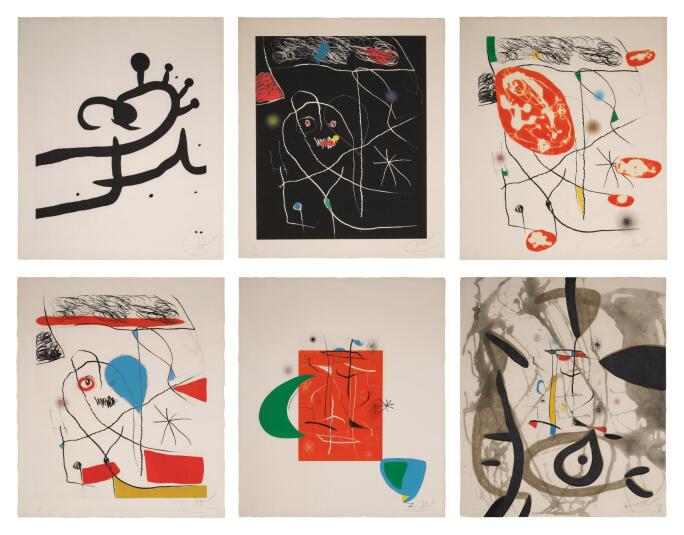
This transformation was not an attempt to abandon reality. Instead, Miró sought to move beyond appearances and create images capable of expressing ideas that could not easily be conveyed through conventional representation. Over time, his work became less concerned with depicting a specific place or subject and more interested in evoking a state of mind. By the later decades of his career, even projects rooted in literary narratives were filtered through this highly personal visual language. The complete portfolio Passage de L'Egyptienne, which sold for $74,500 USD in 2010, reflects this evolution. Published in 1985 by Robert and Lydie Dutrou, the work unfolds through a sequence of color etchings that prioritize association and atmosphere over straightforward storytelling, demonstrating how completely Miró had reimagined the relationship between image and meaning.
For collectors, this openness remains one of the most rewarding aspects of Miró's work. His imagery invites interpretation without demanding a single answer. Rather than delivering a fixed narrative, Miró creates space for discovery, allowing viewers to return to the same work repeatedly and encounter it from a different perspective each time.
The night sky became one of the most enduring sources of inspiration in Joan Miró's art. Throughout his career, stars, moons, and celestial forms appeared across paintings, sculptures, and prints, helping him construct a visual language that feels both intimate and expansive. These motifs were never simply decorative. They allowed Miró to move beyond the limitations of observable reality and create images that suggest infinite space, possibility, and transformation. Even his smallest compositions often evoke a sense of vastness, as though the viewer is looking into a universe governed by its own poetic logic.
This fascination found one of its fullest expressions in Constellations, a project that occupies a special place within Miró's editioned work. Published by Pierre Matisse in 1959, the portfolio combines a color lithograph with twenty-two pochoir reproductions after the celebrated gouaches Miró created during the Second World War. Accompanied by text from André Breton, the project brought together two of the central figures of Surrealism and translated Miró's cosmic vision into an ambitious editioned format. The significance of the portfolio has long been recognized by collectors. A complete example realized $111K USD in 2012, underscoring its status as one of the defining achievements of Miró's printmaking career.
What continues to distinguish Miró's celestial imagery is its openness. His stars and moons are not tied to a specific narrative, nor do they function as traditional symbols with fixed meanings. Instead, they create a space for imagination, encouraging viewers to engage with the work on an intuitive level. This sense of freedom remains central to the appeal of Miró's editions and helps explain why projects such as Constellations continue to attract attention decades after their publication. That enduring interest was evident again in 2023, when another complete portfolio changed hands for $44,450 USD. Rather than illustrating a single story, these works invite viewers to construct their own, which is one reason Miró's vision of the cosmos continues to resonate with collectors today.
Certain motifs recur throughout Joan Miró's work with remarkable consistency, none more prominently than the female figure and the bird. These subjects became foundational elements of his artistic language, appearing across paintings, sculptures, and prints for decades. Although Miró rarely depicted them in a realistic manner, they remain instantly recognizable. Through a process of continual simplification, he transformed familiar forms into signs that could carry emotion, movement, and meaning without relying on detailed description.
The female figure occupied a particularly important place within this visual vocabulary. Rather than functioning as a portrait or narrative subject, it often became a vehicle for invention, allowing Miró to explore the relationship between line, color, and space. This approach can be seen in La Femme au miroir, a color lithograph published by Maeght in 1956. Executed in an edition of 150, the work distills the figure into a series of fluid forms that feel both playful and psychologically charged. Its continued appeal among collectors was evident when an example sold for $16,510 USD in 2025. A similar spirit animates Femmes: One Plate, a 1965 woodcut with extensive hand-coloring that realized $22,860 USD in 2023. Here, Miró demonstrates how far he could push simplification while preserving the expressive presence of the human figure.
Birds offered Miró a different kind of freedom. Throughout his career, they became symbols of movement and possibility, appearing as creatures that seem to drift effortlessly between earth and sky. In works such as Migratory Bird: Two Plates, published by Louis Broder and printed by Mourlot in 1970, the subject is reduced to a few essential forms without losing its sense of vitality. The pair of signed lithographs sold for $7,500 USD in 2020, illustrating the enduring appeal of a motif that remained central to Miró's imagination. For collectors, these recurring subjects are especially rewarding because they reveal how a single idea could evolve continuously throughout the artist's career, producing works that feel unmistakably Miró while never appearing repetitive.
Illustrated books occupied a unique place within Joan Miró's artistic practice. Throughout his career, he worked closely with poets, authors, and publishers to create projects in which image and text became inseparable. These collaborations appealed to Miró because they offered a different kind of creative freedom. Rather than producing a single print or composition, he could develop a visual world that unfolded gradually across a sequence of pages, allowing ideas to evolve through rhythm, association, and surprise.
Miró approached these projects as genuine collaborations rather than opportunities to simply decorate a text. One notable example is Album 19, created with the writer Raymond Queneau and published by Maeght in 1961. The portfolio comprises twenty-six lithographs that interact with Queneau's text in ways that feel playful and inventive, reflecting Miró's longstanding interest in the relationship between language and image. Collectors continue to value the project for the quality of the collaboration as well as its ambitious scale. A complete example sold for $32,760 USD in 2021, underscoring the enduring appeal of Miró's artist books among collectors of modern prints.
His illustrated projects could also become deeply personal responses to a place or an idea. El Pi de Formentor, published by Sala Gaspar in 1976, centers on a celebrated pine tree overlooking the coast of Mallorca, a landscape that held particular significance for the artist. The complete set of six aquatints combines Miró's highly distilled imagery with a strong sense of atmosphere, demonstrating how naturally his visual language could adapt to a literary or thematic framework. When an edition of the portfolio realized $35,560 USD in 2023, it reinforced the continued demand for projects that reveal the breadth of Miró's imagination beyond the single-sheet print. For collectors, these books remain among the most rewarding areas of Miró's editioned work because they show an artist expanding his universe through collaboration, narrative, and the printed page itself.
Lithography proved exceptionally well suited to Joan Miró's artistic vision because it preserved the immediacy that was essential to his work. Rather than requiring the careful incision associated with certain printmaking techniques, lithography allowed Miró to draw directly onto the printing surface and retain much of the spontaneity of the original gesture. This directness was particularly important for an artist whose imagery often depended on the energy of a line, the placement of a mark, or the interaction between form and color. As his visual language became increasingly distilled, lithography offered a medium capable of translating those ideas without sacrificing their vitality.
Miró embraced these possibilities throughout his career, working closely with some of the most accomplished printers of the twentieth century. Among them, Fernand Mourlot played a particularly important role in helping the artist expand the expressive potential of color lithography. Their collaboration produced works of remarkable inventiveness, including Le lézard aux plumes d'or, a 1971 project published by Louis Broder and printed by Mourlot in Paris. The suite demonstrates how freely Miró moved between drawing and printmaking, treating the lithographic stone not as a reproductive tool but as a space for creation in its own right. The continued appreciation for these works was evident in 2024 when a group of five lithographs from the project sold for €16,800 EUR. For collectors, projects such as this help explain why lithography became one of the most important vehicles for Miró's artistic imagination, allowing him to continually reinvent his imagery while preserving the sense of freedom that defines his work.
Color became increasingly important to Joan Miró as his career evolved. Rather than using it to describe the visible world, he treated color as an expressive force capable of shaping the emotional character of an image. Even the most simplified compositions can feel remarkably energetic because of the way Miró balanced saturated fields of color against open space. This approach allowed him to create works that feel spontaneous and immediate while remaining carefully resolved.
What is particularly striking about Miró's later editions is the extent to which he continued to experiment. Success never led him toward repetition. Instead, he remained committed to discovering new possibilities within printmaking, often working on a larger scale and embracing increasingly bold visual solutions. Stevedore, executed in 1971 and published by Maeght, reflects this spirit of exploration. The monumental color lithograph demonstrates the confidence with which Miró handled both scale and color during the final decades of his career. The impression that sold for £17,780 GBP in 2025 was one of fourteen hors commerce examples aside from the edition of fifty, highlighting the continued interest collectors have in works from this highly inventive period. More than a display of technical skill, editions such as Stevedore reveal an artist who remained curious throughout his life, continually expanding the possibilities of his own visual language rather than settling into established formulas.
Miró created imagery that is instantly recognizable while remaining difficult to imitate. His symbols, forms, and compositions occupy a unique place within modern art, giving collectors access to one of the most original artistic voices of the twentieth century.
Miró's influence extends far beyond Surrealism. His innovations helped shape the development of abstraction, postwar painting, and later generations of artists who sought new ways of approaching visual language. His editions provide direct connections to that broader history.
Because printmaking remained central to Miró's practice for decades, collectors can encounter virtually every stage of his artistic development through editions. These works reveal how his ideas evolved while maintaining the visual identity that defines his career.
Despite being rooted in twentieth-century modernism, Miró's imagery feels surprisingly current. His simplified forms, bold colors, and symbolic language continue to resonate with contemporary audiences, allowing the work to speak across generations.
Joan Miró editions continue to occupy an important place within the market for modern prints because they remain remarkably difficult to categorize. His work emerged from Surrealism, yet it ultimately transcended any single movement, developing into a visual language that feels as fresh today as it did when it was first created. Collectors, scholars, and institutions continue to return to these works because they reveal an artist who never stopped exploring new possibilities within image-making. Whether expressed through lithography, etching, aquatint, or the illustrated book, Miró's editions document a lifelong commitment to invention and experimentation.
What continues to distinguish these works is their ability to balance immediacy with depth. A Miró print can be appreciated for its color, energy, and visual clarity, yet sustained viewing often reveals new associations and meanings. Rather than offering fixed interpretations, his imagery encourages curiosity and personal discovery. As collecting interest increasingly favors works that reward repeated engagement and reflect a distinctive artistic vision, Miró's editions remain uniquely positioned to retain their relevance. More than accessible entry points into the artist's oeuvre, they stand among the most complete expressions of a creative imagination that helped redefine the possibilities of modern art.
Joan Miró editions are limited-edition artworks produced in defined quantities under the artist's supervision. They include lithographs, etchings, aquatints, woodcuts, illustrated books, and other printmaking projects created throughout his career.
Miró's prints are important because they played a central role within his artistic practice. Many were conceived specifically for printmaking and demonstrate the same innovation, imagination, and experimentation found in his paintings and sculptures.
Miró worked across a wide range of printmaking techniques, including lithography, etching, aquatint, and woodcut. He also produced numerous illustrated books and portfolios that are considered important contributions to twentieth-century printmaking.
Lithography allowed Miró to preserve the spontaneity of his drawing while exploring bold color combinations and complex compositions. Many collectors view these works as some of the clearest expressions of his artistic vision.
Recurring themes include celestial imagery, women, birds, poetic symbols, imagined landscapes, and abstract forms that reflect his fascination with dreams, nature, and the unconscious.
Yes. Miró editions provide an accessible way to engage with one of modern art's most influential artists while offering works that remain closely connected to the themes and innovations that defined his career.
Whether you are beginning your contemporary art collection or expanding an established one, Sotheby’s offers a trusted, seamless way to buy and sell Joan Miró editions on the secondary market.
Trust our worldwide team of leading contemporary art specialists at a globally renowned auction house established in 1744.