A Collector's Guide to Gibson Guitar Models: From the Les Paul to the Firebird
See how Gibson moved from the Les Paul to the SG, Firebird and Thunderbird, with the model changes that distinguish important vintage guitars.

Gibson’s history is not a neat progression from one successful guitar to the next. Some of its most important models emerged when the company was reacting—to changing music, new competitors or the sense that an existing design had run its course. The result was a catalog that could move from the carved maple top of a Les Paul to the razor-thin SG, then veer into the automotive lines of the Firebird within little more than a decade.
Those shifts are part of what makes vintage Gibson guitars so interesting to collect. A late-1950s Les Paul and a first-year Reverse Firebird may both carry the Gibson name on the headstock, but they belong to different design moments and reward a different kind of knowledge. Even models separated by only a year or two can have meaningful changes in construction, hardware or body shape.
Understanding a vintage Gibson begins with more than identifying the model. Production year, construction and original specifications can reveal where an instrument sits within a design’s evolution. From the Les Paul and SG to the Firebird, Thunderbird and more specialized artist models, Gibson’s catalog tells a story of a company willing to rethink its own ideas—sometimes surprisingly quickly.
| Gibson Model | What Collectors Should Know |
|---|---|
| Les Paul | Introduced in 1952 and transformed repeatedly thereafter, the Les Paul encompasses everything from Goldtops and late-1950s sunburst Standards to later designs that departed dramatically from the original formula. |
| SG | What began in 1961 as a redesigned Les Paul became its own model, pairing a thin body with pointed double cutaways and a very different playing feel. |
| Firebird | Introduced in 1963 with automotive designer Ray Dietrich, the Firebird changed considerably within several years. Reverse and Non-Reverse examples represent genuinely different constructions, not just different silhouettes. |
| Thunderbird | Gibson carried the Firebird’s automotive-inspired design language into an electric bass, producing Reverse and later Non-Reverse versions during the 1960s. |
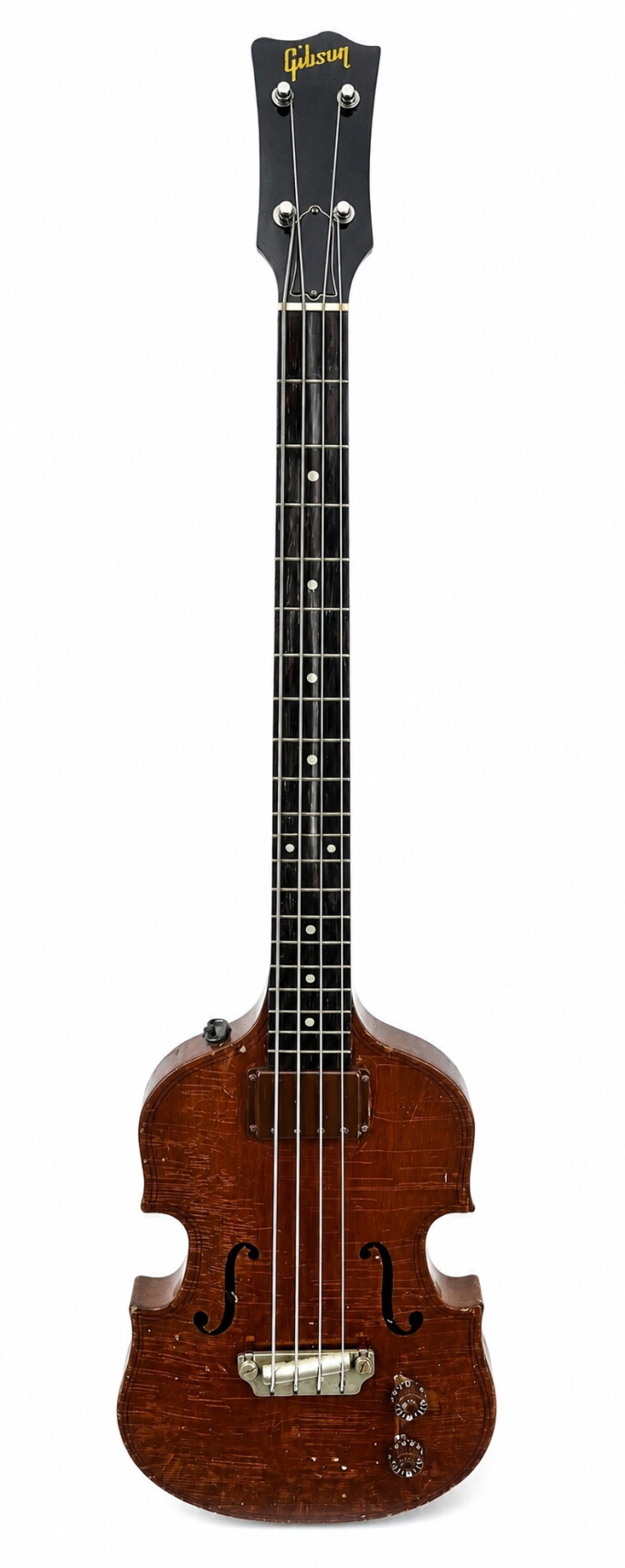
| EB-1 | Gibson’s first electric bass arrived in 1953 with a compact violin-shaped body—a strikingly different solution from the basses the company would build a decade later. |
| Barney Kessel | This hollow-body artist model connects Gibson’s 1960s catalog to its longer jazz-guitar tradition and its history of building instruments around individual musicians. |
When Gibson introduced the Les Paul in 1952, the company was entering a solid-body electric guitar market that was still taking shape. Gibson had built its reputation on acoustic and hollow-body instruments; the new model instead paired a solid mahogany body with a carved maple top and a gold finish, bringing elements of the company’s established craftsmanship into a distinctly new format.
The guitar evolved at remarkable speed. Early Goldtops were followed by the Les Paul Custom, while pickup configurations and other specifications changed through the decade. In 1958, Gibson introduced the sunburst finish now associated with the celebrated late-1950s Les Paul Standards. Original production of the single-cutaway Les Paul would soon end, making the 1958–1960 sunburst run a relatively concentrated chapter within a much larger story.
Yet focusing only on those guitars can obscure how elastic the Les Paul name eventually became. When Gibson revived it later in the 1960s, the company began developing variations that stretched well beyond the original single-cutaway format.
The 1973 Gibson Les Paul Signature Guitar makes that point vividly. Finished in gold metallic, it uses a semi-hollow double-cutaway body whose proportions are far removed from a 1950s Standard. A 1973 Les Paul Signature Bass carries the same concept into an electric bass. Seen together, the two instruments show Gibson treating “Les Paul” not as a fixed design but as a name with room for considerable reinterpretation.
That distinction matters when comparing vintage Les Pauls. The name encompasses guitars built for different players, periods and musical contexts. Knowing exactly which Les Paul you are looking at—and what Gibson was trying to accomplish with it—is more useful than treating every example as part of a single, continuous design.
By the beginning of the 1960s, the original Les Paul had disappeared from Gibson’s catalog and the company was searching for a new direction. Its answer was dramatic. In 1961, Gibson introduced a much thinner solid-body guitar with pointed double cutaways, beveled edges and easier access to the upper frets.
It was initially sold as a Les Paul. That historical detail can be confusing today because the guitar looks so unlike the model now associated with the name. After Les Paul’s association with the design ended, Gibson adopted the SG designation—short for “Solid Guitar”—and what had begun as a replacement quickly developed an identity of its own.
The contrast between the two models goes deeper than silhouette. A classic Les Paul feels substantial, with its carved maple top over mahogany and single-cutaway construction. The SG strips away much of that mass. Its thinner body and double cutaways create a different balance in the hands and a sharper, more stripped-back profile.
Musicians subsequently gave the SG associations Gibson could never have designed into it at the factory. Tony Iommi helped connect it to the heavy sound of Black Sabbath, while Angus Young made the model inseparable from AC/DC’s stage image. What began as a replacement for the Les Paul became one of Gibson’s defining guitars on entirely different terms.
If the SG represented Gibson reworking an existing idea, the Firebird was a more dramatic break. Introduced in 1963, it arrived at a moment when American automotive design was exerting enormous cultural influence—and Gibson went directly to that world for help.
Ray Dietrich, the automobile designer associated with custom coachwork and later Detroit design, was brought in to develop the guitar. The result did not look like an incremental update to anything Gibson already made. Its asymmetrical body stretched outward rather than settling into the rounded geometry of a Les Paul or the near symmetry of an SG.
The engineering was just as distinctive. Early Firebirds used neck-through construction, with a laminated neck section extending through the body and separate wings attached at either side. Banjo-style tuners contributed to the unusual headstock profile. The pickups, too, helped give the Firebird a character separate from Gibson’s other electric guitars.
Gibson organized the original Firebird line as a hierarchy. The Firebird I sat at the pared-back end, followed by the III and V, with the Firebird VII receiving the richest appointments. Those distinctions in pickups, hardware and trim mean that “vintage Firebird” describes a family of related guitars rather than one standard specification.
The first generation is now known as the Reverse Firebird, terminology that only became necessary once Gibson redesigned the guitar. Its asymmetrical form appears to lean in the opposite direction from the Non-Reverse version that followed, but the difference is more than a flipped outline.
A 1963 Gibson Firebird V Reverse Guitar shows the model at the very beginning of that story. Dating to the Firebird’s debut year, it combines the original Reverse body with neck-through construction and banjo-style tuners. As a Firebird V, it also sits between the more restrained early models and the highly appointed VII.
First-year status is meaningful here because the original Firebird did not remain static for long. Gibson was already revising the concept within a couple of years, making the 1963 guitar a useful reference point for the Firebird as it was first conceived.
Two years after the Firebird appeared, Gibson reconsidered it almost from the ground up. The Non-Reverse Firebird introduced in 1965 did not merely turn the original body around. It adopted a different silhouette and moved away from the neck-through construction that had been one of the first Firebird’s defining technical features, instead using a set neck.
That makes 1965 an important dividing line. Reverse and Non-Reverse Firebirds share a name, but they reflect two distinct approaches developed within an unusually compressed period.
A 1965 Firebird I Non-Reverse captures the redesign at its starting point, while a 1966 example shows the model immediately afterward. The Firebird I specification keeps the guitars visually restrained, allowing the new body shape to dominate. Set beside a 1963 Firebird V Reverse, they make the scale of Gibson’s redesign especially clear.
The Non-Reverse period was itself short. Gibson discontinued the original Firebird line before the decade was over, leaving the 1960s history of the model divided into compact phases. That compressed chronology is one reason dates and construction matter so much when evaluating an early Firebird: several years can separate instruments that share a name but little else structurally.
The Firebird was not conceived as an isolated six-string experiment. Gibson introduced the Thunderbird alongside it in 1963, translating much of the same elongated, automotive-inspired design language into an electric bass.
The relationship between the two is clear, but the Thunderbird developed its own model structure. Gibson offered the Thunderbird II with a single pickup and the Thunderbird IV with two, while the earliest instruments shared the neck-through construction associated with the Reverse Firebird. Their long bodies and unconventional proportions were a sharp departure from Gibson’s earlier electric basses
The Thunderbird then followed the Firebird through another change of direction. A 1965 Gibson Thunderbird II Non-Reverse Bass Guitar belongs to the redesigned generation, combining the Non-Reverse body with the more restrained single-pickup II configuration.
Its date is telling. Only two years separate it from the Thunderbird’s introduction, yet Gibson had already altered one of the most visually assertive bass designs in its catalog. Early Thunderbirds therefore reward the same close attention as Firebirds: “Reverse” and “Non-Reverse” identify separate chapters rather than minor variations on the same instrument.
The Thunderbird can seem even more radical when viewed beside Gibson’s first electric bass. Introduced in 1953, the EB-1 came from an earlier moment, when the solid-body electric bass itself was still a relatively new proposition and manufacturers had not settled on what the instrument should look like.
Gibson’s answer borrowed the outline of a violin. The EB-1’s compact body and brown finish connected it visually to older stringed instruments rather than to the futuristic forms Gibson would embrace a decade later. Banjo-style tuning pegs added another unusual detail.
A 1956 Gibson EB-1 preserves that early vocabulary. It predates the Thunderbird by several years and belongs to a period when Gibson was still establishing its approach to electric basses. Later designs including the EB-2 and EB-3 would take the category elsewhere before the Thunderbird pushed it in another direction again.
Seen in that sequence, the EB-1 becomes more than an eccentric shape. It records Gibsonworking out its approach to a new type of instrument in real time, years before the Thunderbird established a radically different direction.
The Firebird and Thunderbird can make Gibson’s 1960s catalog look relentlessly futuristic. The Barney Kessel tells another story. While the company experimented with radically new solid-body shapes, it continued drawing on decades of experience building archtop and hollow-body guitars for jazz musicians.
Barney Kessel was an especially fitting collaborator. A prominent jazz guitarist and prolific session player, he belonged to a musical world quite different from the rock players who would later become associated with the SG and Firebird. Gibson offered his namesake guitar in Regular and more highly appointed Custom versions.
A 1964 Gibson Barney Kessel Custom represents the more elaborate side of that partnership. Its large double-cutaway hollow body is finished in cherry sunburst and fitted with dual humbuckers, while musical-note headstock inlays give the model a playful detail all its own.
Its appeal lies partly in how difficult it is to fit into the standard story of 1960s Gibson. The Barney Kessel was neither an extension of the Les Paul nor an exercise in futuristic industrial design. It came from Gibson’s longer tradition of artist-associated hollow-body guitars, making it a useful reminder that several different versions of the company were operating at once.
There is no single checklist that determines the significance of every vintage Gibson. The details that matter depend heavily on the model. With a Les Paul, the production period can place a guitar within one of several very different chapters of the model’s history. With a Firebird or Thunderbird, construction and body orientation quickly separate Reverse instruments from their Non-Reverse successors. An EB-1 or Barney Kessel asks a different question altogether: where does a more specialized design fit within Gibson’s broader catalog?
Originality remains important, but it also requires nuance. Factory finish, pickups, hardware and electronics can help establish how closely a guitar corresponds to its original specification. Repairs and replacement parts should be understood rather than treated as interchangeable deductions in value. On instruments that were built to be played—and may have spent decades doing exactly that—condition has to be considered alongside history, rarity and the significance of what has changed.
The strongest vintage Gibson collections can make the company’s constant reinvention visible. Put a 1950s-style Les Paul beside an SG and the break between them is obvious. Move from a 1963 Reverse Firebird to a 1965 Non-Reverse example and the pace of Gibson’s experimentation becomes even clearer. Add an EB-1 or Barney Kessel and the story widens again.
That is what makes Gibson difficult to reduce to a handful of icons. Some of its most interesting guitars came from ideas the company abandoned, redesigned or replaced within only a few years. Those short chapters—and the instruments left behind—are often where the history becomes most revealing.
Because Gibson sometimes changed a model substantially within only a few years. A 1963 Reverse Firebird, for example, belongs to the original neck-through design, while a 1965 Non-Reverse Firebird uses a different body and set-neck construction. The year can identify a distinct phase of the model rather than merely its age.
Original finish, pickups, hardware and electronics can strengthen a guitar’s appeal, but originality should be considered alongside condition and history. A replacement component or repair does not affect every instrument in the same way; what changed, when and how significant that component is to the model all matter.
They are substantially different guitars. The original Reverse Firebird introduced in 1963 used neck-through construction and an asymmetrical body, while the Non-Reverse generation introduced in 1965 adopted a new silhouette and set-neck construction.
Models such as the EB-1 and Barney Kessel expand the story beyond Gibson’s best-known solid-body guitars. The EB-1 documents the company’s first approach to an electric bass, while the Barney Kessel connects its 1960s catalog to an established tradition of hollow-body jazz guitars and artist collaborations.
Start with the production year and exact variant, then compare construction and period-correct specifications. Finish, pickups, hardware, electronics, repairs and modifications can help determine how closely each guitar corresponds to its original configuration—and whether the two instruments actually belong to the same phase of the model’s history.
Whether you're a seasoned collector or new to collectible instruments, Sotheby’s offers a trusted, seamless way to buy and sell rare collectible guitars on the secondary market.
Trust our worldwide network of leading specialists from a globally renowned auction house established in 1744.