For three decades, artist and stage designer Es Devlin built worlds for others. Now, ahead of a major retrospective at the Design Museum in London, she is bringing her own creative language into focus.
Photography by Nigel Shafran
For three decades, artist and stage designer Es Devlin built worlds for others. Now, ahead of a major retrospective at the Design Museum in London, she is bringing her own creative language into focus.
Photography by Nigel Shafran
E
s Devlin is on the path toward the kind of institutional embrace most artists spend a lifetime chasing. Having transformed national theaters, opera houses and music arenas the world over as perhaps the most in-demand set designer alive—with Lady Gaga, U2 and Sam Mendes among her collaborators—she has lately begun to draw a different kind of applause for a more personal practice. On October 2, the largest exhibition of her career opens at the Design Museum in her hometown of London, surveying three decades of work. Still, she seems determined to wriggle free of the gilded frame.
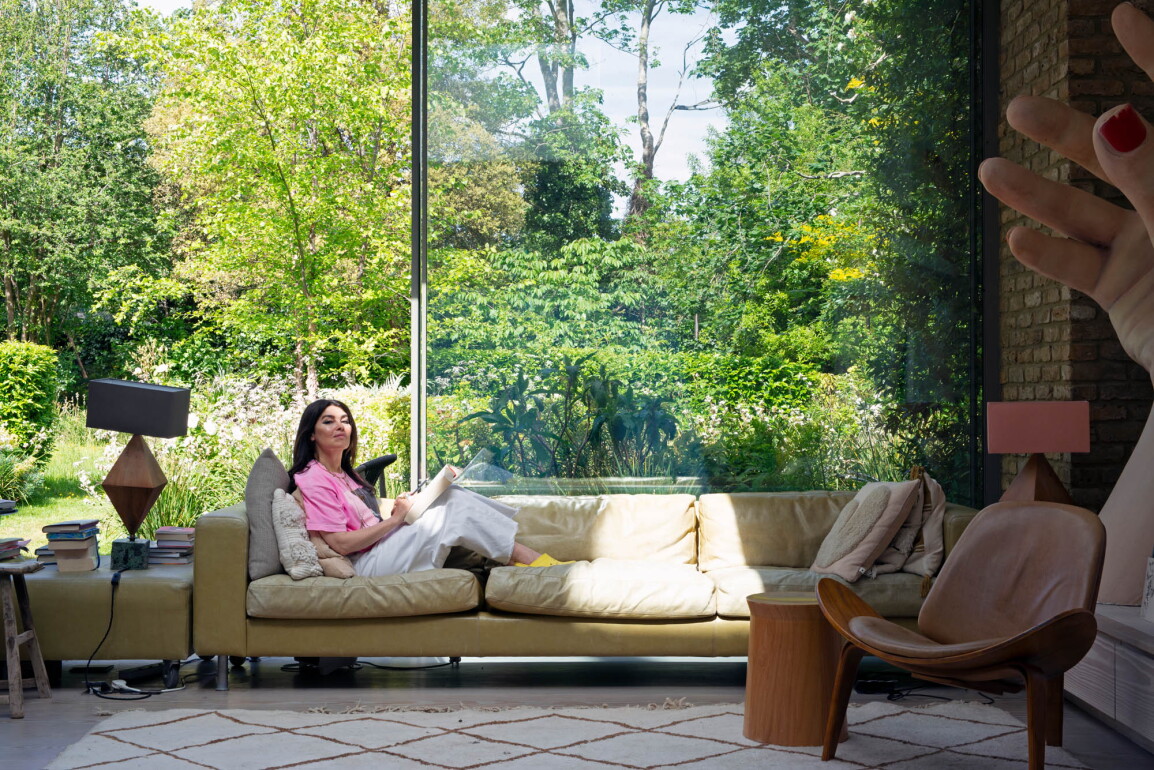
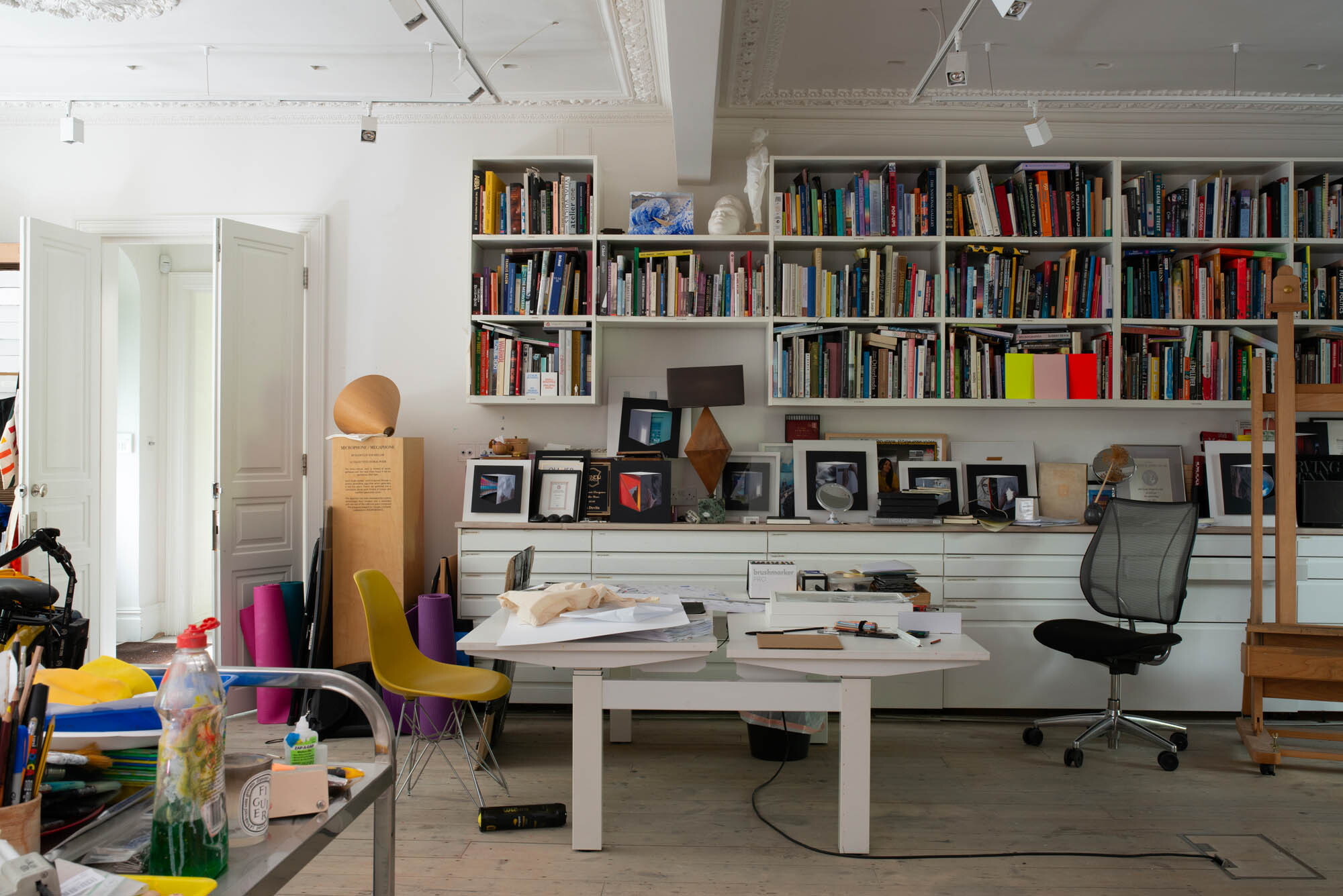
We meet on a warm day in late May, at her home in Dulwich, south London, an Edwardian house that keeps up a conventional frontage trimmed in yellow brick before opening at the rear into a 60-foot-wide sweep of glass with the polish of high-end tech retail. Devlin, 54, lives here with her husband, the theatrical costume designer Jack Galloway, and their two children. Though her personal studio is divided from the living space by a run of mirror-clad walls, a stack of books and papers has spilled out onto a rug, evidence of one of her current projects.
Devlin in the glass-walled living space at the rear of the Edwardian house that adjoins her studio. Photography by Nigel Shafran.
“We’ve been sat in that corner for three days working on the ‘Ring’ cycle,” the artist says of developing her production of Wagner’s four-opera epic for the Metropolitan Opera in New York with director Yuval Sharon, who had flown in for the planning sessions. “It doesn’t open until 2028, but you have to get ahead.”
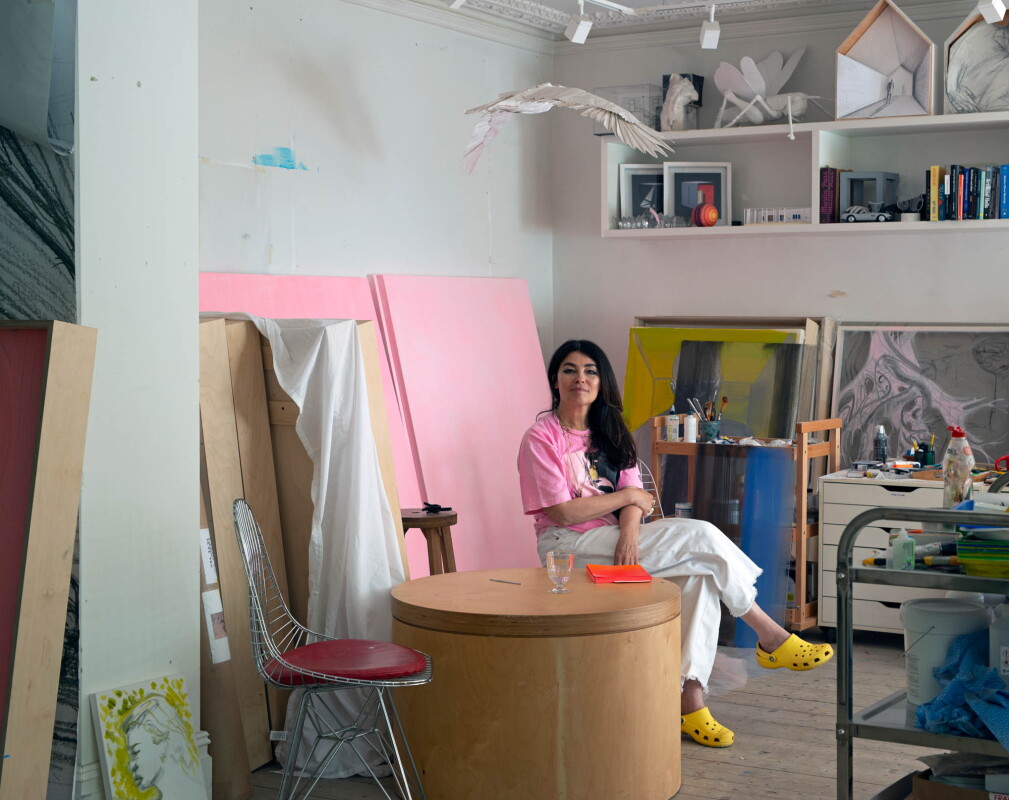
The artist’s studio, with an alphabetized library of artist monographs and art theory books, supporting a practice steeped in language and symbolism. Photography by Nigel Shafran.
It’s a glimpse of Devlin’s restless range, though theatricality, in one form or another, remains the common thread. In June, “Library of the Four Winds,” a literary installation inside a folly at Castle Howard, the great Yorkshire estate created by the playwright turned baroque architect John Vanbrugh, opened to the public. In July came “The Everythingists” at V&A East Storehouse, a commission responding to Russian artist Natalia Goncharova’s 1926 painted backcloth for the Ballets Russes production of “The Firebird.” Whatever the setting, Devlin keeps finding the stage.
The September 2026 cover of Sotheby’s Magazine, photographed in Devlin’s home studio.
H
er family moved to Rye, a coastal town in Sussex, when Devlin was six, and by her teenage years she was eager to move on. “To me, the main purpose of going into tertiary education was to leave home,” Devlin explains. “I didn’t want to go to art school because you didn’t leave home back then. You would go to the local foundation course in Canterbury.” Instead, she applied to the University of Bristol, drawn less by any grand academic plan than by the promise of a different bedroom from the one she had occupied since she was 13. What happened to be appended to it was a three-year, in-depth study of English literature, “including a first year entirely dedicated to the study of Anglo-Saxon,” Devlin recalls wryly.
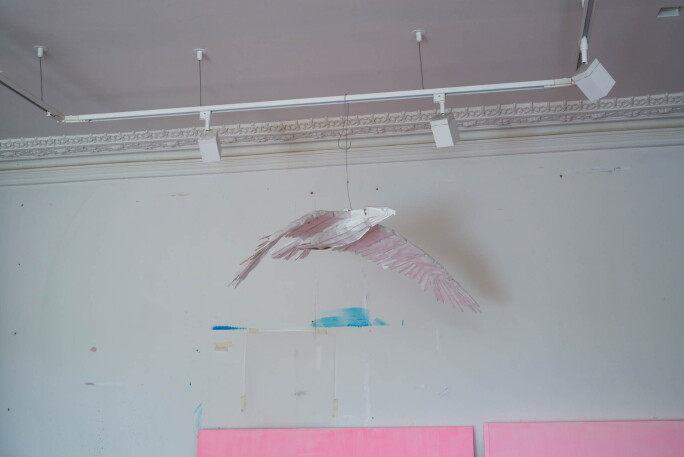
A bird sculpture hangs above the studio, reflecting Devlin’s focus on London’s biodiversity in works including “Come Home Again,” 2022, installed in Tate Modern’s garden and made with guidance from London Wildlife Trust. Photography by Nigel Shafran.
In rebellion, she returned to the idea of art school, later moving to London to complete a foundation course at Central Saint Martins, with plans to stay on for a degree in printmaking and photography. But a visit to the studio changed her mind. “It was a white room—empty—and it became apparent that it would be me, myself and I. I guess I’m about ready to have that encounter now in my 50s, but I wasn’t when I was 22.” She found her way instead to the Motley Theatre Design Course, an independent program then housed in the scene dock of Theatre Royal Drury Lane. “One of the key deciding factors was that the studio was open 24 hours, whereas Saint Martins closed at 6 p.m., and I knew I was going to go hard.” After graduating in 1995, she won the Linbury Prize for Stage Design, took on her first professional commission—a production of Christopher Marlowe’s “Edward II”—and was soon working at the National Theatre.
That hands-on education is still visible in the way Devlin runs her own studio, which has something of a medieval workshop about it. Assistants tend to stay for several years, training alongside her before leaving with her blessing to make work of their own. The team is small and mostly female. “We’ve got one guy, but generally it’s eight women,” she says. For years, the operation was based in the house, until William Kentridge, a longtime mentor, visited and told her: “This is all great, but you’ve got to have a place of your own.” More than space, he meant permission. “You need to be able to walk into a studio knowing that no outcome is necessary,” Devlin recalls.
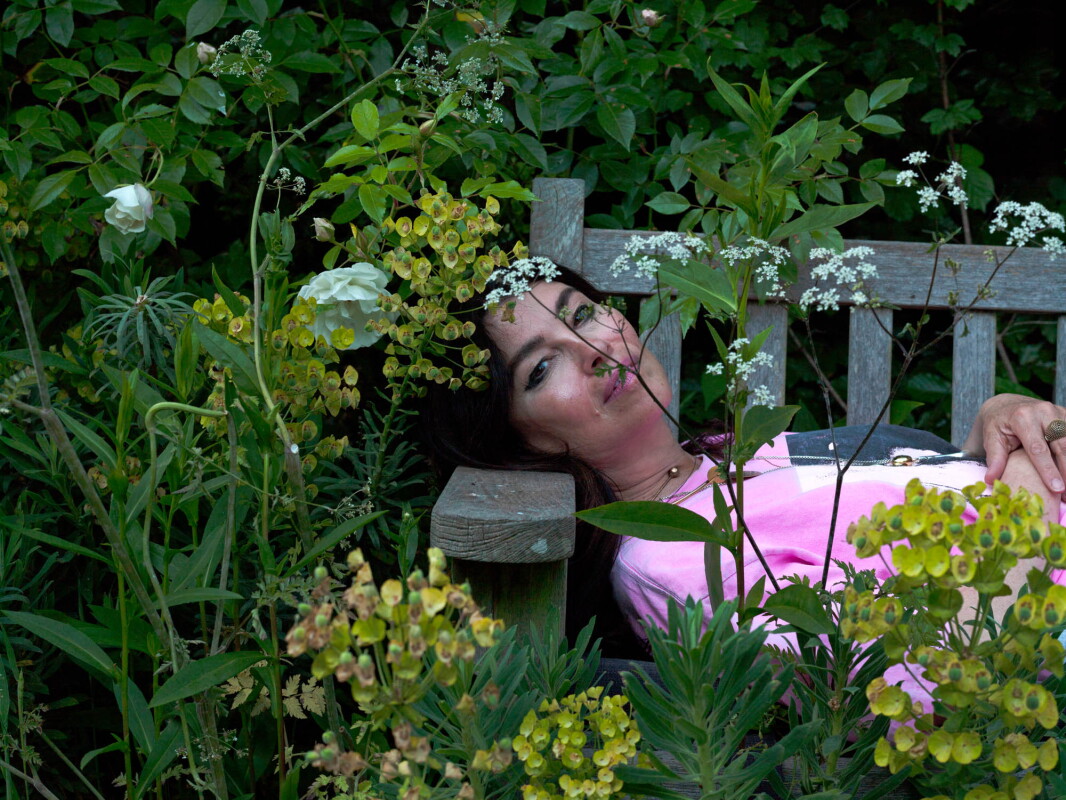
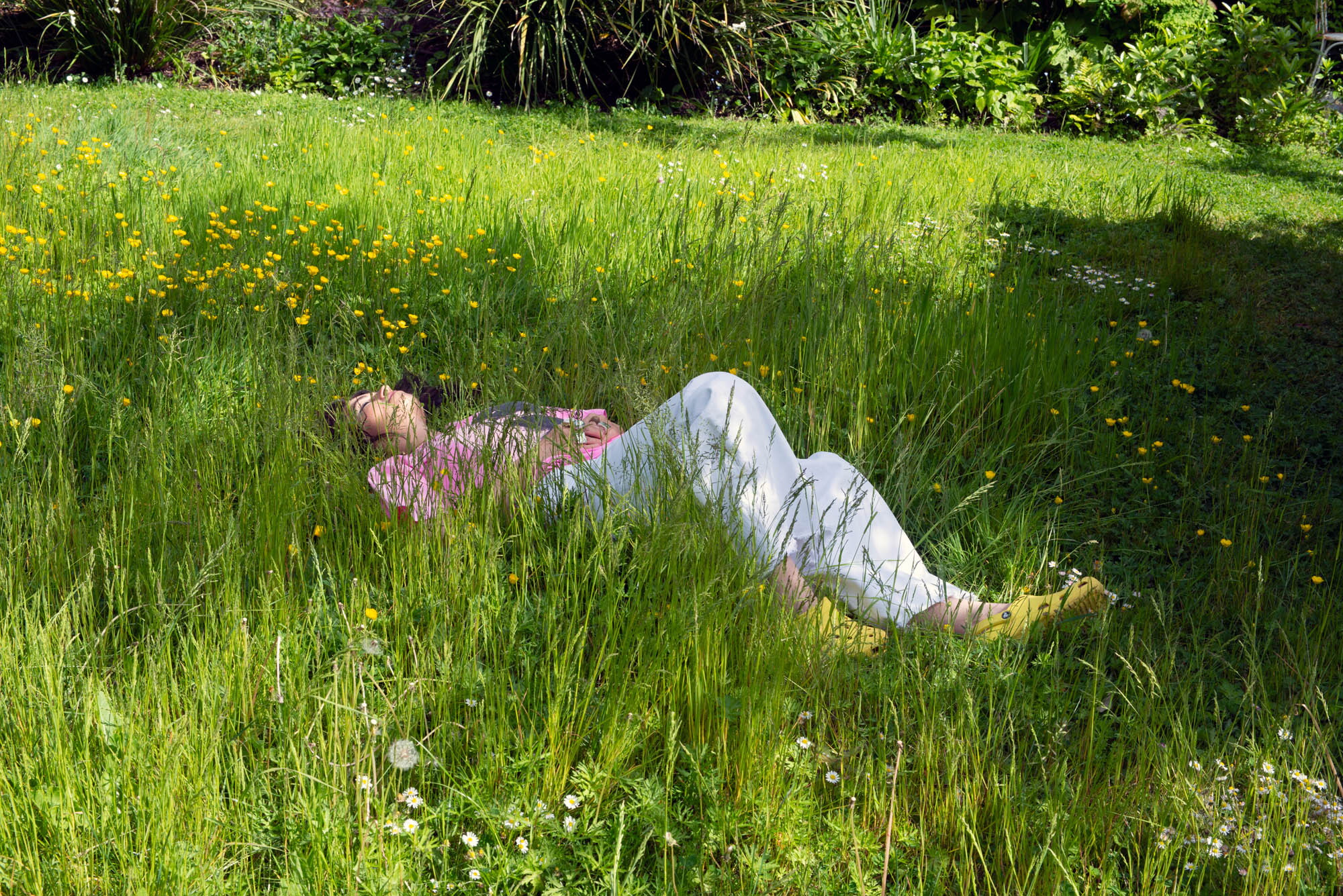
Devlin among the long grasses and wildflowers in a garden created with landscape designer Declan Buckley. Photography by Nigel Shafran.
“I want to make pictures like the picture of Dorian Gray that continue to change.”
Es Devlin
A monumental image of Adele’s eyes fills the stage in Devlin’s design for the singer’s 2016-17 world arena tour. Photo: Courtesy of Es Devlin Studio.
A
s Devlin's work has reached ever larger audiences, one subject has sharpened: national identity and the fragile group feelings that sustain it. In June 2016, she watched Adele’s Glastonbury debut from the side of a stage she had designed, the day after the Brexit referendum result was announced. During “Someone Like You,” the timing gave the song a different national weight. “Everybody was weeping,” she remembers. Afterward, she got into a taxi back to London, planning to sleep before rehearsals the next day. When she mentioned the vote, the driver told her he had voted “Leave.” “Of course, I didn’t go to sleep—I spent the whole journey explaining to him,” she says. His answer was simple: “I just wanted a change.”
In the years that followed, Devlin made a series of works that seemed to test whether a politically fragmented Britain might be pieced back together through language, one public encounter at a time, often with the aid of algorithmic text. In 2017, at the invitation of Hans Ulrich Obrist, “PoemPortraits” asked guests at the Serpentine Summer Party to offer a single word to a collective composition. The following year, “Please Feed the Lions” installed a temporary fifth lion in Trafalgar Square in Devlin’s signature fluorescent red-orange, a poetry machine that swallowed words from the public and projected verse from its mouth after dark. By Expo 2020 Dubai, where her “Poem Pavilion” represented the UK, the proposition had become explicitly national: Britain as a chorus of contributed words rather than a fixed emblem.
Devlin’s fluorescent red-orange poetry machine “Please Feed the Lions,” 2018, in Trafalgar Square. Photo: Courtesy of Es Devlin Studio.
That logic now extends to portraiture. In May, the National Portrait Gallery opened “A National Portrait,” made with Google Arts & Culture Lab, inviting people across the UK to submit their faces to an evolving collective image of the nation. The invitation is geolocated rather than passport-bound, widening the idea of who gets to appear in the national image. The portraits are generated by an AI system trained on Devlin’s own drawing process, translating each face into the restless charcoal-and-chalk language of her hand. The medium has shifted from words to likenesses, but the proposition has become more hopeful, imagining identity as something assembled by participation rather than bestowed from above.
When I press Devlin on the tension of making participatory works with tech companies whose power many artists regard with suspicion, she does not pretend there is a clean position to occupy. Her early career, she points out, was spent largely insulated inside state-subsidized theater. “The first time I heard the word client was in 2016,” she says. She disliked it enough to ban the term in her studio. In theater, hierarchy was hardly absent, but the authority was different. “The show was the boss.” Money, she has come to think, is never quite as distant as artists might like to imagine. “We are all entangled in the systems we wish to change,” she adds.
Devlin in the garden’s wildflower meadow. Photography by Nigel Shafran.
Her own entanglements are not incidental. Devlin sits on the board of Bloomberg Philanthropies and is a fellow at Oxford University’s Stephen A. Schwarzman Centre for the Humanities, developed with support from the Blackstone co-founder. But she is less interested in speaking about institutions than about the people she finds inside them. “I tend to see how I feel about rooms and people,” she says. She mentions Amit Sood, director of Google Arts & Culture, and Damien Baines, her collaborator at Meta, as figures negotiating systems they do not necessarily find simple. “I am drawn to those people and the reasons why they’re there,” she says. “There’s no doubt that’s very complicated and quite painful, and probably it would be much easier to say I’ll have none of it, but that hasn’t been my instinct.”
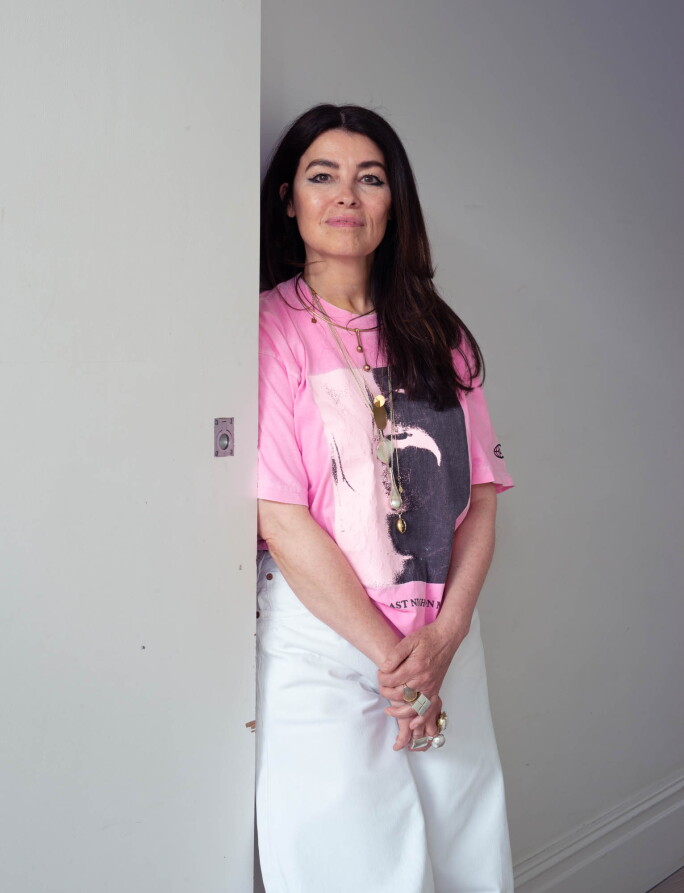
Es Devlin at home in London. Photography by Nigel Shafran
The same concern with encounter has also led her toward organizations working at the edge of some of the most charged questions of belonging and displacement: how people divided by circumstance or conviction might be brought into one another’s presence. In 2024, with UK for UNHCR, a charity partner of the UN Refugee Agency, Devlin made “Congregation,” a choral installation of portraits of 50 Londoners who had experienced forced displacement. The project took shape amid what she saw as a national contradiction: Britain’s embrace of Ukrainians fleeing war on one hand, and the rhetoric of “stop the boats,” the slogan associated with efforts to curb migrants and asylum seekers crossing the English Channel, on the other. “If this confusion and dissonance is at work in my culture, my community, my city, my country, it’s probably in my body and in me as well,” she says. “I should meet it so that I understand it better, so I can be more of service to changing it.”
The method also drew on Zen practice at Thich Nhat Hanh’s monastery in the South of France, which Devlin encountered through climate diplomat Christiana Figueres. What interested her was the broader idea that people might first be quietly present with one another—meditating, washing dishes—before anyone had to declare a position. “When it gets to the fourth day and the thorny issues of entrenched positions arise, they’re much more broachable,” she says. For “Congregation,” each sitter entered without talking, and Devlin drew them before interviewing them. She has since imagined repeating the format around the country, bringing together people otherwise unlikely to meet. The aim, as she puts it, is “engineering encounters without words.”
W
hen “Es Devlin: Other Worlds” opens at the Design Museum, it will gather a practice that has spent three decades resisting easy containment. Expanding significantly on her 2023-24 Cooper Hewitt exhibition in New York, the show is her first retrospective in Europe, a distinction that carries its own charge. It will deepen her standing, but its real test may be whether it can bring into view the personal practice now moving out from behind the spectacle.
Though there will be some clear departures, Devlin offers only hints of what that may look like. One strand involves painted televisions and mobile phones, objects that draw the screen back into the older languages of portraiture. The idea began, she says, after seeing a work by Michal Rovner at the home of Mollie Dent-Brocklehurst, the art curator and former president of Pace Gallery in London, about a decade ago. “I thought it was a painting, and it kept twitching,” Devlin recalls. “I want to make pictures like the picture of Dorian Gray that continue to change,” she says. The works are “ambitious,” she adds, including “a portrait that never sits still.”
As part of this new phase, Devlin is also opening up to the idea of selling artworks to collectors. Earlier this year, when she opened an exhibition at Casa Bradesco, a cultural space in São Paulo, curator Marcello Dantas posed the practical question: “What will you sell?” Though cautious, she is drawn to this evolution in sharing her vision. “That’s the next step, to sit in that room and make stuff,” she says, signaling to the space. “At the moment, my studio isn’t quite set up like that.”
Before any of these works are likely to find collectors, however, one more institution has a claim on Devlin’s year. Two weeks after the Design Museum exhibition opens, she will serve as artistic director of the British Museum Ball, this year shaped by the return of the Bayeux Tapestry to Britain for the first time in nearly a millennium. The evening’s honorary chair is Igor Tulchinsky, the Belarusian-born, US-based quant entrepreneur whose reported £5 million support helped secure the loan of the famed embroidery depicting the Norman Conquest of 1066.
For Devlin, the ingredients are familiar: patronage, national memory, spectacle. It may test which identity appears—the maker of grand institutional theater or the artist now making room for something less easily contained. But perhaps those selves were never so separate. “Quite a few times I’ve made work where I’ve entirely put on the glasses of another person’s point of view and been in service of it,” she says. “I didn’t mind losing myself…” Devlin reflects. “My own work has come through it, like those weeds cracking through the pavement outside.”
Es Devlin in her studio in Dulwich, south London, surrounded by models, materials and works in progress. Photography by Nigel Shafran.