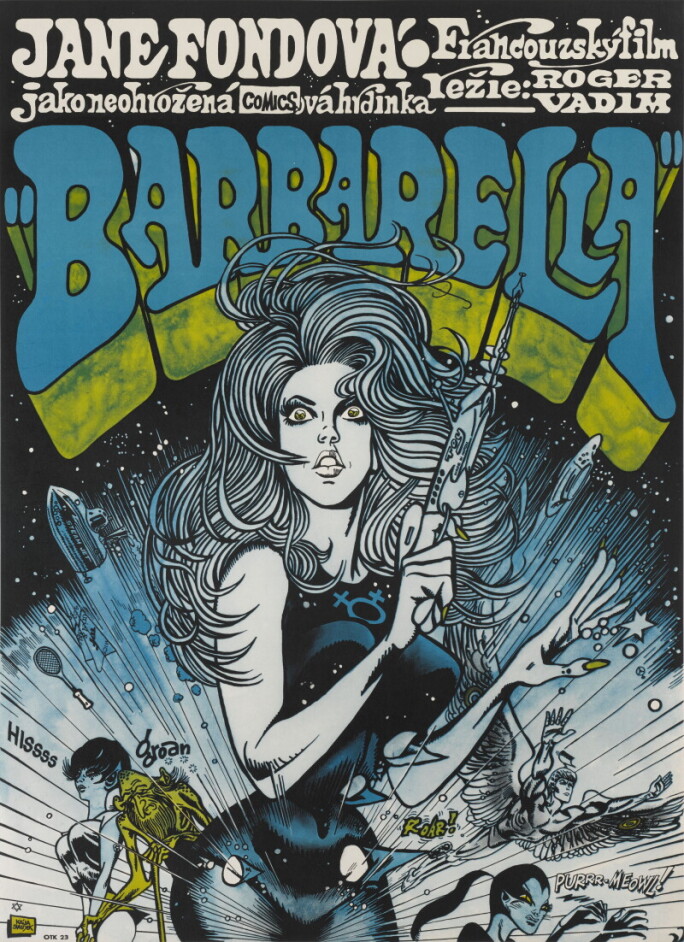
The Aesthetics of Foreign Posters for Domestic Films
From Czech Barbarella to Japanese Casablanca, see how international artists reimagined Hollywood classics through vintage movie posters.

A film might have been made in Hollywood, but its visual identity didn't necessarily stop there. As American and British films reached theaters overseas, they often arrived with entirely different promotional artwork. A leading man could be rendered in bold, exaggerated colors, while a romantic drama might take on a darker mood. For audiences encountering these films abroad, the poster offered a first impression that was sometimes worlds apart from the original.
Before standardized global marketing campaigns became the norm, international distributors frequently commissioned local artists to reinterpret films for their own audiences. These designers drew on regional artistic traditions, from the experimental graphic culture of postwar Eastern Europe to the richly illustrated cinema posters of Italy and France. The results included some of the most inventive vintage film posters of the 20th century, with compositions that often departed dramatically from their Hollywood counterparts.
For collectors, vintage posters created for international releases offer another perspective on cinema history. Works by artists such as Kája Saudek, Enzo Nistri and Boris Grinsson reveal how a single film could inspire strikingly different interpretations across borders. Many of these original international editions have become sought-after examples of graphic design in their own right, sometimes rivaling the appeal of the domestic posters that first advertised the films.
| Category | Key Takeaway |
|---|---|
| Regional Design | Foreign film posters often departed from Hollywood's original advertising, reflecting local artistic movements and design traditions. |
| Notable Artists | Designers such as Kája Saudek, Enzo Nistri and Boris Grinsson brought distinctive styles to international releases, making their work collectible beyond the films themselves. |
| First-Release Posters | A film's first theatrical release varied by country, sometimes occurring years after its original premiere. These dates are essential when identifying early printings. |
| Country-Specific Formats | Italian, French, Japanese and Eastern European posters were produced in different sizes and formats, which can help establish their intended market and theatrical use. |
| Condition and Conservation | Original paper, restoration history and linen backing can affect desirability. Professional conservation should be assessed alongside the poster's overall condition. |
| Collector Appeal | Scarcity, artist attribution, film significance and the originality of the artwork all influence demand for international posters. |
Eastern European film posters developed a visual language that often departed sharply from Hollywood advertising. In East Germany and Czechoslovakia, artists working within state-controlled film distribution systems drew on modernist design, surrealism and experimental illustration. Rather than reproducing studio publicity photographs, they frequently created original compositions that interpreted a film's mood or subject through their own artistic sensibilities.
The East German poster for The Hound of the Baskervilles, designed by Schleissing Gruppe, captures the sinister atmosphere of the Hammer Films adaptation through an expressionistic approach. Its unsettling imagery reflects the psychological tension of Arthur Conan Doyle's mystery, giving the British production a distinctly different visual identity. Kája Saudek's Czech poster for Barbarella takes another direction entirely. Known as the “King of Czech Comics,” Saudek brings his comic-book sensibility to Jane Fonda's science-fiction heroine, emphasizing the film's playful sexuality and pop-art influences. Together, these vintage film posters illustrate the creative range of Eastern European artists, whose interpretations could be as memorable as the films they advertised.
Italian film poster artists approached Hollywood releases with a flair for illustration, often favoring expressive portraits over conventional studio photography. Painters such as Enzo Nistri helped define the country's mid-century cinema advertising, creating artwork that heightened the glamour and personality of American stars. Their posters gave familiar Hollywood productions a distinctly Italian visual identity.
Nistri's Italian poster for How to Marry a Millionaire, produced for the film's first Italian release in 1954, offers an example of this tradition. The 1953 romantic comedy starred Marilyn Monroe alongside Lauren Bacall and Betty Grable, bringing together three of Hollywood's leading actresses. Nistri's interpretation belongs to a period when hand-painted film posters were central to Italian cinema advertising, and artists could bring their own style to major studio releases. For collectors of vintage movie posters, original Italian artwork from this era holds appeal for both its connection to Hollywood's golden age and the illustrators who helped shape its image abroad.
By the time Casablanca reached Japanese theaters in 1946, the film had already become a major Hollywood success. Released in the United States in 1942, Michael Curtiz's wartime romance arrived in Japan during the Allied occupation, giving local audiences their first theatrical introduction to Humphrey Bogart and Ingrid Bergman's celebrated screen pairing. Its Japanese release also produced a distinct piece of cinema history: an original poster created for a market encountering the film under dramatically different circumstances.
The 1946 Japanese first-release poster for Casablanca offers collectors a connection to this moment in postwar film distribution. Japanese vintage film posters are distinguished by their country-specific typography and formats, with early theatrical examples offering insight into how American cinema was promoted abroad. The poster's first-release status is especially significant, separating it from later Japanese reissues produced as the film's reputation grew. Its historical context adds another dimension to one of Hollywood's most celebrated romances.
French film posters of the mid-20th century often favored dramatic painted illustrations, giving Hollywood productions a different visual identity from their original advertising campaigns. Among the artists who shaped this tradition was Boris Grinsson, a Russian-born illustrator who designed more than 2,000 French film posters over a career spanning four decades. His work ranged from Hollywood noir classics such as Gilda and The Lady from Shanghai to the growing wave of international action films.
Grinsson's French poster for From Russia with Love (1963) brings his illustrative style to Sean Connery's second appearance as James Bond. The film helped establish the espionage series as an international phenomenon, while Grinsson's interpretation became part of its French promotional history. His extensive body of work makes artist attribution an important consideration for collectors of vintage film posters, especially those interested in tracing how celebrated Hollywood films were marketed across different countries.
Original foreign-release posters can appeal to collectors for reasons that extend beyond the popularity of the film itself. Artist attribution, regional design traditions and the originality of the composition all influence desirability. A poster by Kája Saudek or Boris Grinsson, for example, may attract interest from collectors of graphic art as well as cinema memorabilia. First-release examples are often especially desirable, although later printings with distinctive artwork can have their own following.
Identifying an original requires attention to its production history. Country-specific formats, printer credits and theatrical release dates can help distinguish early editions from rereleases and reproductions. Condition matters, too. Many vintage movie posters were folded for distribution, and professional linen backing can help stabilize fragile paper. Collectors should also examine the extent of any restoration, as significant retouching or replaced paper can affect value.
Beyond these considerations, international film posters capture a period when artists across the world could offer their own interpretations of Hollywood cinema. These vintage movie posters are valued as much for their artwork as for the films they advertised, making foreign-release editions an intriguing part of both cinema history and graphic design.
They can be. Value depends on the film, artist, rarity, condition and demand for the specific design. Some international posters command higher prices than their American counterparts, especially when the foreign artwork is highly regarded or difficult to find.
Start with the film's theatrical release date in the country of origin for the poster. Printer credits, dimensions, paper stock and distribution markings can help establish authenticity. Comparing these details with documented examples is essential, as later rereleases may use similar artwork.
An established artist's attribution can influence demand, especially when the designer has a following beyond cinema memorabilia. However, many original theatrical posters were printed without the artist's signature. A documented attribution doesn't necessarily require a visible signature.
Linen backing is common among professionally conserved vintage posters and doesn't automatically reduce their value. The extent of restoration matters more. Extensive repainting, replaced sections or alterations to the original artwork can affect desirability.
Some are, although scarcity varies by country, film and printing. Posters produced for smaller theatrical markets may survive in limited quantities, while others were printed extensively. Collectors should distinguish documented rarity from assumptions based on a poster's age or country of origin.
Whether you’re a seasoned collector or new to the world of collecting, Sotheby’s offers a trusted, seamless way to buy and sell vintage film posters on the secondary market.
Trust our worldwide network of specialists at a globally renowned auction house established in 1744.