
The Evolution of 16th-20th Century Italian Art
Two auctions in Milan tell the visual story of Italy across four centuries and four major cities.

O n view at Sotheby’s Milan from September 17-21 before heading to auction on September 25, “An Italian Collecting Journey” and its accompanying online auction tell the visual story of Italy across four centuries of art, focusing on the major cities of Naples, Venice, Rome and Florence.
Between the 16th and 19th centuries, Italy was a collection of independent city-states and foreign territories, each with its own artistic voice. As Italy moved toward unification in the 19th century, art helped to create a shared national identity. Foreign visitors on the Grand Tour helped elevate Italy as a cultural institution, while Italians themselves looked to their artistic heritage as a source of pride and unity.
From the dramatic landscapes and porcelain of Naples to the vedute of Venice, to Rome’s baroque churches and the pietre dure of Florence, Italian art demonstrates not only beauty and technical skill, but also the country’s evolving identity through time.
Read below on the evolution of art in each of these extraordinary cities.

In Naples, the discoveries of ancient Pompeii and Herculaneum ignited a wave of neoclassical revival. This revitalization established Naples as a major artistic center in Europe.
Included in the sale is a selection of works, led by Pietro Fabris’ Naples, as well as a sculpture by Filippo Taglioini, a gold pique casket and a Capodimonte porcelain.
Pietro Fabris played a significant role in the development of 18th-century Neapolitan landscape painting, and this magnificent painting of Mergellina ranks among his largest and most ambitious works.
The work shows his skill in blending vivid scenes from Neapolitan everyday life with a topographically correct depiction of the landscape. Framed by the striking ruins of the Baroque Palazzo Donn’Anna and carefully rendered figures of Napoleon attire and tradition, Fabris presents a lively scene unfolding along the Mergellina waterfront.
The palazzo was named after Anna Carafa (1604-44), the Duchess of Stigliano, and designed by architect Cosimo Fanzago, who planned to create one of the most magnificent residences in Naples. Work stopped abruptly upon the Duchess’ death in 1644, and by the 1700s its dramatic, decaying structure had become a source of inspiration for artists, visitors and antiquarians, securing its place as a symbol of romantic allure along the Neapolitan coast.
This tabletop is rare for several reasons: it’s an early example of inlaid volcanic stone and features a pietre dure view of Naples, which was an unusual subject for the 18th century.
At the time, Mount Vesuvius fascinated tourists, historians and geologists alike after the 1790s excavations of Pompeii. As interest grew, so did demand for souvenirs made from volcanic materials. By 1805, Peter Beckford listed lava among Naples’ most traded goods. However, this table dates from an earlier period when such pieces were uncommon and mainly sold by top dealers like Tomasso Valenziani (1725-1780) who supplied pieces to figures like Tsar Peter the Great. A few other notable Neapolitan tables use volcanic stone in a similar way, but the inclusion of a pietre dure view of Naples and Vesuvius is especially rare for this period.
Sculptor Filippo Tagliolini was among the earliest European artists to craft a distinctive Neoclassical style by copying, reproducing and restoring prototypes of classical statues. While drawing inspiration from antiquity was not new, Tagliolini’s innovation was through his use of biscuit porcelain. Its white hue, matte finish and marble-like appearance made it an ideal medium for exploring the new classical style.
This sculpture depicts Mercury handing the golden apple to Paris, in anticipation of the Judgment of Paris. This likely was inspired by Tagliolini’s daily access to sculptures unearthed at Pompeii and Herculaneum, which he closely studied. The small-scale “portable classics” he reproduced restored these fragmented ruins of the past to their ideal beauty.
By the late 1600s and early 1700s, Italian-style theater featuring Commedia dell’Arte characters was extremely popular at fairs and public celebrations, inspiring many artists of the time. One such artist was the Tuscan painter Gian Domenico Ferretti (1692–1768), known for his dramatic, almost Fuselian, depictions of these characters. The lively composition of this porcelain sculpture closely resembles a drawing by Ferretti where Arlecchino, one of the Commedia dell’Arte characters, is fought by two girls.
Naples stood at the epicenter of pique craftsmanship, a decorative technique that involved inlaying precious materials into tortoiseshell. The city’s reputation for this craft is reflected in Lady Miller’s 1777 remark calling it “famous for a manufacture in tortoise-shell, which they inlay curiously with gold, and are very ingenious at representing any object you choose.” Decorative trays of this size were common – likely reflecting the size of whole tortoiseshells – and were first softened in a mixture of water and olive oil before being inlaid with gold and mother-of-pearl.

Venetian art has unique historical significance through its decorative arts, glassmaking, vedute paintings and lacca povera furniture.
The sale includes works such as Venice, the Piazza San Marco by Giovanni Battista Cimaroli, Pagoda figures by Giovanni Bonazza and a Vezzi porcelain teapot.
Giovanni Battista Cimaroli is extremely important in 18th-century Venetian painting, bridging the gap between the grand tradition of vedute and a more intimate portrait of the city. As historian Dott.ssa Federica Spadotto pointed out in her 2011 monograph on the painter, this lively painting illustrates Cimaroli’s artistic debt to Luca Carlevarijs (1663-1730), a pioneering figure in early Venetian vedutismo. While both artists share a fascination with everyday urban life, Cimaroli’s deliberate brushwork and approach to light illustrate his unique style.
In 1720, Venice housed Italy’s first porcelain manufactory – and only the third in Europe – to successfully produce hard-paste, or “true,” porcelain. This ambitious enterprise was launched by the Venetian nobleman Giovanni Vezzi (1686-1746). To realize his vision, Vezzi recruited highly skilled artisans from central and northern Europe, including Christoph Conrad Hunger, a former goldsmith from Vienna, who worked at the Venetian factory until 1721. Although the Vezzi factory only stayed open for seven years, it produced some of the most distinctive wares of the early European porcelain period.
Octagonal teapots in this ornate Baroque style were inspired by contemporary designs from Meissen and Du Paquier, who drew frequently upon silver prototypes. Of particular note is the oval medallion at the base of the sprout – a feature that appears to be unique among surviving examples of Vezzi teapots.
This bureau cabinet is a rare and valuable example of arte povera furniture, meaning “poor art” or “pauper’s art.” It refers to the 18th-century European technique of imitating East Asian lacquer using cut-out prints applied under varnish. This inventive approach emerged in response to the widespread demand for Asian lacquerware among European collectors.
The arte povera technique, particularly associated with Venice, typically involved affixing printed scenes of figures to a painted surface, then coating the entire composition with a glossy varnish known as sandracca, designed to replicate the lustrous finish of lacquer. With its vivid colors and variety of subjects, arte povera remains a vibrant reinterpretation of its lacquer inspirations.
While the bureau as a form originated in England, the version seen here adopts a dramatically serpentine silhouette with sharp, pointed colors that aligns far more with Venetian design.
The “fruit and flowers” motif, set against a striking blue background, was a favored decorative theme in 16th-century Venice. This design was most commonly applied to globular pharmacy vessels. This theme was frequently associated with Maestro Domenego de Venezia, who drew designs of flowers and fruits in his manuscript treatise I tre libri dell’arte del vasaio (c. 1557), noting that “truly there are Venetian types of painting, very charming.”
Notably, this lot is extremely rare because of its association of the Fruits and Flowers ornament with the form of the boccale.
These two comical chinoiseries sculptures reflect a Western reinterpretation of Chinese mythological figures, such as the beggar god Chi Kung. Each figure features dwarf-like proportions, a corpulent frame clothed in voluminous drapery, and a wide grin. The differences in the bases and seating positions indicate that the two pairs were likely made independently, rather than in a group of four. This piece is unique in its material, as marble was not used frequently in similar pagoda figures of the time.

Few cities reflect the evolving spirit of Italian art as vividly as Rome. With the revival of classical antiquity in the 16th century and the rise of the Baroque in the 17th century, Roman art evolved as a renaissance balancing tradition and innovation.
Included in the sale is a selection of Roman works, led by a painting by Isaac de Moucheron, a biscuit porcelain figure of The Barberini Faun and a bust of the Dioscuro Castor.
This exceptionally rare and previously undocumented depiction of the Vatican by Issac de Moucheron is one of only eight recorded views of Rome by the artist.
After studying in Amsterdam under the guidance of his father, De Moucheron journeyed to Italy around 1965-67. He spent the majority of his time in Rome, focusing on vedute and drawing inspiration from fellow Dutch artist Gaspar van Wittel (1652/3-1736). While in Rome, De Moucheron created many sketches en plein air, which he later refined into carefully detailed and signed drawings – many of which served as preparatory studies for his painted works. A sketch capturing a similar perspective of the Vatican (from a slightly more distant perspective) and a more polished drawing align closely with the current composition.
This biscuit figure is inspired by the renowned marble statue known as the Barberini Faun (also called the Drunken or Sleeping Faun). It is thought to be a refined copy of a late 3rd or early 2nd century B.C. Pergamene bronze – or possibly an original marble work from that time.
Named after its earliest recorded owner, Cardinal Francesco Barberini, it entered his family’s collection around 1627 and remained in the family palace until 1820, when it was acquired by the Crown Prince of Bavaria.
Highly regarded in the 17th century, the faun gained popularity partly due to its supposed discovery at Castel Sant’Angelo in 1624. Its popularity soured in the late 18th century after a restoration by Vincenzo Pacetti, sparking competition among European collectors.
In 1814, Cardinal Pacca banned its export, but the restriction was lifted in 1819 under pressure from the Austrian Empress for Crown advocating for her brother, Crown Prince Ludwig of Bavaria, who famously called it “the most perfect statue in the world.” The faun was finally moved to Munich on January 6, 1820.
Despite widespread acclaim, reproductions of the Barberini Faun are rare, due to the Barberini family’s reluctance to allow casts and the statue’s challenging size and erotic nature.
The piece shows an unusually early example of Italian furniture designed to resemble a tree. The naturalistic form was quite rare in 17th-century design, until becoming more fashionable in 18th-century garden settings and grotto interiors. Its inventive character, along with some related documented works, points to a collection with Johann Paul Schor (1615–74), an Austrian-born designer and a collaborator of Gian Lorenzo Bernini (1598–1680).
Beyond the works of Bernini and Schor, there are few early examples of naturalistic ornament in the Baroque period.
This coffee pot is a variation of a design by Giuseppe Valadier, originally created for Antonio Maria Odescalchi (1763-1812), the son of Prince Livio and Vittoria Corsini and whose lineage included several popes. Antonio began a prominent ecclesiastical career, which significantly advanced when he was appointed apostolic nuncio to Florence in 1795. It was likely around this time that he commissioned this important set, notable for its innovative decoration.
The coffee pot features handles shaped like mask heads serving as spouts with a simple body adorned and a Medusa head – a decorative motif favored by the Valadier family.
This bronze bust is a small-scale reproduction of Castor’s head from the grand marble group of the Dioscuri with horses. In the early 1790s, Francesco Righetti, a leading Roman sculptor, crafted and marketed miniature bronze heads of Castor alone. His creations are known for exceptional quality – even smaller items like this bust maintain a sculptural grandeur.
Righetti began working with Luigi Valadier, Rome’s foremost silversmith, who produced exquisite bronzes inspired by ancient art. This collaboration allowed Righetti to perfect bronze casting techniques. He later succeeded Valadier, creating replicas of Roman bronzes, including a notable commission of 12 large lead casts of renowned antique statues for Henry Hope. Pope Pius VII, after visiting his workshop, commissioned several works, such as the grand candelabra for San Giorgio Maggiore monastery in Venice. In 1805, Righetti was appointed head of the Vatican foundry.
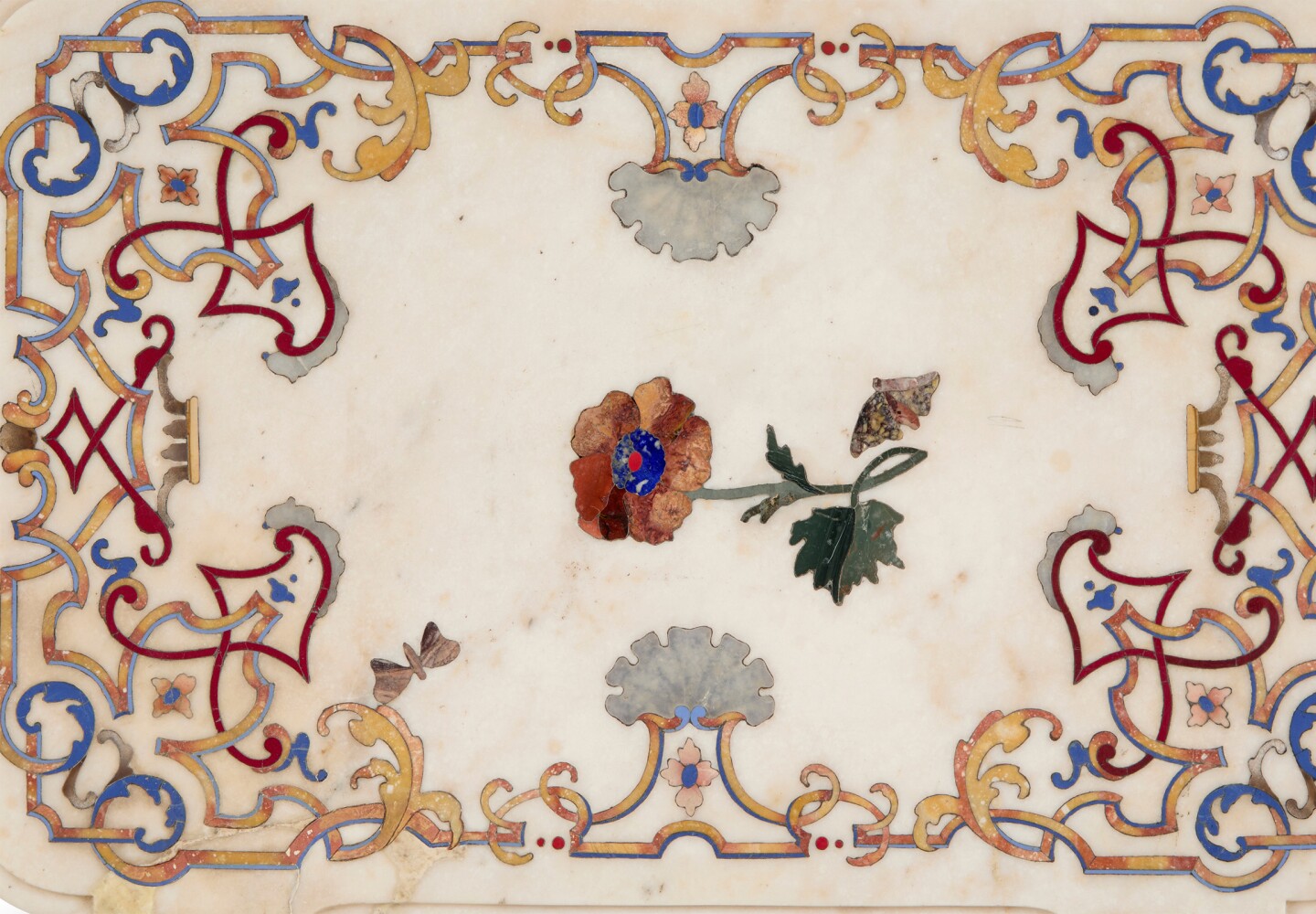
Florence’s artistic development between the 16th and 20th centuries is marked by craftsmanship and innovation. The city became renowned for its exquisite coat of arms designs, intricate pietre dure inlay work and beautifully crafted furniture that combined functionality with artistic elegance.
The sale includes works such as a pietre dure panel, a Gio Ponti vase and an armorial tapestry with the Medici coat of arms.
This panel may have originated in the Florentine Grand Ducal workshop. It was inspired by a pietre dure and gilt-bronze relief of the Annunciation, commissioned by Cosimo III in 1720 as a gift for his daughter, Anna Maria Luisa, who married the Elector of the Palatine. The design was made by court sculptor Giovanni Battista Foggini and is now in the badisches Landesmuseum in Karlsruhe. The workshop created several pietre dure panels based on the 14th-century Annunciation painting in Santa Maria Annunziara, Florence.
In 15th-century Florence, the Pitti family was wealthy and powerful, largely thanks to Luca di Bonaccorso Pitti’s close ties with Cosimo de’ Medici. A merchant and loyal politician, Luca was appointed Gonfalonier of Justice by Cosimo in 1458. This strong connection between two leading families allowed Luca to commission the Palazzo Pitti, the largest private home in Florence. Today, it is one of Italy’s most famous museums.
Stemmi, or coats of arms, were visible symbols of aristocratic influence. They were often made from glazed terracotta – a durable material developed by Luca della Robbia. These were commonly placed on the façades of public buildings and noble homes across Tuscany. The stemma shown here is characteristically Tuscan, with a shield shape typical of Andrea della Robbia’s later works and frequently seen in Giovanni’s pieces. Its size suggests it was displayed above a doorway in a private Pitti residence.
This tapestry is part of a small group featuring the Medici family coat-of-arms. These were mainly made in the Medici grand-ducal workshops, known as the Arazzerie Medicee. In 1545-46, Cosimo I de’ Medici founded two tapestry workshops in Florence and hired two Flemish master weavers, Nicholas Karcher and Jan Rost, to lead them. While the weavers could create tapestries for others, their main focus was the duke’s commissions. This gave the Medici direct control over production and boosted Florence’s status in the international tapestry market, strengthening the Medici’s political influence. Tapestries were the most prestigious decorative art in European courts, and these Florentine designs often came from the top artists of the era.
The decoration on this vase features mostly female figures, either on horseback or on foot, engaged in hunting scenes surrounded by wild animals, dogs and trees. For this series, Ponti also created a grand “program vase” depicting all the stages of a fallow-deer hunt. Each part of the hunt was then depicted separately on various vases and plates.
This table is a rare example of the limited pietre dure commessi produced by the Ginori Manufactory in Doccia, Florence. A hallmark of this work is the use of a white marble background with floral designs inlaid from hard and soft stones. While white marble backgrounds were not entirely new, mid-18th-century artists began adopting lighter grounds inspired by earlier Medici works, moving away from the darker, traditional style.
Only a few tabletops were made at Ginori, and even fewer survive. Mann mentions two pairs made in the late 1750s, one purchased by King Frederick of Prussia, and the other, which took three years to complete, was priced at 1,500 Zecchini in 1759.


