
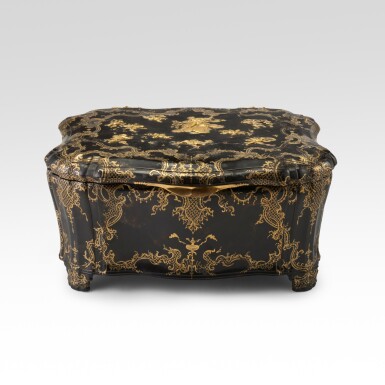
An Italian gold and tortoiseshell piqué casket, Naples, third quarter of the 18th century
Auction Closed
September 25, 05:46 PM GMT
Estimate
20,000 - 30,000 EUR
Lot Details
Description
of serpentine shape with lobated corners, the cover centred by a female figure between Cupids, the lid with repairs
16.5cm high, 33cm wide, 25cm deep; 6 1/2in., 13in., 9 3/4in.
Please note that this lot includes endangered species, which will require a CITES permit for export. It may be subject to one or more export or import licenses being granted. Please refer to the Guide for Buyers at Auction and Conditions of Business for Buyers for additional information and please contact the shipping department at shipping.milan@sothebys.com for the export of this property from Italy to other Member States both within and outside the European Union.
This work is accompanied by an Export License. We suggest contacting shipping.milan@sothebys.com for additional details on procedures and timing.
Naples was the epicentre of the art of piqué, and many discussions of the art form quote Lady Miller’s 1777 description of the city as being “famous for a manufacture in tortoise-shell, which they inlay curiously with gold, and are very ingenious at representing any object you choose”.1 Decorative trays of these dimensions were common, plausibly mirroring the dimensions of entire tortoiseshells, and would have been boiled in water and olive oil before being pricked and inlaid with gold and mother-of-pearl. Some trays depict single scenes, others an assortment of smaller motifs, and the treatment of borders varies considerably. Amongst these various examples, though, there is a small group that are surprisingly similar to the present example, almost certainly indicating a common workshop. One of these is in the Victoria & Albert Museum (M.241-1960) and another at Waddesdon Manor;2 thanks to Geoffrey de Bellaigue’s thorough cataloguing, several others in this group are also identified, including that sold at Sotheby’s in 1927.3 These all feature disparate islands, two of which will have colonnade-style architectural fragments, another a shepherd with his flock, another with two gentlemen wearing hats and an obelisk to the centre encircled by birds or insects. Even the balance between different materials (such as the gold for the hats of the gentlemen) and the graphic use of piqué point under the islands is very similar, and the most notable differences are to the ornament of the border.
Beyond the group that share so many of these characteristics, there are even more variations on these piqué trays: the example in the Royal Collection (RCIN 22285), for instance, has the same shape and a composition of ‘islands’ though lacking an obelisk, while another that was recently with Kugel has just a slightly different arrangement of figures and islands.4
1 A. Miller, Letters from Italy, 1777, London, vol II, p.57. Available at: <https://archive.org/details/lettersfromitaly02mill/page/56/mode/2up> [accessed 19 August 2025]
2 G. de Bellaigue, The James A. de Rothschild Collection at Waddesdon Manor: Furniture, Clocks and Gilt Bronzes, London, 1974, vol II, pp.827-828.
3 Sotheby’s London, 22 June 1927, lot 160.
4 A. Kugel, Piqué: Gold, Tortoiseshell and Mother-of-Pearl at the Court of Naples, Milan, 2018, p.266, cat.34.
You May Also Like


