A chance discovery at an antiques market in 1970s Paris marked the beginning of Terry de Gunzburg’s life with art. Part of the collection she and her husband, Jean, have assembled comes to auction at Sotheby’s this spring.
A chance discovery at an antiques market in 1970s Paris marked the beginning of Terry de Gunzburg’s life with art. Part of the collection she and her husband, Jean, have assembled comes to auction at Sotheby’s this spring.
P
aris, 1970s. On weekend mornings, Parisians drifted north, crossing the Périphérique toward Les Puces de Paris Saint-Ouen, the vast flea and antiques market that spread through the streets of Saint-Ouen. The market—its origins tracing back to the 1870s—was rougher and more improvised than the polished destination it would later become. Stalls were tightly packed, objects piled on tables or leaning against walls, the air thick with dust and cigarette smoke.
Terry de Gunzburg, a precocious 20-year-old medical student, would visit the market when she could, using spare money earned from various part-time jobs—working for a florist, in a department store, at a school—balanced alongside her studies. During one visit, she stopped at a dealer’s table where a plate caught her eye. It was the image that held her first: the delicate outline of a woman’s face. She turned the plate over. On the back was the name “Picasso.”
Terry’s parents were not collectors, but they were intellectuals, and visits to museums had been an integral part of her upbringing. She had grown up seeing Picasso’s paintings and sculptures around the world, yet the idea of owning even a small work by the artist in ceramic form felt both exciting and unfamiliar.
She seized the opportunity, even though the price was not insignificant for a young student. It was an early awakening of two of her lifelong affinities: Picasso and ceramics.
A second formative encounter in Terry’s 20s was meeting the French interior designer Jacques Grange, whose star was very much on the rise. He would soon begin working on the legendary rue de Babylone apartment of Yves Saint Laurent—a figure Terry would later be linked to professionally when she went on to lead Yves Saint Laurent Beauté and develop the highlighter Touche Éclat, which cemented her reputation as a defining figure of the beauty industry. Grange would become her lifelong confidant, and the two would later collaborate on the homes she shared with her husband, Jean de Gunzburg—in London, New York, Saint-Rémy-de-Provence and Tel Aviv—shaping the environments in which her collection would live.
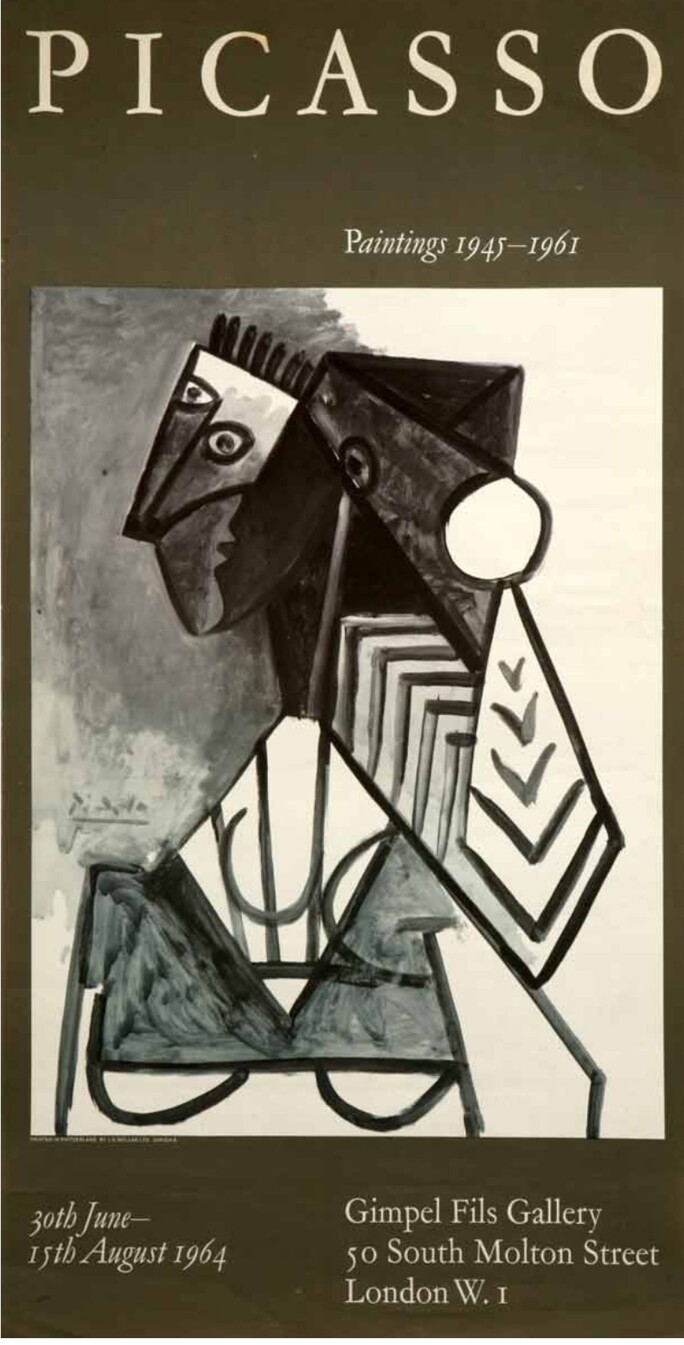
Later, in 1999, the de Gunzburgs were approached by their close friend Dominique Lévy, who was then leading private sales at Christie’s and had come across “Buste de Femme” (1955), a sharp, architectural female portrait rendered in black and gray, hanging in a private New York collection. Lévy immediately thought of the couple. “Knowing their passion for sculpture and ceramics, I was keen to show it to them,” she recalled.
The painting carried an unexpected coincidence: It was painted the same year both de Gunzburgs were born. “We bought it as a sort of mutual birthday gift,” Terry told me, laughing as she remembered the moment. After acquiring the work, they installed it in their New York apartment, designed, as ever, in collaboration with Grange. There, it hangs in an intimate corner above a fireplace (unused, of course) and an exquisite Alexandre Noll four-panel screen from 1925. A series of ceramics line the wood-paneled bookshelves surrounding it. It has remained in the same spot ever since.
In some ways, the painting reaffirmed something already present decades earlier. Terry still responded first to the same element that had stopped her in the ’70s at the antiques market: the human face. “What really caught my eye when I first saw that plate at the market was the face of the woman,” she said.
The original Picasso plate, meanwhile, did not survive. It was broken by a nephew during a birthday party. Terry recounts this with characteristic lightness. “It’s fine. I bought two of the same plates later at auction to replace it.”
Picasso’s “Buste de Femme” (1955) will be offered at Sotheby’s New York in May.
Sotheby’s Magazine
About the Author
Lucas Oliver Mill
Lucas Oliver Mill is a London-based curator and writer. He is the creator of Collector Walls (@collectorwalls), an Instagram account that explores the homes of art collectors. He has worked on multiple museum exhibitions, such as the first survey of American Pop art in Asia.