News and notes from the worlds of art, books, culture, design, fashion, food, philanthropy and travel. Edited by Julie Coe
News and notes from the worlds of art, books, culture, design, fashion, food, philanthropy and travel. Edited by Julie Coe
Design Forward
Sculpting A Life | Isamu Noguchi saw artistic opportunity everywhere: in the studio, onstage, at a lantern shop, while walking a city street. Two spring shows highlight the range and impact of his long career, which flourished between 1922 and his death in 1988 and culminated in his founding of the Isamu Noguchi Foundation and Garden Museum, in Long Island City, Queens.
Through September 13, the museum delves into the ways the city transformed the artist and vice versa with “Noguchi’s New York,” a fitting subject in our politicized present. “It was in New York that Noguchi cultivated a sense of civic and social responsibility,” curator Kate Wiener explains. “He talked about finding himself ‘bitten by some kind of an idealism’— coming to believe that he could sculpt the city and world into a better place.”
From April 10, “Isamu Noguchi: ‘I am not a designer’” at Atlanta’s High Museum of Art explores the conceptual overlaps between function and sculpture in the artist’s work. Visitors may come for his Akari light sculptures, but they’ll stay for his playground equipment, a rarely seen Martha Graham stage set and a model of a house he designed with architect Kazumi Adachi.
Despite their fragility, Noguchi’s utilitarian and affordable Akari paper lanterns are back in vogue and collectible today. The series dates to 1952 and is still in production in Japan, though some of the 200 or so models have been retired. “The market has a material prejudice—i.e. bronze over paper—but that may be falling away,” says New York private dealer Patrick Parrish. “Serious collectors are willing to buy a paper sculpture, acknowledging that if it is vintage, it may need conservation at some point.” Consider that when Noguchi was chosen to represent the U.S. at the 1986 Venice Biennale, alongside his marble and steel sculptures, he filled an entire gallery with Akari.—Sarah Medford
Obsessions
Courtesy of deVOL Kitchens
Going Daft for Delft | The delicate blue-and-white pottery style, famous from Dutch tilework, is inspiring fresh tableware and furniture designs that embrace its sprightly energy. Above: Ditsy Delft Tiles by deVOL, from $12 per tile; devolkitchens.com. Below, clockwise from top left: BDDW Lotch table, from $30,000, and BDDW Knob and Tube wall light, from $12,500; bddw.com. Kevin Quale tea cup, part of the “What’s the Tea” set, $5,500; kevinquale.com; Studio Glithero Blueware vase, $5,390; glithero.com.
Courtesy of BDDW
Left to right: Photo by Maarten Willemstein; courtesy of Lamb Gallery.
View Finder
Lucie Rie’s 1936 Vienna-period cup and saucer at “Provenance,” a design show on view through April at the Hotel Almhof Schneider in Lech am Arlberg, Austria. Photo: Jake Curtis.
Origin Stories |As the Swiss-Austrian Alps area increasingly becomes a magnet for new museums and galleries, alternative arts venues are cropping up too, often in unlikely settings. Take the car park at the Hotel Almhof Schneider, a fourth-generation winter resort in Lech am Arlberg, Austria. Through April 6, important works by Frank Auerbach, Lucie Rie, Le Corbusier and Pierre Jeanneret are on view against the backdrop of its futuristic underground garage and oak-lined public rooms, ready for guests and visitors to discover—and maybe drive away with, for the right price.
“Provenance,” curated by the London-based collector Rajan Bijlani, explores the migration of modernism across continents and cultures, from Eastern Europe to Britain and from western Europe to the Himalayan foothills of India. Taking Bijlani’s holdings of early furniture by Le Corbusier and Pierre Jeanneret for Chandigarh, India, as a starting point, the show tracks the relationships between place, time and experience in the formation of an artistic self.
Among the key works are German-born Auerbach’s urgent 1951 charcoal drawing of a seated figure and Austrian émigré Rie’s Platonic ideal of an earthenware cup, from 1936. A 1954 Chandigarh desk is a marvel of simplicity, with cantilevers and other Corbusian hallmarks. For Bijlani, the sophistication of the Almhof Schneider seemed like reason enough to take on the ambitious project. “That car park—well, it took me right back to Chandigarh,” he says of the immaculate space, conceived by Japanese designer Shinichiro Ogata. “The concrete, the sandy color, the slant light from above. Amazing.” rajanbijlani.com—S.M.
Greater Good
Vignettes from Kettle’s Yard, a house museum in Cambridge, England. Photos by Jasper Fry.
Home Where the Art Is |For a modest house museum on a quiet street in Cambridge, England, Kettle’s Yard has earned an outsized reputation among artists, leading to an exhibition program that punches far above its weight. The former home of Tate curator Jim Ede and his wife, Helen (and now part of Cambridge University), Kettle’s Yard mixes contemporary and modern art with the Edes’ personal effects in an unassuming, delectably intimate way—paintings and pebbles on the windowsills, ancient pottery on the stairs. Opened in 1957, it expanded with new gallery space for contemporary exhibitions in 2018. To fund its endowment, the museum has organized a benefit exhibition titled “Artists for Kettle’s Yard,” running March 14 through April 12 and featuring over 75 pieces by Chantal Joffe, Antony Gormley, Celia Paul, Ai Weiwei, Anni Albers, Magdalene Odundo and others. Works will be sold onsite, online and at Sotheby’s as part of a modern and contemporary sale in June.—S.M.
The salotto, or living room at Casabianca, featuring “Holding Emptiness” (2012) by Marina Abramović. Photo: Casabianca.
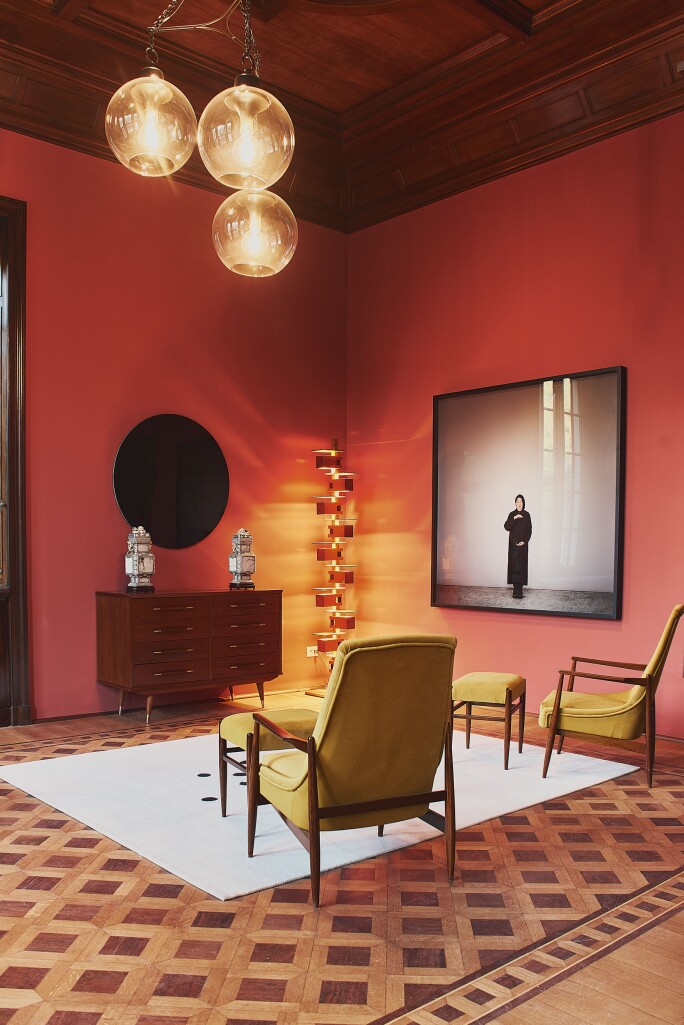
Como On In And Take A Look | The founders of Passalacqua—ranked the top hotel in Europe by the World’s 50 Best—and its sister property, the Grand Hotel Tremezzo, have added to their Lake Como mini-empire: Casabianca is a new art space from Paolo and Antonella De Santis, featuring the couple’s collection of modern and contemporary works amassed over the past 40 years. Set in a 1930s marble-clad townhouse, the three-floor gallery displays pieces by artists like Vanessa Beecroft, Marina Abramović and William Kentridge in a home-like setting full of mid-century furnishings. A wiry Anselm Kiefer sculpture stands against windows framing striking views of the surrounding hillsides, while Alfredo Jaar’s neon “Si ballava e ancora si sperava” speaks of dancing and hope from the wall of a chic living-room area. Arte povera in particular and the last half-century of Italian art more generally are well represented in works by Alighiero Boetti, Jannis Kounellis and Michelangelo Pistoletto. The De Santises curated Casabianca themselves, with the idea of changing things up frequently and inviting guest exhibitions. On the ground floor is an outpost of the Milan bakery Cova, where works on paper by MarioMerz hang above the dining tables, and for those looking to experience the famous De Santis hospitality, three guest suites will open on the top floor, just in time for the summer season.casabiancacomo.com/it
Haute Tote | With a silhouette that recalls a cinched waist, Givenchy’s new Snatch Bag lives up to its name. Created by designer Sarah Burton, it comes in three sizes and a variety of shades. The Snatch Bag, Givenchy by Sarah Burton, $3,150; givenchy.com.
Silver Linings | When Peter Marino first started collecting Tiffany & Co. silver in the 1980s, it most certainly wasn’t in style. But the architect, known for working with the world’s top fashion brands, doesn’t really care if things are fashionable. If anything, that just adds to the appeal, he explains in the new book, “Tiffany Silver: The Peter Marino Collection” (Phaidon). He found that the Aesthetic movement silver had all the hallmarks of great art: endless fascination, revelations of truth and expert craftsmanship. His holdings, which are particularly deep in examples of Japanese-inspired designs, run from a tray overlaid with a larger-than-life spider and its web to a jardiniere dotted with baby turtles, demonstrating the natural-world synchronicity and technical prowess of Tiffany’s 19th-century silversmiths. In a full-circle moment, after Marino created Tiffany & Co.’s New York flagship in 2023, he was able to display his collection there. $275; available March 25; phaidon.com
Fresh Takes
Photo: Clement Pascal.
Next Steps |Dance Reflections by Van Cleef & Arpels brings 20 dynamic performances, including nine U.S. premieres, to New York this winter. The festival, which runs across multiple venues from February 19 through March 21, was created in 2020 by the French jewelry house to support contemporary dance around the world. This year’s New York program presents works by renowned choreographers such as Benjamin Millepied and Trisha Brown, as well as by up-and-comers like Soa Ratsifandrihana and Noé Soulier; it also features more than 20 workshops open to all levels. Dance Reflections has its roots in Van Cleef & Arpels history: a member of its founding family, Louis Arpels, was an avid balletgoer, inspiring the creation, in the 1940s, of the iconic ballerina clip—part of the company’s DNA ever since.
Going for Gold |In addition to her day job as a womenswear director at Prada, Ilaria Icardi designs jewelry for her namesake line. Her latest offering, Series 05, draws on ’70s vibes and her own family histories. The 18-karat gold “Otto” ring, with carnelian and diamond, $5,690; ilariaicardi.com.
World Building |A forthcoming book traces the career of architect Kulapat Yantrasast and his firm, WHY, known for its innovative museum projects across the globe. “Why WHY? Where Architecture Loves People,” $62; hatjecantz.com.
Grand Tour
When In Venice | This May, the world’s oldest and most prestigious art biennale returns for its 61st edition with “In Minor Keys,” honoring the vision of the late curator Koyo Kouoh. Beyond the central exhibition, Venice comes alive with openings, events, and surprises around every canal.—James Haldane
Photo: Sasha Feldman. Courtesy of Indagare
INDAGARE Masked Marvels
Collectors with a taste for la dolce vita, take note. Sotheby’s and Indagare present a new Insider Journey to Venice, September 24-27—four days exploring Biennale highlights and the secrets of La Serenissima. Sotheby’s expert Lorenzo Rebecchini will guide an intimate group through top pavilions, the Peggy Guggenheim Collection and AMA Venezia, including time with its founder, Laurent Asscher. With the storied Gritti Palace as your base, overlooking the Grand Canal and Santa Maria della Salute, expect Venetian splendor expertly unlocked.
Courtesy of Laguna-B
LAGUNA-B Masters of Murano
Laguna-B fuses centuries-old glassmaking knowledge with contemporary design under the vision of its art director, Venice-raised Marcantonio Brandolini d’Adda, continuing the studio that his mother founded in 1994. The brand will unveil installations at its Dorsoduro concept store, where visitors can experience the ritual of drinking from its distinctive vessels firsthand.
Photo: Dahlia Dandashi. Courtesy of National Pavilion UAE
UAE PAVILION Landscape Artist
The UAE has chosen Bana Kattan, curator and associate head of exhibitions at the eagerly awaited Guggenheim Abu Dhabi, designed by the late Frank Gehry, to lead its 15th Venice Biennale appearance. Born in Abu Dhabi and seasoned in Chicago, Kattan is crafting a showcase that, in her words, “reflects the UAE’s vibrant artistic landscape while engaging with broader histories, complexities and conversations.”
Photo: Yu Jieyu
MARINA ABRAMOVIĆ Past & Present
Marina Abramović will make history as the first woman honored with a major exhibition at the Gallerie dell’Accademia, marking her 80th birthday. “Transforming Energy” presents early performances alongside new works, exploring endurance, vulnerability and transcendence. Reflecting on her first encounter with Venice at 14, she remembers stepping off the train from Belgrade, weeping at the city’s incomparable splendor: “It was so incredibly beautiful—unlike anything I had ever seen.”
Once a docent at the Hong Kong Pavilion, the late Chinese-Canadian painter returns to Venice posthumously with “Matthew Wong: Interiors,” a solo exhibition at Palazzo Tiepolo Passi. Presenting some 35 rarely seen and never-before-exhibited works, curated by his former mentor, gallerist John Cheim, the show underscores Venice’s enduring influence on Wong’s celebrated synthesis of color, space and form.
Photo: Camilla Glorioso
FONDAZIONE DRIES VAN NOTEN
Palazzo Appreciation
Fondazione Dries Van Noten opens in April within the ornate rococo interiors of 15th-century Palazzo Pisani Moretta. Conceived by Dries Van Noten and his partner, Patrick Vangheluwe, the foundation celebrates craftsmanship across art, fashion and design. According to Van Noten and Vangheluwe, the palazzo was chosen “not as a monument frozen in time, but as a stage for creativity.”