
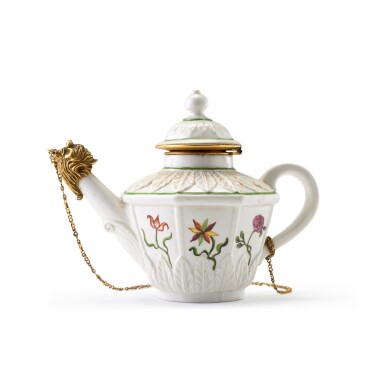
A Vezzi porcelain gilt-bronze-mounted teapot and cover, circa 1725
Auction Closed
September 25, 05:46 PM GMT
Estimate
30,000 - 50,000 EUR
Lot Details
Description
of octagonal form with moulded oval medallion below the spout, applied with bands of acanthus leaves above and below moulded panels each painted with a polychrome flower sprig, with gilt-bronze-mounted hinged domed cover, the spout with a grotesque-mask mount with stopper and chain, iron-red enamel Ve. and incised 16f
13 cm, 5 1/8 in. high
This work is accompanied by an Export License. We suggest contacting shipping.milan@sothebys.com for additional details on procedures and timing.
Skinner Boston, 8 January 2011, lot 632.
In 1720, the first porcelain factory in Italy, and the third in Europe, to produce “true” (hard paste) porcelain was founded in Venice by nobleman Giovanni Vezzi (1686-1746), aided financially by his father, Francesco (1651-1740). It followed the earlier foundations laid by Augustus the Strong (1670-1733) at Meissen just outside of Dresden in 1710, and by Claudius Innocentius Du Paquier (1679-1751) in Vienna in 1718. In this venture, the young Giovanni Vezzi managed to tempt skilled workers from northern Europe to join him, among them the former goldsmith Christoph Conrad Hunger who came from Vienna and worked at the Vezzi factory until 1724. In its all too brief lifespan the factory was able to produce some of the most distinctive objects among the early European factories, and in ways challenged the dominance of Meissen and Du Paquier. Despite producing high quality objects, the factory faced significant financial difficulties and was not a commercial success. It lasted just seven years before being forced to close in 1727.
Octagonal teapots of this highly Baroque form were influenced by contemporary porcelains produced at Meissen and particularly Du Paquier, which in turn imitated silver forms. Certainly, the stiff acanthus leaf borders appear to be derived from Meissen models by Johann Jacob Irminger. The feature of an oval medallion seen at the base of the spout on the present teapot is perhaps unique among the surviving Vezzi teapots of this shape. A octagonal teapot, painted with similar stylized flower sprigs, formerly in the Vercellotti Collection, sold at Sotheby’s, London, 25 October 1977, lot 173 and again, 18 October 1988, lot 376, illustrated in L. Melegati, Giovanni Vezzi e le sue porcellane, Milan 1998, pp. 86-89, no. 19; N. Barbantini, Le Porcellane di Venezia e delle Nove, exhibition catalogue, Venice 1936, tav. XIV, fig. 45. A second teapot with sprigs, in a Venetian private collection, is illustrated in Melagati, op.cit., no. 20; and Barbantini, op.cit., no. 47. A third octagonal teapot painted with stylized flower sprigs is in the Sanseverino Collection and was most recently published in the collection catalogue by G. de Girolamo, et al., Arte e Porcellane Europee nella Collezione Vimercati Sanseverino, Livorno 2025, pp. 244-45, cat. no. 55. Another, with purple flower flower sprigs a geometric border around the shoulder was sold Christie's, London, 25 April 2017, lot 83 and is published by A. Agliano, et. al, Brittle Beauty, Reflections on 18th-century European Porcelain, London, 2023, p. 152, cat. no. 20.
Ten years after the Venice closure, in 1737, the Marchese Carlo Andrea Ginori (1702-57) established porcelain works in Sesto Fiorentino on the outskirts of Florence, which became the fourth site to successfully produce true porcelain in Europe.
You May Also Like


