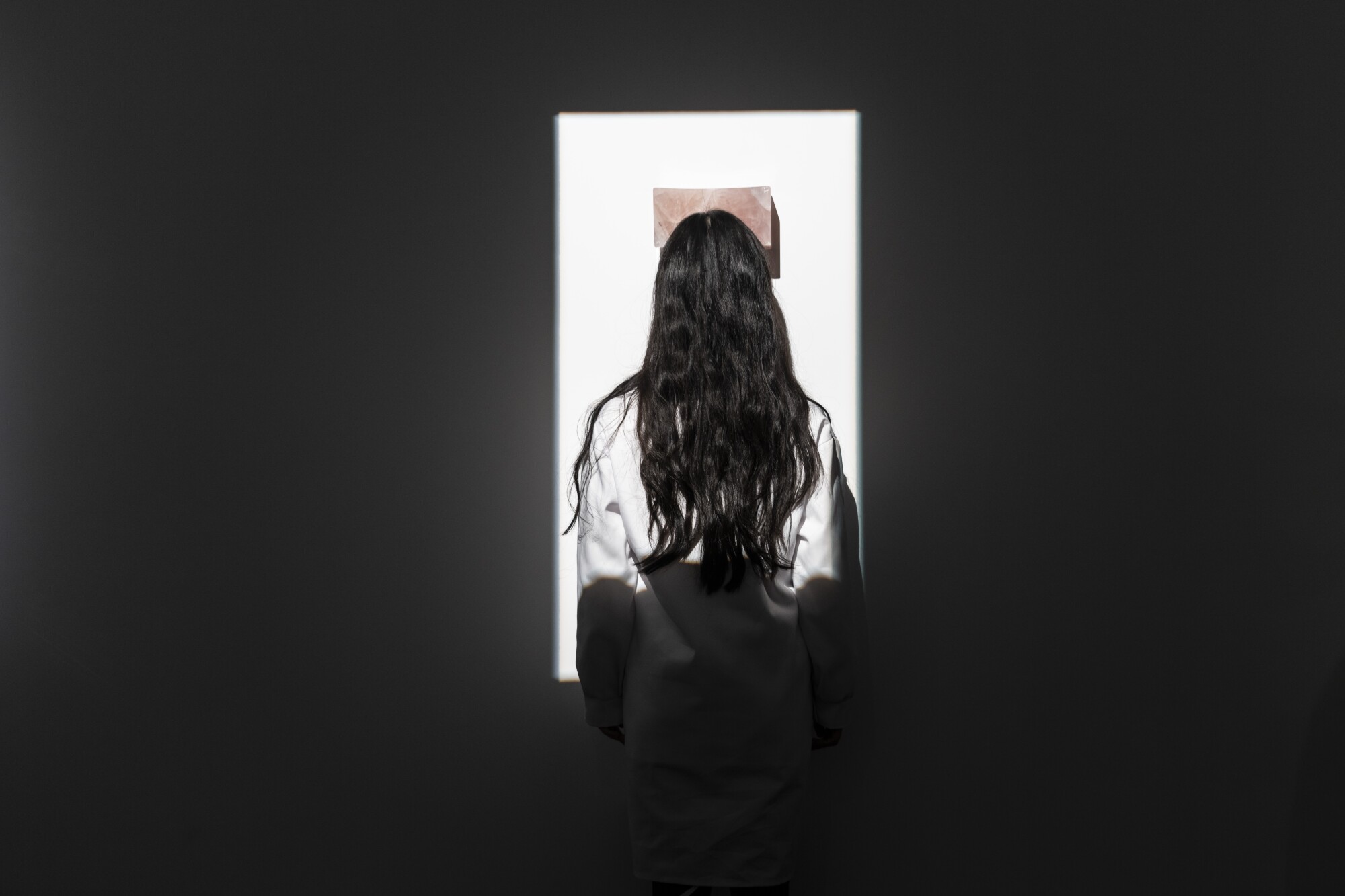
With so much opening alongside the 61st Venice Biennale, the city becomes an exhibition unto itself.
O
n a table in Marina Abramović’s six-hour-long durational performance “Rhythm 0” (1974), 72 objects — including a knife, gun, scissors, chain and lipstick — were arranged for audience members to use, without consequence, on a motionless Abramović. The shocking performance, of total surrender to a public that grew increasingly violent, is among the seminal pieces that join historic and new works in the Serbian performance artist’s exhibition “Transforming Energy” (6 May–19 October), opening at the Galleria dell'Accademia in Venice alongside the Venice Biennale.
First shown at the Museum of Modern Art in Shanghai (MAM), the exhibition is already being lauded as historic — the first devoted to a living woman artist at the prestigious Venice institution — as well as timely, coinciding with Abramović’s 80th birthday. It might also quietly echo the biennale’s theme, “In Minor Keys.” Conceived by the late curator Koyo Kouoh and presented posthumously, its philosophical grounding is rich and introspective. “Through a visual and meditative procession,” Kouoh wrote in her curatorial statement, “the exhibition prompts all senses to interconnect and meander from one universe to the other, rendering visible the possibilities that reside in the in-between spaces and beyond the portals.”
“Transforming Energy” by Marina Abramović at Modern Art Museum (MAM) Shanghai. Photod by Yu Jieyu
Much of Abramović’s career output is what Kouoh described as “sequences of exhilarating journeys that address the sensate and the affective, inviting visitors to marvel, meditate, dream, revel, reflect, and commune in realms…” Among those on view, her transitory objects, the crystal- or geode-studded beds and other structures arranged for interaction and “energy transmission,” ask for moments of immersion. Throughout the museum, Abramović’s works are being displayed alongside their collection of Renaissance masterpieces — such as her “Pietà (with Ulay)” (1983), a modern interpretation of the lamentation scene with Abramović-as-Virgin in a blood-red dress, shown with Titian’s own unfinished treatment of the theme, his final painting c.1575–76.
The conversation with art history continues across the city. “Jenny Saville a Ca’ Pesaro” (through 22 November) will see the British artist showcasing approximately 30 paintings from across her career, beginning in the 1990s. Saville’s radically frank treatment of the body has notably engaged with past masters — from Egon Schiele, Pablo Picasso and Cy Twombly to Michelangelo, Titian and Giorgione — references she metabolizes through her own inventive style. Early monumental nudes like “Propped” (1992) and “Hybrid” (1997) open the show, while the final room debuts a new series of paintings inspired by Venice and the works of its famed colorist, Titian.
Another artist working in the figurative tradition is the Russian-born, New York-based Sanya Kantarovsky, whose exhibition “Basic Failure” (6 May–22 November) opens at L’Istituto Veneto di Scienze, Lettere ed Arti, Palazzo Loredan in the San Marco district.A multimedia artist who often centers painting, Kantarovsky makes hauntingly spiritual and strangely disquieting works inflected with a mordant humor — the kind rooted in Soviet satire and Eastern European literature. His distinctive style draws fluidly on the history of painting to create archetypal subjects that are at once detached and pleading, delicate and macabre, alluring and uncomfortable. In Venice, Kantarovsky engages the historic spaces of the palazzo with site-specific interventions and unveils a new body of work comprising paintings, ceramic works and a sculpture made in collaboration with a Murano glass studio.
Erwin Wurm is equally attuned to Venice’s storied surroundings, bringing his radically expanded concept of sculpture to Palazzo Fortuny for the artist’s first monographic exhibition in the city. “Erwin Wurm” (6 May–22 November) displays celebrated “One Minute Sculptures” — ephemeral performances activated by visitors according to written instructions — and the whimsical “Substitutes” series, in which garments stripped of the human form become monuments to absence. Throughout, Wurm’s work communes with the palazzo itself, once the home and creative laboratory of the brilliant polymath Mariano Fortuny.
At Fondazione Bevilacqua La Masa, meanwhile, fans of Picasso can see his still lifes go on view alongside those by the Italian modernist Giorgio Morandi and contemporary Italian artist Claudio Parmiggiani, known for shadowy but radiant “displacements” created using smoke and soot, in “Picasso, Morandi, Parmiggiani: Still Lifes”(7 May–25 July).
Artistic dialogues continue beyond links to the great masters. At Fondazione Prada’s Ca’ Corner della Regina site, “Helter Skelter: Arthur Jafa and Richard Prince” (9 May–23 November) unites the two American artists in an exhibition curated by Nancy Spector. Defined by a shared sense of lawlessness and an affinity for appropriation, their works draw from the vast image bank of popular culture for a conversation that unfolds as an unflinching indictment of America.
For a more Venice-centric focus, “1948-1958 Murano Glass and the Venice Biennale” (19 April–22 November) is the third in a series of exhibitions charting the history of Venice’s famed Murano glass at the biennale itself. On view at Le Stanze del Vetro, a joint initiative between Fondazione Giorgio Cini and Pentagram Stiftung located in a former boarding school on the island of San Giorgio Maggiore, the exhibition presents an especially creative decade of glassmaking defined by experimentation with intense colors and rigorous shapes.
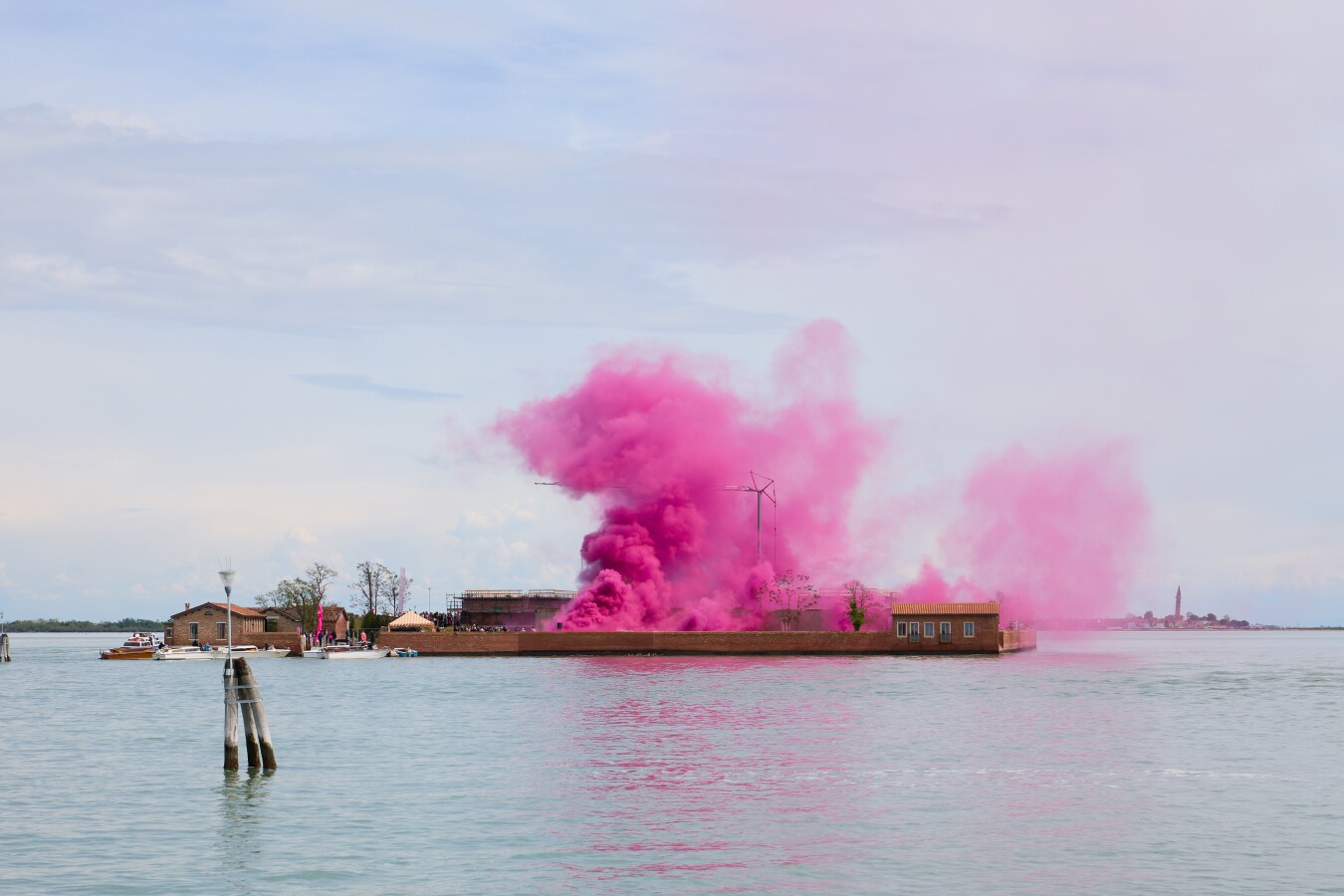
Installation view of Eun-Me Ahn, “Pinky Pinky ‘Good’” on the island of San Giacomo, 2024, which opens in May as the Fondazione Sandretto Re Rebaudengo Venice, a contemporary art center. Courtesy Fondazione Sandretto Re Rebaudengo
Biennale traffic usually makes for fertile ground for openings. The long-awaited Fondazione Sandretto Re Rebaudengo Venice, the third venue by the Italian art collector Patrizia Sandretto Re Rebaudengo, sees the once-abandoned Isola di San Giacomo, in Venice’s northern lagoon, reemerge as a cultural hub with a focus on ecological reflection. It opens with a solo exhibition on the British artist Matt Copson, highlights from Patrizia’s collection, and a series of permanent outdoor installations that include a newly commissioned full-scale skewed brick chapel by Hugh Hayden (7 May).
Fondazione Dries Van Noten, the new cultural initiative from the Belgian fashion designer who semi-retired in 2024, opens this April in the Palazzo Pisani Moretta, a 15th-century building famed for its Rococo decorations by Giambattista Tiepolo and others. Dedicated to art and craftsmanship, the foundation launches with “The Only True Protest Is Beauty” (25 April–4 October), an exhibition which takes its name from a song by the 1960s political activist Phil Ochs. It explores beauty as a charged encounter through multimedia works that include archival fashions by Comme des Garçons and Christian Lacroix, jewelry, sculptures by Peter Buggenhout, textile works and design, accompanied by behind-the-scenes videos with the creators that document their artistic processes.
“The Only True Protest Is Beauty” at Fondazione Dries Van Noten enters conversation with the decorative language of Palazzo Pisani Moretta. Photo by Camilla Glorioso
The not-for-profit Parasol unit foundation for contemporary art relaunches after a two-year hiatus. Founded in 2004 by Dr Ziba Ardalan, the art institution closed its London gallery and reemerges internationally with “TURANDOT: To the Daughters of the East” (9 May–31 October), a group exhibition featuring eleven female artists from Central Asia and wider regions of the East. Video works, installations, sculpture, painting and spoken word by artists including Lida Abdul, Hera Büyüktașcıyan and Mona Hatoum honor the voice of Turandot, the cross-cultural mythological figure who first appeared in 12th-century Persian literature.
Other institutions are also returning for their second year. The Nicoletta Fiorucci Foundation — an evolution of the Fiorucci Art Trust, which the Italian collector Nicoletta Fiorucci founded in 2010 — opened its Venice space in Dorsoduro last year, adding to its London base. It will show “5 Works” (5 May–22 November), a solo exhibition by the conceptual artist Lydia Ourahmane, who recently completed a residency at the foundation. Engaging with the community association Poveglia per tutti (Poveglia for all) — a group transforming the island of Poveglia into a public park — Ourahmane has designed a fully functioning pier that will join the island.
AMA Venezia, the exhibition space opened in 2025 by the collector and philanthropist Laurent Asscher, presents “AURA” (5 May–22 November) a group exhibition addressing themes of presence, intensity, materiality and perception. Drawn from the AMA’s collection, the presentation includes a monumental new painting by Jenny Saville — the British artist’s largest to date — a major work by Ed Ruscha inspired by his time in Venice, California, and a live experience by British-born German artist Tino Sehgal, first staged in Nantes in 2002, titled “Kiss (Clean Version).”
Two exhibitions launch concurrently at the San Marco Art Center (SMAC), opened last year in the historic Procuratie Vecchie that frames Saint Mark’s Square. “Alighiero Boetti” (7 May–22 November) explores 25 years of the Italian post-war master through his interest in duality, systems and process. Early self-portraits give way to his famous embroidered maps, and series devoted to planes and calendar dates. “Lee Ufan” (9 May–22 November), presented by Dia Art Foundation, showcases new and historical works spanning seven decades of the South Korean artist’s singular engagement with space and time, including a new site-specific commission.
Anish Kapoor will present “Anish Kapoor: Palazzo Manfrin” (6 May–9 August), opening his 16th-century building in Cannaregio — the site of the foundation the artist launched in 2022 — to the public for the second time. Considering his practice in terms of architectural grandeur, Kapoor will present models and sculptures from the past 50 years — both realized and unrealized — that testify to his monumental engagement with space. A new iteration of “At the Edge of the World” (1998), his seminal suspended dome in two editions, trades its intense red hue for black pigment in an 8-meter diameter reprisal. That black, conferring a sense of infinity or the void, also defines “Descent into Limbo” (1992), scheduled to remain at the foundation permanently following the exhibition, and his Vantablack sculptures, made with his patented nanotube pigment that absorbs light to a hauntingly absolutist effect. New works will include a small room conceived as an immersive painting, viewable from the threshold.
If the interiors of Palazzo Pisani Moretta are not enough of the magic of Tiepolo, the Scuola Grande dei Carmini, home to nine ceiling canvases by the graceful master, takes him into the 21st century. In “The Seven Celestial Spheres” (May–September), the institution’s first contemporary art project, Franco-Hungarian artist Anna Peter Breton displays monumental canvases in dialogue with panels by Tiepolo. Seven diptychs take inspiration from ancient and medieval cosmologies, each focused on a specific planet and a corresponding human virtue and chromatic tone. These are built up with thin, translucent layers of color, conferring a luminous, expansive property to the portal-like panels arranged in niches and existing building architecture.
These colorful expanses invite contemplation, as do the poignant interior scenes by the self-taught Chinese-Canadian painter Matthew Wong, who died by suicide in 2019 at the age of 35. In his bright, seven-year career, Wong captured the attention of the art world, particularly with his rhythmic landscapes. “Matthew Wong: Interiors” (6 May–1 November) at Palazzo Tiepolo Passi debuts rarely seen and previously unexhibited paintings and works on paper depicting domestic spaces. Organized by the Matthew Wong Foundation established by the artist’s parents in 2020, it follows the opening of a new headquarters for Wong’s archive last autumn, which includes exhibition space and a scholarly study center.
At Berggruen Arts & Culture, Venice’s major new space dedicated to contemporary art — opened in 2024 in Palazzo Diedo, an 18th-century mansion in the Cannaregio district — “Unfinished” (4 May–22 November) pays tribute to the late British artist Ceal Floyer who passed away in December 2025. The conceptual artist rose to prominence with inventive films and installations using familiar objects like light bulbs, slide projectors, drains, receipts, and umbrellas that incorporated humor and the absurd in the everyday. It is being shown alongside “Strange Rules” (4 May–22 November), an interdisciplinary project focusing on Protocol Art — an approach using digital networks and infrastructure that treats the blockchain as a medium.
A more process-oriented approach to digital technologies emerges in David Salle’s first solo exhibition in Venice. At Palazzo Cini,“Painting in the Present Tense” (6 May–27 September) sees the American artist showing a series of paintings developed using a custom AI model he began experimenting with in 2022. Trained on his early “Tapestry Paintings,” from 1990–91, the model produces deformed abstractions printed on canvas that Salle then hand-alters — a move that feels highly reminiscent of the master studio practices defined by classical artists like Rubens. By contrast, “Georg Baselitz. Eroi d’Oro” (6 May–27 September) at Fondazione Giorgio Cini on the Island of San Giorgio Maggiore, offers a more classically embodied experience, presenting an exhibition of new, large-scale figurative paintings on a golden-hued ground overlaid with colored impasto.
Outdoors, Studio DRIFT reprises its “Shy Society” series, last displayed in the courtyard of Florence’s Palazzo Strozzi in 2024. Here in Venice, the floating, floral-like constellation of light sculptures will be installed on the facade of Palazzo Balbi between the Peggy Guggenheim Collection and the historic Ponte dell’Accademia on the Grand Canal (3–10 May). Carefully choreographed to open and close, the diaphanous silk pendants serve as a contemplative emblem announcing the biennale’s anticipated arrival in Venice.
Lead image: On view in “The Only Protest Is Beauty” at Fondazione Dries Van Noten: Comme des Garçons, Collection Spring/Summer 2025, headpiece by Julien d'Ys. Courtesy of Comme des Garçons; Christian Lacroix, Haute Couture Fall/Winter 2004, wig by Fabio Petri. Courtesy of Christian Lacroix, STL group; Kate MccGwire, “STIFLE,” 2008. Private collector. Photo by Matteo de Mayda, courtesy Fondazione Dries Van Noten