How Louis Vuitton Turned Trunks Into Status Symbols
How Louis Vuitton Turned Trunks Into Status Symbols
By
Lilah Ramzi-Goetteman| Jun 19, 2026
As part of Luxury Week at Sotheby’s New York, a unique sale featured a selection of antique and vintage Louis Vuitton trunks and luggage—here’s how they became an enduring marker of elegance and style.
As part of Luxury Week at Sotheby’s New York, a unique sale featured a selection of antique and vintage Louis Vuitton trunks and luggage—here’s how they became an enduring marker of elegance and style.
L
ong before the “LV” monogram became one of the most recognizable motifs in fashion (before Marc Jacobs enlisted artistic interventions from Takashi Murakami and Stephen Sprouse and before Virgil Abloh introduced a generation raised on streetwear to the rituals of French luxury), Louis Vuitton was a maker of trunks.
A close up of the interior of Monogram Canvas Malle Armoire 110 Brass Hardware. Lot sold $24,320.
That story begins, fittingly, with a woman whose wardrobe helped shape an era: Empress Eugénie. She was among the notable patrons of the couturier Charles Frederick Worth and set the trends for fashionable women from Paris to St. Petersburg. As her powdery-hued, style-forward portraits circulated, her gowns inspired imitation the world over. Keeping such a collection in motion required its own choreography, and among the young men helping orchestrate it? Monsieur Louis Vuitton.
When, in 1854, he opened his own workshop on Rue Neuve-des-Capucines, travel itself was modernizing—railways were shrinking travel times and steamships were making jaunts across the pond faster and more frequent. A new generation of Victorians developed a growing wanderlust for grand tours throughout Europe and passages to the new world via oceanliners—and their ubiquitous rounded-top trunks engineered to shed rainwater suddenly revealed themselves as cumbersome and poorly suited for such excursions.
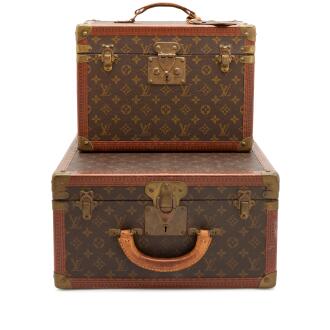
Set of Two Vintage Monogram Canvas Pharmacie Case Brass Hardware and Vintage Monogram Canvas Small Square Case Brass Hardware. Lot sold $2,816.
Vuitton's solution was simple: he devised a flat-topped trunk covered in lightweight waterproof Trianon canvas (a new fabric of his own invention). Unlike its rounded predecessors, the trunks could be stacked efficiently aboard trains and steamships, resisted moisture, and weighed considerably less than traditional leather and wood luggage. Luxury travelers could pack more into their trunks and stack them as tall as a story.
The success of Vuitton’s trunk design was immediate—but imitation followed swiftly. To distinguish themselves, the house developed striped canvases in the 1870s, followed by the famed Damier check (which is still in commission) in 1888. By 1896, Georges Vuitton—Louis's son—had developed the Monogram canvas, scattering the LV initials among stylized flowers, quatrefoils, and diamond-shaped stars. Intended to be instantly recognizable and difficult to imitate, the design transformed a practical anti-counterfeiting measure into one of fashion's most enduring symbols. One of fashion's most famous logos emerged not as a marketing exercise but as a form of self-defense.
Vintage Ebene Damier Canvas Malle Courrier 80 Brass Hardware. Lot sold $3,584.
The technical innovations and family history are fascinating enough, but the real pleasure lies in the special commissions that ensued. In 1927, Gaston-Louis Vuitton—Louis's grandson and perhaps the most imaginative member of the dynasty—created a Library Trunk for Ernest Hemingway. Covered in monogram canvas, it opened to reveal shelves secured by leather straps, drawers for correspondence, compartments for manuscripts, and space for a portable typewriter. It was less a piece of luggage than a traveling study—and demand surged.
A tea trunk was commissioned by Maharaja Sayajirao Gaekwad III of Baroda, who refused to forgo a proper tea service while on hunting expeditions. Prince Youssef Kamal of Egypt ordered an elaborate picnic trunk fitted for outdoor entertaining.
Not every commission, however, belonged to royalty. For the 1925 Croisière Noire expedition—French automobile maker Citroën's audacious attempt to drive a convoy of automobiles across the African continent—the maison devised a suite of rugged travel trunks, including one that unfolded into a camp bed and others fitted to withstand dust, heat, and months of travel.
In a 1937 profile for Vogue, Cecil Beaton described Wallis Simpson as being "as compact as a Vuitton travelling-case." It was a curious comparison in a story that had nothing whatsoever to do with travel, but Beaton knew precisely what he was doing. By then, a Louis Vuitton trunk signified a particular kind of person: streamlined, organized, cosmopolitan, and prepared for any eventuality. One imagines the Duchess of Windsor herself appreciating the compliment.
Vintage Ebene Damier Canvas Malle Courrier 80 Brass Hardware. Lot sold $3,584.
The following year, the house even turned its attention to a rather smaller clientele, crafting pink silk-lined trunks for the dolls of Princess Elizabeth and Princess Margaret.
By the end of the century, the same spirit of customization had found new expression. In 1996, Helmut Lang designed a Vuitton DJ box sized precisely for vinyl records. In the early 2000s, Vuitton created a traveling hair salon—complete with mirrors, combs, wig stands, and even a folding stool—for the celebrated hairstylist John Nollet. More recently, the house has produced trunks for everything from Formula One trophies and World Cup timepieces to portable cocktail bars complete with glassware, an ice bucket, and even a mirrored disco ball. The archive moves effortlessly between aristocratic indulgence and practical ingenuity.
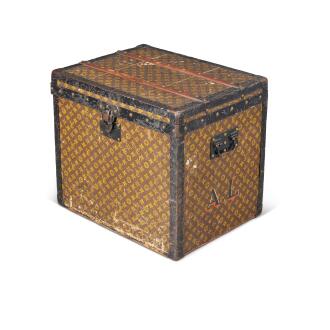
Vintage Monogram Canvas Wardrobe Trunk Brass Hardware. Lot sold $1,664.
It also reads like a social history of the twentieth century. Lauren Bacall traveled with a coordinated set comprising a hat-and-shoe trunk and matching vanity case, each trimmed in honey-colored leather and designed to stack neatly atop one another. The American businesswoman and art collector, Marjorie Merriweather Post possessed trunks featuring broad blue-and-yellow racing stripes interrupted by enormous painted initials—P—making them instantly recognizable from across a railway platform or steamship deck.
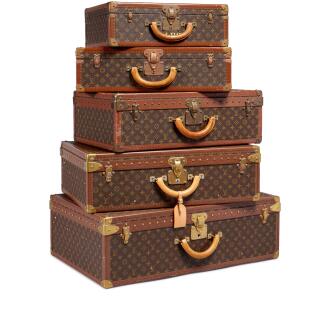
Set of Two Fawn Epi Leather Alzer 70 Trunk Brass Hardware and Vintage Ebene Damier Canvas Alzer 75 Trunk Brass Hardware. Lot sold $4,480.
Vuitton trunks had become such potent symbols of glamour and mobility that they began making regular appearances on the silver screen. In Charade (1963), Audrey Hepburn's character drags Vuitton luggage through a whirlwind of Parisian hotels. Years earlier, in Hepburn’s turn in Billy Wilder's Love in the Afternoon (1957), the lovesick ingenu skulks in the hallways of the Ritz Paris which are lined with cases emblazoned with LV. In the 1958 comedy Paris Holiday, Anita Ekberg’s character infiltrates Bob Hope’s hotel room and hides behind an assortment of Vuitton travel wares. Decades later, Wes Anderson commissioned a set of custom Vuitton cases for The Darjeeling Limited (2007), decorating them with hand-painted elephants, antelopes, and palm trees.
Meanwhile, vintage Louis Vuitton trunks live a second life. A recent Sotheby's sale included cognac-colored wardrobe trunks fitted with hanging compartments, brass-cornered pharmacy cases lined for toiletries, round hatboxes designed for an age when women traveled with entire millinery wardrobes, and graphite-hued sets with chrome perfect for the man about towns.
A Louis Vuitton trunk is, on one level, simply a box. And yet for more than 170 years, it has managed to contain something far larger: the fantasy that one might pack up a life, fasten those brass locks, and set off toward somewhere marvelous.