Colored Gemstones vs Fancy Colored Diamonds: What Collectors Should Know
Compare colored gemstones and fancy colored diamonds to understand how rarity, natural color, origin and treatment shape value on the secondary market.

Color brings some of the rarest gemstones into the same collecting conversation, but it does not make them directly comparable. An exceptional ruby, sapphire or emerald may be more valuable than some fancy colored diamonds, while the rarest natural pink, blue or red diamonds can reach another level entirely. The difference lies in what creates that rarity. With colored gemstones, origin and treatment can matter enormously, as can the limited availability of exceptional material from certain deposits. Fancy colored diamonds face a different set of constraints, beginning with how infrequently certain colors occur naturally.
That difference makes broad comparisons difficult. A Burmese ruby showing no indications of heating, a Kashmir sapphire or a Colombian emerald with no clarity enhancement represents a very different form of rarity from a Fancy Vivid Blue diamond. Even within a single category, two stones of similar size can occupy dramatically different levels of the secondary market depending on their color and overall quality. Carat weight alone is not a reliable measure of rarity.
A more useful question is not whether colored gemstones or fancy colored diamonds are categorically rarer or more valuable, but what makes an individual stone exceptional within its own category. Comparing those qualities across the highest levels of the market reveals why the answer can change considerably from one gemstone to the next.
| Colored Gemstones | Fancy Colored Diamonds | |
|---|---|---|
| Rarity | Scarcity can reflect gemstone quality, treatment, origin and size, as well as limited supply from important deposits. | Rarity is closely tied to natural color, with certain hues occurring in exceptionally small quantities. |
| Color | Each gemstone has its own standards. Fine ruby, sapphire and emerald cannot be judged against one universal color scale. | Hue and intensity are central, with laboratory grades helping define the strength of natural color. |
| Origin | Geographic origin can add substantial significance, particularly for Burmese rubies, Kashmir sapphires and Colombian emeralds. | Geographic origin generally plays a smaller role, although provenance from certain sources can matter. Pink and red diamonds from the now-closed Argyle Mine, for example, can command premiums associated with their origin and limited supply. |
| Treatment | Heating and clarity enhancement are common considerations, depending on the gemstone. Exceptional stones with little or no treatment can become considerably rarer. | Natural color is fundamental; artificially treated color represents a different category. |
| Price per carat | Similar-size stones can occupy dramatically different levels of the market depending on their individual rarity and quality. | Hue and color intensity can create substantial differences in value even between diamonds of similar size. |
| How to compare them | Evaluate the stone according to the standards that define rarity within its gemstone variety. | Evaluate the rarity and quality of the natural color before making comparisons based on size or price per carat. |
There is no simple answer to whether colored gemstones are rarer than fancy colored diamonds. With ruby, sapphire and emerald, scarcity may reflect limited production from a specific deposit or the difficulty of finding exceptional natural color with little or no treatment. Size can narrow the field further. In some cases, supply from a celebrated source is now extremely limited or historic, as with Kashmir sapphires.
The White Gold, 16.21ctw Burmese Ruby and Diamond Bracelet, currently offered on Sotheby’s Buy Now marketplace, demonstrates another form of scarcity. Its 18 cushion-shaped Burmese rubies total 16.21 carats, with individual GRS reports stating that every stone shows no indications of thermal treatment. Fifteen are described as vivid red or vivid to deep red, corresponding to GRS-type “pigeon’s blood.” Finding one fine Burmese ruby with these characteristics can be difficult; assembling 18 that work convincingly together is rarer still.
Fancy colored diamonds follow a different pattern, with supply varying dramatically by hue. The Fancy Red Diamond and Diamond Ring, sold for $2M USD in December 2021, centers a diamond weighing just 1.03 carats. GIA graded it Fancy Red with natural color. Its modest size compared with many important colored gemstones shows why carat weight alone cannot be used as shorthand for rarity across the two categories.
A fine ruby may be scarcer than a fancy colored diamond from a less scarce color or quality range, while an exceptional natural red or blue diamond may be rarer than many colored gemstones. The meaningful comparison is between individual stones at comparable levels of quality and scarcity, not the two categories as a whole.
Color drives desirability across both categories, but there is no single standard for what constitutes the finest color. Ruby, sapphire and emerald each have their own benchmarks. A ruby needs sufficient saturation without becoming overly dark, while blue sapphire requires a different balance of color and brightness. With emerald, transparency becomes especially important because even an intense green can lose impact if the stone appears too included or closed. Terms such as “pigeon’s blood” or “royal blue” can provide context for qualifying stones, but they do not replace an assessment of the gemstone itself.
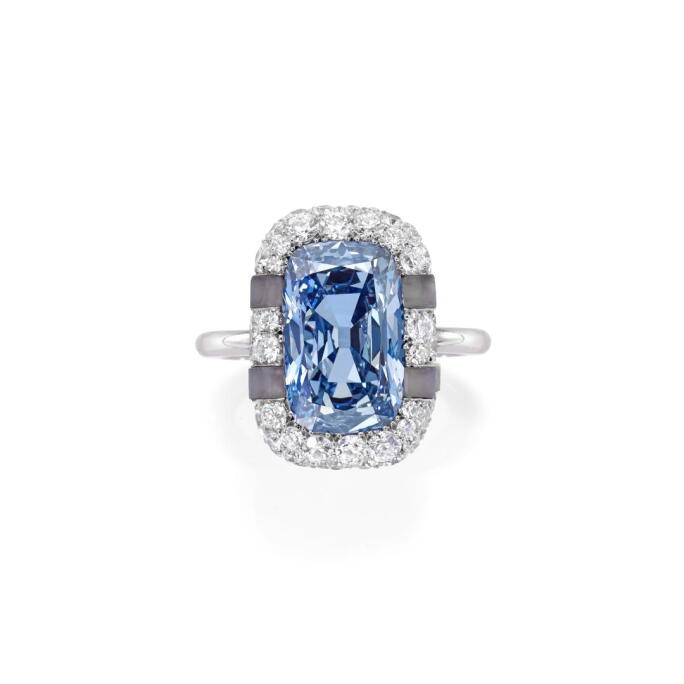
Fancy colored diamonds follow a more standardized grading system based on hue and the strength of the color. The ‘Circe’ Fancy Vivid Blue Diamond, Chalcedony and Diamond Ring, sold for 41.5M HKD in April 2022, centers a 3.27-carat diamond graded by GIA as Fancy Vivid Blue, Natural Colour and Internally Flawless. Its rare natural hue and vivid color grade place it within an exceptionally scarce area of the market.
A useful comparison comes from the 3.27-carat Fancy Vivid Orangy Pink Diamond Ring, sold for $921K USD in December 2025. GIA graded the diamond Fancy Vivid Orangy Pink, Natural color and VVS1 clarity. Despite matching the ‘Circe’ diamond in weight and sharing a Fancy Vivid grade, the two stones are fundamentally different. Hue, modifying color and the rarity of that particular color remain critical to how each diamond is evaluated.
The same principle applies when comparing diamonds with colored gemstones. An exceptional ruby cannot be ranked against a Fancy Vivid Blue diamond simply by asking which has stronger saturation. Color must be understood according to the standards and rarity of the individual gemstone.
Treatment does not mean the same thing across colored gemstones. Heating is commonly encountered in ruby and sapphire, while emeralds are frequently treated with oil or other substances to reduce the visibility of surface-reaching fissures. An untreated stone is not automatically superior, but fine natural quality with little or no treatment can substantially narrow the available supply.
The Platinum, 5.02ct Kashmir Sapphire and Diamond Ring, currently offered on Sotheby’s Buy Now marketplace, was identified by SSEF and Gübelin as Kashmir origin with no indications of heating. By contrast, the Schlumberger for Tiffany & Co. ‘Two Bees’ Emerald and Diamond Ring, sold for 254K HKD in October 2023, centers a 2.01-carat Colombian emerald that Gübelin reported as showing no indications of clarity enhancement. In each case, the finding becomes significant when paired with the quality and rarity of the gemstone itself.
Fancy colored diamonds require a different distinction: the color must be naturally occurring rather than artificially induced through treatment. A laboratory finding of Natural Colour establishes something different from “no indications of heating” for sapphire or “no indications of clarity enhancement” for emerald. The terminology is specific to each gemstone and should be interpreted within the standards of that category.
Geographic origin can carry considerable significance for colored gemstones. Kashmir sapphires, Burmese rubies and Colombian emeralds are among the best-known examples, especially when historic or limited production restricts the supply of comparable material. Origin is not a guarantee of quality, however. A Burmese ruby still needs exceptional color and overall appearance, just as a Colombian emerald is not automatically superior to a fine Zambian stone. Origin carries the most weight when it reinforces qualities already evident in the gemstone.
Fancy colored diamonds are evaluated differently. Geographic source usually carries less weight, although there are important exceptions. Pink and red diamonds from the now-closed Argyle Mine can command premiums associated with their origin and increasingly finite supply. Outside such cases, the rarity and quality of the natural color generally carry far greater weight. Origin can be central to the scarcity of a colored gemstone and occasionally distinguish a fancy colored diamond, but it does not function uniformly across the two categories.
Price per carat can describe a sale result, but it is less useful for comparing colored gemstones with fancy colored diamonds. Stones of similar weight can occupy entirely different levels of the secondary market because carat weight alone says little about the rarity or quality of the individual gemstone.
The difference can be striking even within a single variety. A Platinum, 7.87ct Ceylon Royal Blue Sapphire and Diamond Ring, currently offered on Sotheby’s Buy Now marketplace, centers a heated Ceylon sapphire described by GRS as vivid blue, or “royal blue.” By comparison, a 7.69-carat Sapphire and Diamond Ring sold for 914K CHF in 2025. With less than a quarter carat separating them, the two stones demonstrate how sharply value can diverge based on their individual characteristics.
Fancy colored diamonds present the same challenge. Hue and color intensity can create substantial differences in rarity between diamonds of similar size, just as a smaller ruby, sapphire or emerald may be far scarcer than a larger example. Price per carat is most useful in context, after the quality and rarity of the individual stone have been established.
Secondary-market demand for colored gemstones and fancy colored diamonds often centers on different forms of rarity. With colored gemstones, buyers may seek a specific combination of origin, treatment status and quality, while fancy colored diamonds are more strongly differentiated by the rarity of their natural color. In either category, signed jewelry can distinguish the jewel beyond the qualities of the stone itself.
A Graff Fancy Intense Yellow Diamond and Diamond Ring sold for 2.8M HKD in October 2022. Its 13.32-carat center diamond was graded by GIA as Fancy Intense Yellow, Natural Colour and VS2 clarity, while the Graff signature connects the stone to a house closely associated with important diamonds. Secondary-market demand is therefore less about preferring one gemstone category over another than finding stones and jewels that are difficult to replicate within their own market.
Exceptional rubies, sapphires and emeralds can command higher prices than many fancy colored diamonds when rare qualities converge in a single stone. The 13.02-carat Burmese Ruby and Diamond Ring, mounted by Carvin French, sold for $2.5M in June 2021. Multiple laboratory reports identified the ruby as Burmese with no indications of heating, while AGL noted the significance of its size above 10 carats. Its rarity came not from any one attribute, but from the combination of substantial size, important origin and desirable treatment status.
Fancy colored diamonds can reach far higher levels when exceptionally rare colors and other scarce qualities converge. But the category alone does not determine which stone is more valuable. An important colored gemstone can surpass a fancy colored diamond from a less scarce segment of that market, just as an exceptionally rare natural-color diamond can exceed even the finest ruby, sapphire or emerald.
When comparing colored gemstones with fancy colored diamonds, begin with the individual stone rather than the category. Rubies, sapphires and emeralds should be evaluated according to the qualities that define rarity within each gemstone, while fancy colored diamonds follow a different framework centered more heavily on natural color. Direct comparisons become meaningful only once those differences are understood.
The rarest examples are often those that would be exceptionally difficult to replicate, whether an unheated Burmese ruby, a fine Kashmir sapphire or a diamond displaying an extraordinarily scarce natural color. Neither colored gemstones nor fancy colored diamonds are inherently more valuable. What matters is how exceptional an individual stone is within the context of its own market.
They can be. Exceptional rubies, sapphires and emeralds can surpass many fancy colored diamonds, while the rarest natural red, blue and pink diamonds can reach significantly higher levels. Value depends on the rarity of the individual stone, not the category.
There is no category-wide answer. An unheated Burmese ruby or fine Kashmir sapphire represents a different form of scarcity from a natural red or blue diamond. Rarity is most meaningful when assessed against comparable stones within the same gemstone type.
Ruby, sapphire and emerald lead the traditional colored gemstone market. At the highest level, exceptional color must usually coincide with other scarce characteristics, which may include significant size, desirable treatment status or important geographic origin.
Fine ruby becomes disproportionately scarce at larger sizes, particularly when strong natural color and little or no treatment are maintained throughout the stone. Important Burmese examples can narrow the field further, allowing an exceptional ruby to surpass diamonds from more available fancy-color segments.
Compare rarity within each stone’s own category before comparing prices. Origin and treatment can materially distinguish colored gemstones, while the natural hue and intensity of a fancy colored diamond are central to its scarcity. Carat weight and price per carat are most useful only after those differences are understood.
Whether you're a seasoned collector or new to the world of fine jewelry, Sotheby’s offers a trusted, seamless way to buy and sell colored gemstones on the secondary market.
Trust our worldwide network of leading jewelry specialists from a globally renowned auction house established in 1744.