Ruby Jewelry: A Collector’s Guide to One of the World’s Rarest Gemstones
Explore what collectors look for in fine ruby jewelry, from Burmese and Mogok rubies to pigeon blood color, untreated stones and vintage signed jewels.
Exceptional rubies are rare for a reason: the qualities collectors prize seldom occur together. Vivid red color is fundamental, but saturation must be balanced by transparency and brightness, particularly as carat weight increases. Add little or no treatment to that equation and the pool of truly important stones becomes considerably smaller.
Geography introduces another layer of distinction. Burma, now Myanmar, has produced many of the rubies that established the historical benchmark for the category, particularly those from the celebrated mines of Mogok. Mozambique has emerged as another major source of exceptional material, while “pigeon blood” has become one of the most closely watched color descriptions at the highest end of the market. Yet experienced collectors know not to treat any single designation as a guarantee of quality. Burmese origin cannot compensate for weak color or transparency, and an untreated stone is not inherently superior to a finer ruby that has been heated.
Then there is the jewel itself. Once an exceptional ruby enters the hands of a great jeweler, gemstone rarity becomes only part of its significance. Design, period, craftsmanship and maker can materially shape desirability, particularly in vintage signed jewelry by houses such as Boucheron, Harry Winston and Tiffany & Co. Collecting ruby jewelry therefore requires two forms of connoisseurship: understanding the stone and recognizing what the finished jewel contributes to it.
| Primary quality factor | Color leads: the finest rubies combine vivid, balanced red with brightness and strong transparency. |
| Origin | Myanmar, particularly Mogok, is the historic benchmark; Mozambique is a major modern source. Origin alone does not determine quality. |
| Pigeon blood color | A prized vivid-red designation used by certain laboratories. Criteria vary, and the term describes color rather than origin. |
| Treatment | Heating is widely accepted. Fine unheated rubies become increasingly rare as quality and size rise; “unheated” does not always mean entirely untreated. |
| Size and rarity | Rarity compounds when exceptional color, transparency and minimal treatment are sustained at significant carat weights. |
| Collector perspective | Consider the complete stone and its laboratory reports. In signed or vintage jewelry, maker, design, craftsmanship and period can add further significance. |
Color remains the primary consideration in a fine ruby, but experienced collectors look beyond a simple description of “red.” Hue, tone and saturation determine whether the color appears vivid and balanced, while transparency and crystal influence how much light moves through the stone. The finest examples can possess intense saturation without becoming overly dark or opaque. Cut matters too. Because valuable ruby rough is often shaped with weight retention in mind, collectors tend to focus less on standardized proportions than on how successfully a stone presents its color, brightness and scale face-up.
Treatment status and origin can further distinguish exceptional stones. Heating has long been accepted in the ruby market, but fine rubies showing no evidence of heat become substantially rarer as size and quality increase; other treatments that alter clarity or introduce foreign substances require greater scrutiny. Origin carries particular weight for celebrated sources such as Mogok, although geography cannot compensate for mediocre quality. For significant stones, laboratory reports provide essential context by offering opinions on origin, identifying evidence of treatment and, in qualifying cases, applying color terminology such as “pigeon blood.” These findings can substantiate attributes that affect rarity and value, but they remain part of a broader assessment of the ruby itself.
The finest ruby color is not simply the darkest or most saturated red. What collectors prize is intensity without sacrificing life: a red that remains vivid and luminous rather than becoming dense, blackish or visually closed. Secondary hues can shift that impression considerably. Purple, pink or orange may be present to varying degrees, while differences in transparency and crystal can make two stones with seemingly comparable color descriptions appear markedly different when viewed side by side.
Light adds another variable. Chromium, the element responsible for ruby’s red color, can produce red fluorescence, which may heighten the apparent intensity of certain stones under ultraviolet-rich light. Cut, transparency and internal characteristics further influence how that color is returned to the eye. For this reason, experienced collectors evaluate ruby color as a face-up visual experience rather than a specification in isolation. The benchmark is not maximum saturation at any cost, but a red that combines richness, brightness and vitality.
“Pigeon blood” has become one of the most closely watched descriptions in the ruby market, referring to a particularly prized vivid red color. Historically associated with fine Burmese rubies, the designation is now applied by certain gemological laboratories to qualifying stones from multiple geographic sources. Importantly, there is no universal standard. Laboratories establish their own criteria for factors such as hue, saturation and tone, and may not always reach the same conclusion about an individual stone.
For collectors, the distinction is meaningful but should be kept in perspective. Pigeon blood describes color, not origin, and it does not override the other characteristics that determine the quality of a ruby. An unheated Burmese stone with the designation may represent an especially rare combination, but transparency, size and overall appearance still need to support it. Conversely, an exceptional ruby can fall outside a laboratory’s pigeon blood parameters and remain highly desirable.
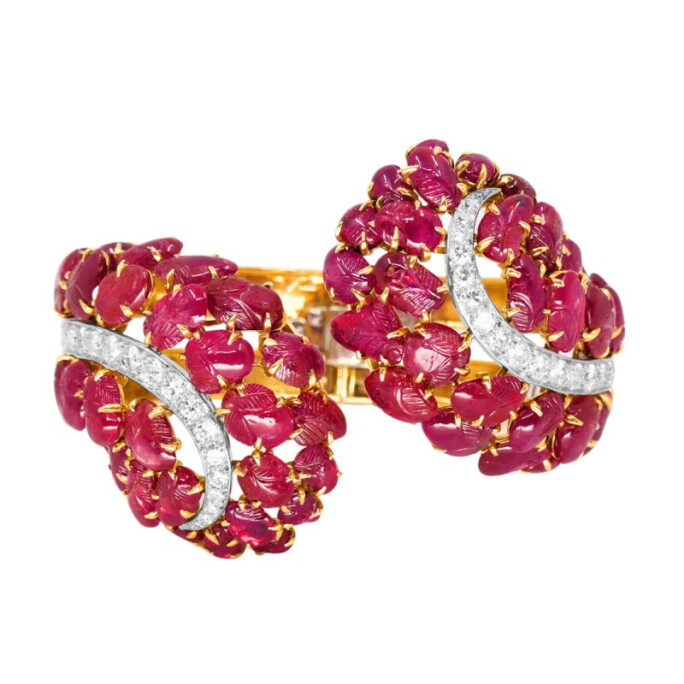
The Harry Winston Ruby and Diamond Bracelet, sold for 227K CHF in May 2022, illustrates that distinction well. SSEF determined that its rubies were Burmese with no indications of heating, with some qualifying as “Pigeon Blood” color. Those characteristics already place the stones within a notably scarce category; their presentation in a flexible, diamond-set bracelet signed Harry Winston adds another source of collector interest altogether.
Burma, now Myanmar, has shaped the historical benchmark for fine ruby more than any other source. The legendary deposits of the Mogok Stone Tract have produced stones renowned for vivid red color, strong saturation and, in exceptional examples, fluorescence that can intensify their appearance. Centuries of production have also given Burmese rubies a significance that extends beyond gemology: origin itself has become part of how collectors understand rarity, history and market importance.
That reputation requires qualification. “Burmese” identifies geographic origin, not a standard of quality, and material from Myanmar varies widely in color, transparency, size and treatment. Mogok origin can add another layer of distinction when it can be supported, but the most consequential combination remains an exceptional stone with fine color and transparency, meaningful size and no evidence of heat. A superior ruby from another source may be considerably more desirable than a lesser Burmese example.
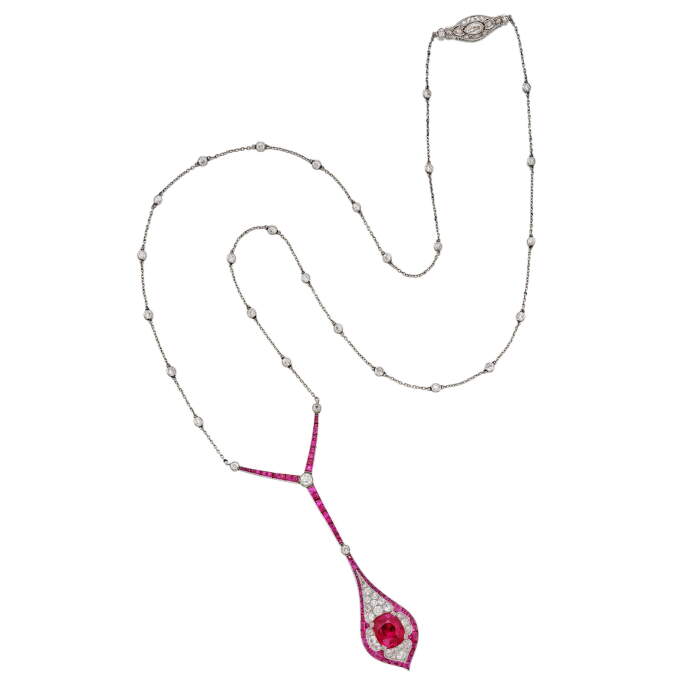
Treatment can therefore change the conversation even when origin is highly regarded. The Platinum, Gold, 79.85ctw Burmese Ruby and Diamond Necklace, currently offered on Sotheby’s Buy Now marketplace, brings together approximately 79.85 carats of oval Burmese rubies with approximately 21.18 carats of diamonds. A C. Dunaigre report identifies the rubies as Burma (Myanmar) origin and notes indications of heating. For collectors, it is a useful reminder of how an important origin should be read: as one component of a ruby’s profile, considered alongside treatment, color, transparency and the quality of the finished jewel.
Within the broader category of Burmese ruby, documented Mogok origin can carry particular significance. The historic Stone Tract has produced exceptional material for centuries, and its name has become closely associated with some of the qualities prized in fine ruby, including vivid red color and strong fluorescence. For an advanced collector, however, “Mogok” is the beginning of the assessment rather than the conclusion. The individual stone still has to justify the importance attached to its origin through color, transparency, size and overall appearance.
Treatment terminology deserves equally close attention. A White Gold, 4.02ct Burmese Ruby and Diamond Ring, currently offered on Sotheby’s Buy Now marketplace, centers an oval ruby identified by GRS as originating from Mogok, Myanmar, with no indication of thermal treatment. The same report notes clarity enhancement in fissures, described as “oiled.” That distinction is an important one: unheated and untreated are not interchangeable terms. When evaluating a significant ruby, collectors should read the complete treatment disclosure rather than allowing a desirable origin or “no heat” finding to stand in for the stone’s full gemological profile.
Heating has a long history in the ruby trade and is commonly used to improve color and, in some stones, clarity. Its presence does not prevent a ruby from being exceptional. The more revealing question is what the stone possessed naturally. When vivid color, strong transparency and substantial size occur without evidence of thermal enhancement, rarity increases considerably. That distinction becomes especially consequential as carat weight rises, since large rubies retaining fine natural color and crystal are increasingly difficult to find.
The 5.33-carat Mozambique Ruby Ring, sold for 4.3M HKD in September 2025, demonstrates how these attributes can converge. Gübelin determined that the ruby was of Mozambican origin with no indications of heating and described its color as “Crimson Red,” citing saturated, homogeneous color and a high degree of transparency. Its accompanying appendix specifically noted the rarity of encountering a ruby of this size with such transparency, color and no indications of thermal treatment. In other words, the significance lies not in “no heat” as an isolated label, but in what the stone was able to achieve without it.
Laboratory language still requires precision. “No indications of heating” addresses thermal treatment; it should not automatically be interpreted as confirmation that no other enhancement is present. For an important ruby, the complete report and any accompanying appendix can reveal considerably more than the headline treatment designation alone.
Myanmar established the historical benchmark for fine ruby, but the geography of the collector market is considerably broader today. Mozambique has become a major source of important stones, including rubies capable of combining substantial size, saturated color and strong transparency with no evidence of heating. Sri Lanka, Thailand, Vietnam, Tanzania and Madagascar have also produced ruby, although the character, quantity and quality of material vary significantly by deposit. For collectors, these origins provide context for a stone’s formation and rarity rather than a fixed hierarchy of desirability.
Mozambique is particularly important to the modern market. The White Gold, Gold, 84.62ctw Mozambique Ruby and Diamond Necklace, currently offered on Sotheby’s Buy Now marketplace, is set with 126 oval-cut Mozambique rubies totaling 84.62 carats, alongside approximately 19.85 carats of diamonds. Reports from C. Dunaigre and Gübelin state that the rubies show no indications of heating, with Gübelin describing their color as pink-red. Beyond the total carat weight, assembling 126 rubies with sufficient consistency to function as a single necklace introduces a different consideration: in multi-stone jewels, matching color and overall visual harmony can matter alongside the quality of each individual gem.
Origin ultimately becomes most meaningful when the stone supports the reputation attached to it. A Burmese pedigree cannot elevate mediocre material into an exceptional ruby, just as Mozambique origin does not place a ceiling on quality. At the collector level, the individual gemstone remains the more important judgment.
Carat weight has a nonlinear relationship with rarity in fine ruby. Larger crystals are more likely to contain fractures, inclusions, uneven color or areas that cannot be retained during cutting, so the amount of rough capable of producing a substantial finished stone with strong color and transparency diminishes quickly. Cutting introduces its own compromises. Because ruby rough can be exceptionally valuable, preserving weight may take precedence over conventional proportions, requiring collectors to judge whether a finished stone achieves an effective balance of size, color and face-up appearance.
What becomes scarce, then, is not size itself but quality sustained at size. A large ruby that remains vivid, transparent and visually lively occupies a different category from one whose carat weight comes at the expense of color or crystal. Add no indications of heating and the field narrows further. This compounding rarity explains why collectors should resist comparing important rubies by carat weight alone: as stones become larger, the survival of exceptional qualities matters more than the number on the scale.
Not categorically. Diamonds and rubies occur under different geological conditions and are evaluated through very different market frameworks, making a simple comparison of rarity misleading. Gem-quality diamonds are available across a comparatively broad range of sizes and standardized grades. Fine rubies are less uniform: color, transparency, inclusions, treatment and origin interact in ways that make exceptional stones difficult to replicate or compare directly.
The distinction becomes clearer at the uppermost level of quality. Large rubies combining vivid red color, strong transparency and no indications of heating can be extraordinarily scarce, with far fewer comparable stones available than in many categories of high-quality diamond. For collectors, that is the more meaningful comparison. Rubies as a species are not necessarily rarer than diamonds, but exceptional untreated rubies of significant size can be substantially harder to find.
Inclusions are expected in natural ruby, and their presence alone says relatively little about quality. More revealing is their effect on the stone. Fine rubies can contain readily visible inclusions yet retain excellent transparency, strong color and a lively face-up appearance. Dense concentrations of inclusions, prominent fractures or internal features that interrupt the passage of light are more consequential, particularly when they diminish transparency or create areas that appear cloudy or visually inactive. Location matters too: an inclusion beneath the table may be far more noticeable than a similar feature positioned closer to the edge of the stone.
For gemologists, inclusions can also be diagnostic. Certain internal features offer evidence of natural formation and may help establish whether a ruby has been heated, clarity enhanced or potentially associated with a particular geological source. Collectors therefore tend to think less in terms of finding a “clean” ruby and more in terms of crystal and transparency: does the stone remain open, bright and visually coherent despite its internal characteristics? In fine ruby, inclusions are part of the gemstone’s identity; their impact matters more than their mere presence.
Cutting an important ruby is often an exercise in calculated compromise. With valuable rough, maximizing brilliance according to standardized proportions may be less important than preserving weight, concentrating desirable color or removing problematic inclusions. This helps explain the prevalence of oval and cushion-shaped rubies, as well as the deeper pavilions, asymmetries and less conventional proportions sometimes encountered in significant stones. Such characteristics are not inherently shortcomings; the relevant question is what the cutter achieved with the rough available.
Collectors should pay particular attention to the relationship between carat weight and face-up presence. A deep stone may retain impressive weight while appearing smaller from above, whereas a broader cut can create greater visual scale at the same carat weight. Color distribution matters just as much. Excessive extinction can leave portions of a ruby looking dark or inactive, while an effective cut allows the red to remain vivid across the face of the stone. Once mounted, proportions, setting and surrounding diamonds can alter that impression again. The best cut is ultimately the one that makes the most of a particular ruby, not necessarily the one that conforms most closely to an ideal formula.
A remarkable ruby does not automatically make a remarkable jewel. Once the stone is set, collectors have another object to assess: who designed it, when it was made, how it was constructed and whether the finished piece represents something distinctive within the maker’s work. In signed and vintage jewelry, those considerations can carry considerable weight. A jewel may be desirable because it contains an exceptional ruby, because it is an important design, or, in the strongest examples, because both qualities reinforce one another.
The Schlumberger for Tiffany & Co. 5.94ct Mozambique Ruby and Diamond Ring, currently offered on Sotheby’s Buy Now marketplace, sits close to that intersection. Its 5.94-carat oval Mozambique ruby shows no indication of thermal treatment, giving the center stone significance in its own right. Schlumberger surrounds it with approximately 1.00 carat of diamonds in his recognizable feather motif, making the designer’s visual language integral to the identity of the ring rather than simply a setting for the gemstone.
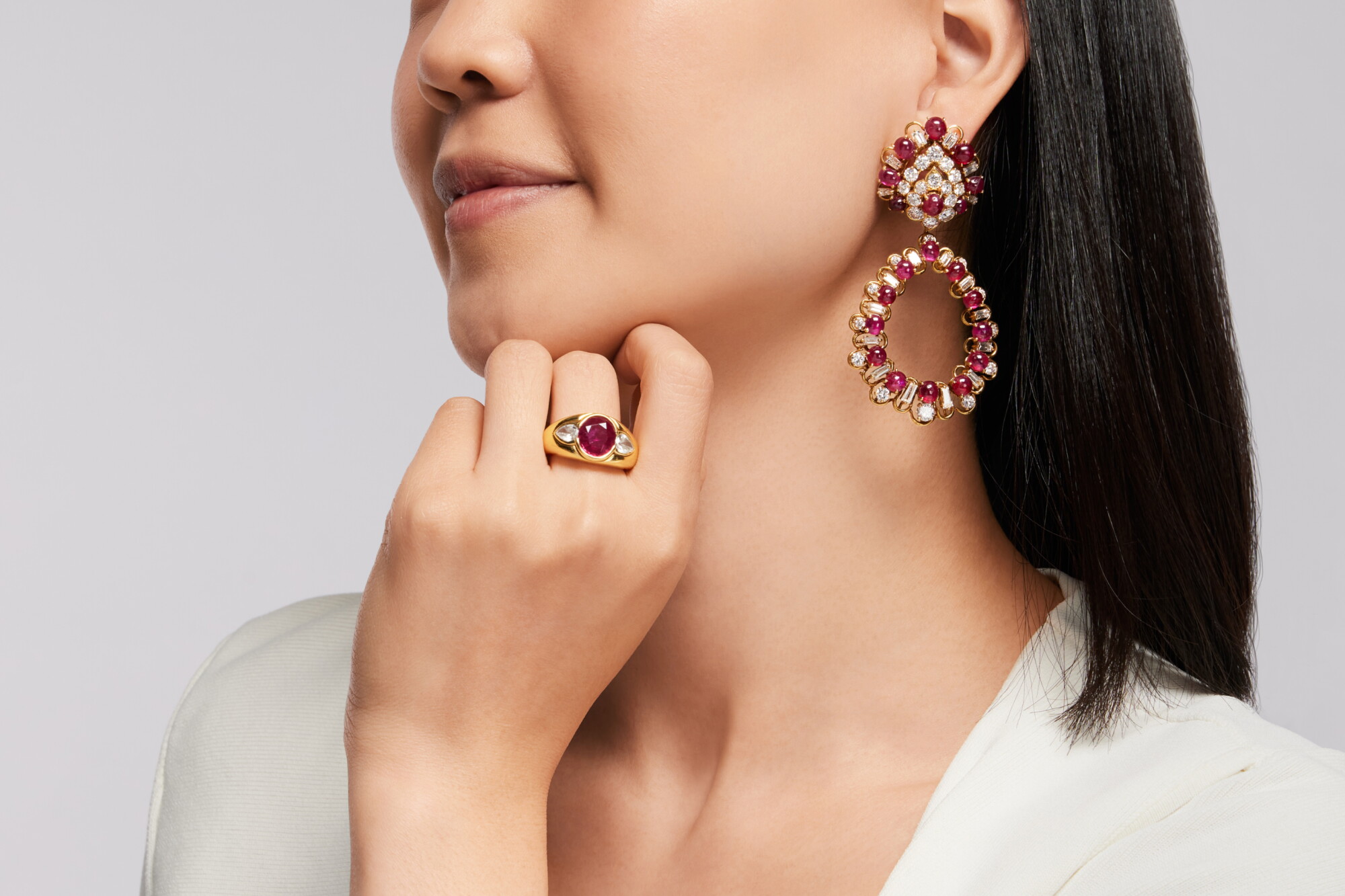
The Boucheron Vintage Gold, Ruby and Diamond Convertible Earclips approach ruby collecting from another direction. Signed Boucheron Paris and bearing the maker’s mark of André Vassort, they combine approximately 30.00 carats of cabochon rubies with 14.00 carats of diamonds in a day-and-night construction with detachable teardrop pendants. No single ruby dominates the composition. Instead, the interest lies in the rhythm of the cabochons, the transformable design, the workmanship and the association with both Boucheron and Vassort. It is precisely this kind of jewel that demonstrates why collectors sometimes need to look beyond conventional gemstone hierarchies to understand what makes a ruby jewel important.
The strongest rubies rarely depend on a single headline attribute. Start with what can be seen: the quality and balance of the red, the transparency of the crystal, the way the cut handles light and how convincingly those characteristics hold together at the stone’s size. Origin, treatment status and color designations can then sharpen the picture of rarity. An unheated Mogok ruby or a stone described as pigeon blood may command immediate attention, but those distinctions are most meaningful when the ruby itself has the quality to support them.
Connoisseurship ultimately comes down to understanding the whole object. Laboratory reports can substantiate important gemological characteristics, while close examination reveals qualities that cannot be reduced to terminology on a certificate. With signed or vintage ruby jewelry, the lens widens again to encompass design, craftsmanship, maker and period. The objective is not to collect the most impressive set of descriptors, but to recognize when an exceptional stone and an exceptional jewel are one and the same.
No. Burmese origin can add significant collector interest, particularly for exceptional Mogok rubies, but color, transparency, size and treatment remain critical. A superior Mozambique ruby can be more valuable than a lower-quality Burmese stone.
Not always. “No indications of heating” refers specifically to thermal treatment. A ruby may still have undergone another form of enhancement, which is why collectors should review the complete gemological report.
There is no fixed premium. The difference can become substantial for large, exceptional stones, but color, transparency, size, origin and overall quality determine how strongly untreated status affects value.
No. Pigeon blood describes a highly prized color and can increase desirability, but it does not independently establish a ruby’s quality or value. Treatment, transparency, size and origin still matter.
Collectors should consider the rubies alongside the maker, design, period, craftsmanship and rarity of the jewel itself. In an important signed piece, the complete object may be more significant than its gemstones considered independently.
Whether you’re a seasoned collector or new to the world of colored gemstones, Sotheby’s offers a trusted, seamless way to buy and sell ruby jewelry on the secondary market.
Trust our worldwide network of leading jewelry specialists from a globally renowned auction house established in 1744.