Paraíba Tourmalines: The Neon Gem That Became a Collector’s Stone
Discover what makes Paraíba tourmaline so rare and valuable, from its electric blue colour and Brazilian provenance to its scarcity, no-heat status and rising auction market.

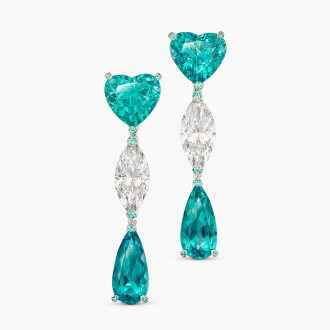
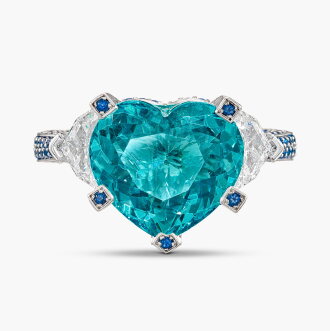
I n the 1980s, a dogged Brazilian miner named Heitor Barbosa began chipping away at a pegmatite mine in the country’s Paraíba state, determined to find a mythic gem. Few thought he might succeed. But at the end of the decade, Barbosa’s hunch proved right. There, he extracted roughly a dozen kilograms of a rare tourmaline—a gemstone possessing a blue-green hue so luminous that it practically radiates a neon glow.
Barbosa’s find was hardly a colourful fascination. Paraíba tourmaline is “one of the most significant gemstone discoveries of the 20th century,” says Stewart Young, Sotheby’s Senior Director and Head of Department for Jewellery in Asia. It’s a favourite among celebrities: Zendaya wore a stunning Paraíba tourmaline-studded necklace at the 2025 Golden Globes, and Taylor Swift has donned earrings glinting with the gemstone to the Grammys and K-Pop artist G-Dragon, meanwhile, was spotted wearing a striking Paraíba tourmaline ring, further fuelling Gen Z’s fascination with the neon-blue gem. But over the last three decades, Paraíba has transformed from a newcomer in the jewellery space into a coveted collector gemstone with an increasingly established auction market “due to its unique combination of ‘impossible’ colour, extreme scarcity, and compelling geological lore,” Young says.
As exceptional Brazilian stones become ever harder to find, Paraíba tourmaline is entering a new chapter—one in which rarity, provenance and untreated quality are increasingly defining both its desirability and its value.
The initial Paraíba boom did not last. The original Brazilian mines neared exhaustion around 1992, a few years after the gemstone’s discovery. But by that point, demand had already surged for the stones, which are typically small and weigh under one carat; reports from the time noted that tourmaline prices shot up ten percent following the discovery of Paraíba. Larger Paraíbas are extraordinarily rare and command staggering prices, as a decent proportion of their weight is usually shed during the cutting process so that they might retain their hypersaturated blue-green hue.
In 2001, newer deposits of tourmaline were found in Nigeria and Mozambique. Although the stones mined from Africa contain similar chemical “neon” properties as their South American counterparts, they tend to be larger and more “watery” in appearance, as Young describes. Young says that the increased availability of tourmalines allowed more collectors to enter the market at a lower price point. Stones from Africa and South America are both dubbed Paraíba-type tourmaline, but those sourced from Brazil, where they were discovered in Paraíba states, are priced at a premium given their rarity—that’s why, for serious collectors, gemmological certification and provenance are paramount.
Tourmaline’s scarcity, coupled with the challenge of finding large, clean stones with the preferred colour saturation, is precisely why the market has evolved “from a local commodity to an international investment asset,” explains Young.
True Paraíba tourmalines are unlike any other gemstone. Here are notable characteristics that collectors seek out when it comes to tourmalines:

Heat treatment is frequently used to rid copper-bearing tourmalines of modifiers, or purple or brown hues that distort the more desirable blue-green neon colour of Paraíba. Young estimates that roughly 95% of all tourmalines are heated to improve their appearance. Although heating is not necessarily a deal breaker within the tourmaline market, Paraíba that have not undergone a heat treatment, meaning their highly saturated colours are totally natural, represent “the absolute pinnacle of rarity [for collectors],” Young says.
The market for Paraíba tourmaline has undergone a tremendous shift in the last ten years, and what was once a highly coveted gemstone is now a bona fide blue-chip investment. Recent auction trends show that Paraíba tourmalines have routinely outperformed rubies, sapphires, and emeralds, and are now rivalling the popularity of high-quality coloured diamonds. The market for Paraíba only continues to surge: Young says that within the last two years, an uptick at “estimate-crushing” at auction—meaning that prized no-heat lots with exceptional colour and saturation will sell for three to ten times their pre-sale high estimates—has caused huge competition between luxury auction houses and private collectors seeking out Paraíba tourmalines.
But among ultra-high-net-worth collectors, top-tier, untreated, and vivid Paraíba stones from Brazil are becoming “core components of elite portfolios” rather than just traditional assets, Young says. “Recent sales reinforce that the market has entered an era of absolute scarcity. Because the original Brazilian mines are long exhausted, every appearance of a fine, large-format Brazilian stone is treated by the market as a finite, non-replaceable asset.”
Besides their glistening neon colour, provenance, and absence of heat treatment, museum-quality Paraíba tourmalines have several key features. According to Young, collectors should look out for stones that “exhibit the unmistakable internal ‘glow’ driven by copper, appearing vivid and saturated even in low-light environments.” Collectors should take care to ensure that the gemstone is accompanied by an official lab report by a respected agency, such as AGL, GIA, Gübelin, and SSEF, that can track its precise provenance. Additionally, an advanced trace-element analysis can help serious collectors discern whether their Paraíba hails from Brazil or Africa, which will also have a substantial effect on its overall value.
For collectors, the allure of Paraíba ultimately lies in what cannot be replicated: an extraordinary natural colour, a finite geological source and the rarity of finding a stone that possesses all the qualities that define a truly exceptional gem.