Complete Guide to Collecting Buccellati Jewelry
Known for intricate hand engraving and lace-like goldwork, Buccellati jewelry combines distinctive craftsmanship with iconic Macri and gem-set designs.

Buccellati jewelry can often be recognized before its signature is visible. Gold is engraved until it resembles silk, woven fabric or delicate lace; openwork gives substantial jewels an unexpected lightness; and diamonds or colored gemstones are frequently incorporated into richly textured surfaces rather than allowed to dominate them. The result is a visual language quite different from the highly polished gold and gemstone-forward designs associated with many other jewelry houses.
Founded in Milan by Mario Buccellati in 1919, the house developed an aesthetic rooted in Italian goldsmithing traditions and Renaissance decorative arts. Many of its most recognizable techniques continue to be executed by hand, making craftsmanship fundamental to how Buccellati jewelry is understood and collected. Earlier pieces reveal how that vocabulary developed across generations, while contemporary jewels continue to reinterpret the intricate engraving and lace-like goldwork that have long distinguished the house.
| Factor | What to Know |
|---|---|
| Signature Style | Buccellati is known for richly textured gold surfaces inspired by fabric, lace and traditional Italian decorative arts. |
| Hand Engraving | Techniques including rigato, telato, segrinato and ornato create different patterns and finishes across the surface of the metal. |
| Tulle and Openwork | Delicate honeycomb structures give gold the appearance of lace, often with diamonds or gemstones incorporated into the openings. |
| Gold | Yellow and white gold are frequently combined to create contrast and emphasize engraved details or gem-set elements. |
| Macri | One of Buccellati’s most recognizable designs, Macri pairs finely engraved gold with small diamond-set elements arranged across the surface. |
| Gemstones | Diamonds and colored stones often become part of the overall pattern rather than functioning solely as dominant center stones. |
| Vintage Buccellati | Earlier signed pieces can offer insight into the development of the house’s techniques and design language across generations. |
Mario Buccellati founded his eponymous house in Milan in 1919 after training with the goldsmiths Beltrami & Besnati. From the beginning, he looked backward as much as forward, reviving traditional Italian goldworking techniques and drawing inspiration from Renaissance ornament, lace and other decorative arts. His ability to reproduce the appearance of woven textiles in metal became particularly important to the emerging Buccellati style.
The business soon expanded beyond Milan, opening in Rome in 1925 and Florence in 1929 before reaching New York in 1951. Subsequent generations preserved the house’s emphasis on hand craftsmanship while developing its designs further. Mario’s son Gianmaria became a central creative figure, followed by his son Andrea and later Andrea’s daughter Lucrezia, extending the family’s involvement across four generations. Through those transitions, the techniques established during Mario’s era remained a defining part of Buccellati jewelry rather than simply a reference to its past.
Much of Buccellati’s distinctive character begins with a burin, the traditional engraving tool used to work patterns directly into the surface of gold. Different methods produce markedly different finishes. Rigato creates fine parallel lines that give the metal a soft, silky appearance, while telato crosses engraved lines at right angles to suggest the weave of linen or canvas. Segrinato is denser and more irregular, using overlapping incisions to achieve a velvety texture particularly suited to leaves, petals and other natural forms.
Ornato takes a more decorative approach. Floral or ornamental motifs are engraved over a textured ground, recalling the elaborate surfaces of brocade and damask. A single Buccellati jewel may combine techniques, allowing polished details to stand out against areas that appear almost matte or fabric-like. Because the engraving changes how gold reflects light, texture becomes part of the design itself rather than simply a finishing detail.
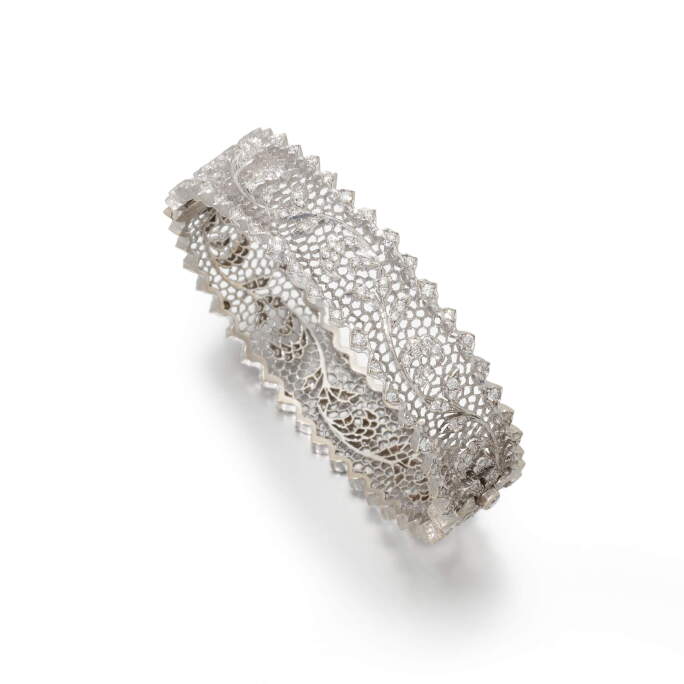
Some of Buccellati’s most intricate jewels transform gold into structures that appear closer to textile than metal. Tulle, or honeycombing, begins with a thin sheet of gold that is pierced by hand and repeatedly refined to form a delicate network of tiny openings. Lace-inspired designs take a related approach to openwork, translating the patterns and lightness of traditional Italian textiles into precious metal.
A Buccellati Diamond Bangle sold for €27,940 EUR in October 2023 demonstrates the effect on a larger scale. Designed as a wide openwork band, the bracelet incorporates foliate motifs set with brilliant-cut diamonds, allowing the pattern of the metal itself to become the dominant feature. Rather than functioning merely as a setting for gemstones, the openwork defines the jewel’s structure and gives a substantial bracelet an unexpectedly delicate appearance.
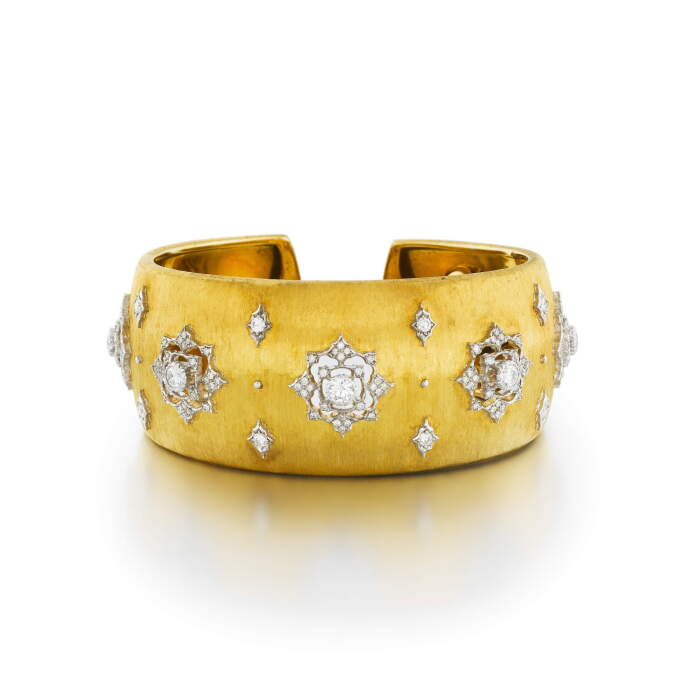
Macri places one of Buccellati’s signature techniques at the center of the design. Conceived by Gianmaria Buccellati and named for his daughter Maria Cristina, the collection uses rigato engraving to cover gold with extremely fine parallel lines, creating a surface with a soft sheen reminiscent of silk. Small brilliant-cut diamonds are often set within decorative motifs that interrupt the matte texture with points of light.
A Buccellati Gold and Diamond ‘Macri’ Bracelet sold for €30,240 EUR in September 2022. Designed as a hinged cuff, the bracelet combines rigato-engraved gold with openwork foliate motifs set with brilliant-cut diamonds. The juxtaposition is characteristic of Macri: diamonds become part of a larger pattern created through engraving, openwork and shifts in surface texture rather than serving as the dominant feature of the jewel.
Gold plays a different role in Buccellati jewelry than it does in many highly polished designs. Engraving softens the metal’s reflective surface, allowing yellow, white and occasionally pink gold to take on finishes that can resemble silk, linen or lace. Contrasting gold tones are also frequently used within a single jewel, helping openwork motifs, engraved details and diamond-set elements stand out from one another. The effect makes texture and craftsmanship central to the composition, often giving the gold itself as much visual importance as the gemstones.
Buccellati cocktail rings bring important gemstones into the house’s highly decorative goldwork rather than treating the setting as a secondary element. Large sapphires, tourmalines and other colored stones may be surrounded by engraved gold, openwork or contrasting gold tones, creating a composition in which the architecture of the ring can be as distinctive as its center stone. Mario Buccellati was already experimenting with substantial cocktail rings by the 1930s, while Gianmaria Buccellati later developed recognizable forms including the domed botoletta, sculptural musone and architectural pagoda.
A Buccellati Sapphire, Tsavorite and Kunzite Cocktail Ring sold for €34,000 EUR in August 2023. The bombé design centers an oval kunzite surrounded by vivid sapphires and tsavorites, while engraving covers the gold surface beneath. Rather than allowing the kunzite to dominate the jewel entirely, Buccellati uses color, texture and the sculptural form of the setting to create the overall effect. It is an approach characteristic of the house, where even a prominent center stone remains part of a larger decorative composition.
Both vintage and contemporary Buccellati jewelry can be collectible, although earlier pieces may offer particular insight into the evolution of the house’s design language. When considering a vintage jewel, look closely at the signature, condition and quality of the engraving, as well as whether the piece appears to retain its original form and gemstones. Contemporary Buccellati continues many of the same hand-engraving and openwork traditions, making the distinction less about old versus new than the quality, rarity and design of the individual jewel. Pieces that particularly showcase the house’s craftsmanship, whether through intricate Tulle work, elaborate engraving or an important historical design, can stand out within either period.
Collecting Buccellati begins with understanding the craftsmanship that distinguishes the house. Fine engraving, lace-like openwork and carefully considered combinations of gold and gemstones can be more important to the character of a piece than carat weight alone. Recognizing techniques such as rigato or Tulle can also make it easier to understand why seemingly similar Buccellati jewels may differ considerably in complexity.
Whether considering a vintage jewel or a contemporary Macri bracelet, look at how successfully the piece expresses Buccellati’s distinctive approach to goldsmithing. Condition, signature and originality remain important, but the strongest examples are often those in which technique and design are inseparable, transforming precious metal into something that appears woven, engraved or almost weightless.
Tulle is among the house’s most labor-intensive techniques because each opening in the gold is pierced and repeatedly refined by hand. Dense engraving and designs combining multiple surface treatments can also require considerable craftsmanship.
Not automatically. Complexity can contribute to desirability, but execution, design, condition, rarity and period also matter. A particularly successful or recognizable design may be more significant than a technically elaborate piece that is less distinctive.
Condition is especially important because engraving and textured surfaces are fundamental to Buccellati’s designs. Excessive polishing can soften fine engraved lines and alter the contrast between finishes, potentially diminishing some of the craftsmanship that originally defined the jewel.
Jewels associated with Mario Buccellati can attract interest because of their connection to the house’s early development, but age or attribution alone does not determine significance. Design, craftsmanship, condition and rarity should still be evaluated individually.
Look beyond gemstone weight and compare the quality and complexity of the goldwork, condition of the engraved surfaces, originality and strength of the design. For pieces from recognizable collections such as Macri, particularly unusual configurations or more elaborate executions may also distinguish one example from another.
Whether you're a seasoned collector or new to luxury jewelry, Sotheby’s offers a trusted, seamless way to buy and sell Buccellati high jewelry pieces on the secondary market.
Trust our worldwide network of leading jewelry specialists from a globally renowned auction house established in 1744.