When Gold Is the Design: The Art of Sculptural Gold Jewelry
Bold gold jewelry is back in focus. See how techniques from engraving and repoussé to Tubogas give vintage gold its sculptural presence.

Gold is having a decidedly bold moment. After years dominated by platinum and white gold, yellow gold has returned with more weight, volume and presence. The shift has renewed interest in vintage jewelry that treats the metal as more than a setting for gemstones. Thick cuffs, substantial necklaces and oversized earrings feel right again, especially when their impact comes from the gold itself.
Much of that character begins with technique. Gold can be hammered until its surface catches light unevenly, worked in repoussé to create volume or woven into forms that move almost like fabric. Tubogas coils around the wrist or neck without traditional soldered links. Other methods carve, twist, chase or texture the metal, transforming a precious material into something architectural, fluid or deliberately irregular.
These ideas stretch across periods and makers, from ancient goldworking methods revived in 19th- and 20th-century jewelry to the sculptural experiments of designers including Jean Schlumberger, Elsa Peretti and Andrew Grima. Houses such as Bvlgari pushed yellow gold toward generous proportions, while other makers developed their own approaches to texture and construction. Looking closely at these techniques reveals why some of the strongest gold jewelry needs very little else: the material, and what the jeweler does with it, becomes the design.
| Gold is moving back into focus | Yellow gold has gained momentum alongside the return of bold, vintage-inspired jewelry, shifting attention toward pieces where scale, surface and metalwork drive the design. |
| Technique can define the jewel | Hammering, repoussé, weaving, engraving and other methods change how gold reflects light, holds volume and moves on the body. The technique is often central to the character of the finished piece. |
| Sculptural does not always mean heavy | Some techniques create the impression of substantial volume without relying on a solid mass of gold. Repoussé, for example, forms relief by working sheet metal into raised shapes. |
| Flexibility can be part of the construction | Techniques such as Tubogas and woven gold allow metal to bend and conform to the body—an engineering challenge that becomes part of the visual effect. |
| Maker and technique should be considered together | Important houses and independent jewelers developed distinct approaches to working gold. Understanding how a piece was constructed can add useful context when comparing jewelry across makers and periods. |
| Vintage gold jewelry feels current again | Substantial cuffs, necklaces and earrings align closely with today’s preference for stronger proportions, bringing renewed attention to sculptural gold designs from earlier decades. |
Sculptural gold jewelry is less about one specific technique than an approach to design. Instead of relying on a prominent gemstone for impact, the jeweler works with volume, contour and surface to give the metal its own visual presence. A broad cuff can curve around the wrist like a piece of sculpture, while a necklace might build its effect through articulated links or a continuous coil.
Gold is especially suited to this kind of experimentation because it is highly malleable. It can be hammered into relief, twisted into wire, woven or shaped into hollow forms that appear substantial without being solid throughout. The finished jewel might feel smooth and polished or intentionally irregular—small changes to the surface can completely alter the way gold responds to light.
The result is jewelry that often makes sense in motion. Flexible constructions follow the body, dimensional earrings change as the wearer turns and textured surfaces shift between brightness and shadow. That relationship between material and form helps explain why so much vintage gold jewelry feels relevant now: the gold is not supporting the design. It is the design.
Repoussé creates relief by working metal from the reverse, pushing the surface outward into raised forms. Chasing can then refine the design from the front, sharpening contours or adding detail. The result is pronounced volume created from relatively thin sheets of gold rather than solid metal.
The technique has a long history in decorative arts and jewelry, lending itself to everything from figurative designs to deeply modeled organic forms. It also transforms the way gold responds to light. Raised surfaces catch it; recessed areas create shadow. That contrast gives an all-gold jewel depth and definition without relying on gemstones.
This makes repoussé especially effective in sculptural jewelry. A cuff or pair of earrings can have an assertive, substantial presence without the physical weight that its scale might suggest. The gold itself creates the drama through volume, relief and the play between light and shadow.
Polished gold reflects light in broad, uninterrupted flashes. Change the surface and the effect shifts. Hammering introduces subtle variations across the metal, while engraving cuts directly into it. Other finishes can make gold appear softer, rougher or even textile-like, changing not only its texture but how the form itself is perceived.
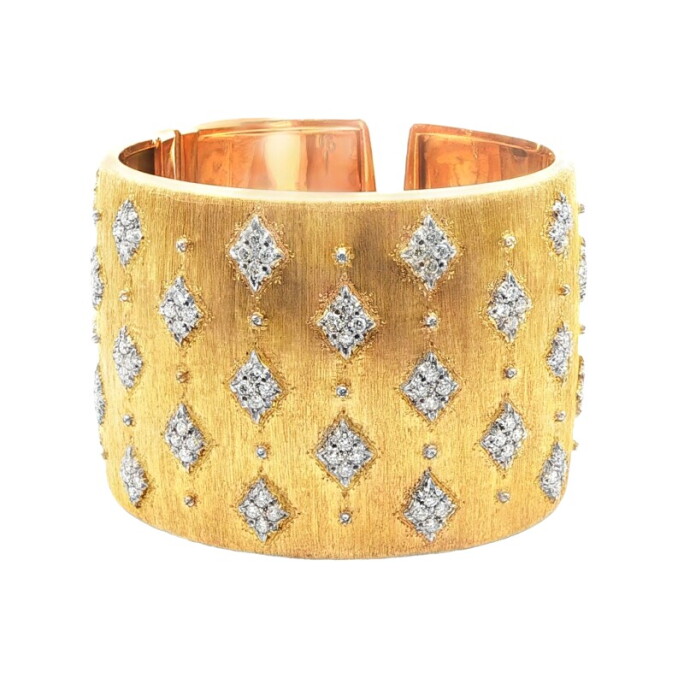
Mario Buccellati made surface central to his approach to gold. Drawing on Italian goldsmithing traditions, the house developed engraving techniques that use closely worked lines and patterns to create depth across the metal. On the Vintage Gold and Diamond Cuff Bracelet offered through Sotheby’s, fine parallel lines created with the house’s Rigato technique run across the broad yellow gold surface, punctuated by lozenge-shaped clusters of round brilliant-cut diamonds.
At 125.80 grams, the cuff has considerable physical presence, yet its impact does not come from scale alone. The engraving breaks up the expanse of yellow gold, altering the way light moves across the bracelet and making the surface part of the composition. In textured gold jewelry, the defining detail is often not what has been added to the metal, but what has been done to it.
Gold does not have to behave like a rigid material. Drawn into wire, twisted or woven, it can take on a flexibility more often associated with fabric. Some techniques create dense mesh or braided surfaces, while others leave space between individual strands, building volume from remarkably fine elements.
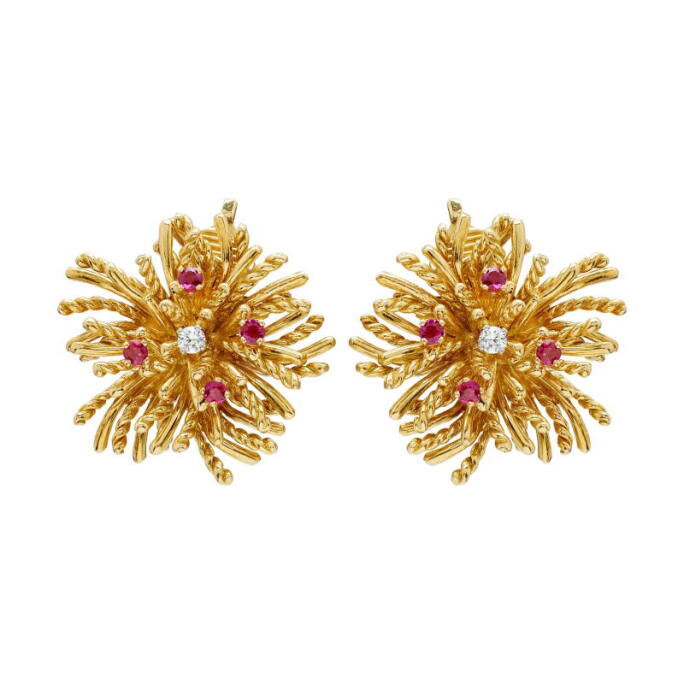
The Tiffany & Co. Gold, Diamond and Ruby Anemone Earclips demonstrate the effect. Twisted yellow gold wires radiate outward in loose sprays, giving the flowers their volume without relying on a solid form. Small diamonds and rubies punctuate the design, but the gold does most of the visual work. By extending the wire outward, Tiffany creates a pair of earrings that feels expansive without appearing dense or heavy.
Wirework also changes how a jewel responds to movement. Individual strands catch the light from different angles, while the silhouette shifts as the piece is worn. This is especially effective in earrings, where a turn of the head can alter the composition. The construction may be delicate, but the effect is anything but.
Tubogas takes flexibility in a different direction. Named for its resemblance to flexible gas tubing, the technique uses tightly wound strips of metal to create a continuous, spring-like form. It can curve closely around the wrist or neck while retaining a substantial profile, helping explain why the technique became so closely associated with Bvlgari’s bold approach to gold jewelry.
A Bvlgari Gold, White Gold, Rose Gold and Ancient Coin Monete Three Row Tubogas Bracelet brings together several of the house’s signatures. Three rows of yellow, white and rose gold wrap around the wrist, centered by an ancient coin depicting Augustus. Instead of conventional links, the Tubogas technique creates an uninterrupted band, allowing the different tones of gold to follow the bracelet’s continuous curve.
At 131.20 grams, the bracelet has real physical weight, and that substance is part of its character. Yet it remains flexible enough to respond to the body rather than sitting rigidly against it. This balance between visual heft and engineered movement gets to the appeal of Tubogas: the technique determines the bracelet’s sculptural form as much as the way it feels on the wrist.
Some gold jewelry becomes sculptural through modeling rather than surface treatment or flexible construction. Animal jewelry makes the distinction especially clear. Gold establishes the volume and contours of the figure, turning precious metal into a recognizable form at a remarkably small scale.
The Cartier Gold, Emerald, Onyx and Diamond Panthère de Cartier Ring transforms the panther’s head into a dimensional yellow gold form. Diamonds cover much of the surface, while pear-shaped emerald eyes and a carved onyx nose define its expression. Beneath those details, the modeled gold gives the head its volume and profile, creating the sense of a three-dimensional figure wrapped around the hand.
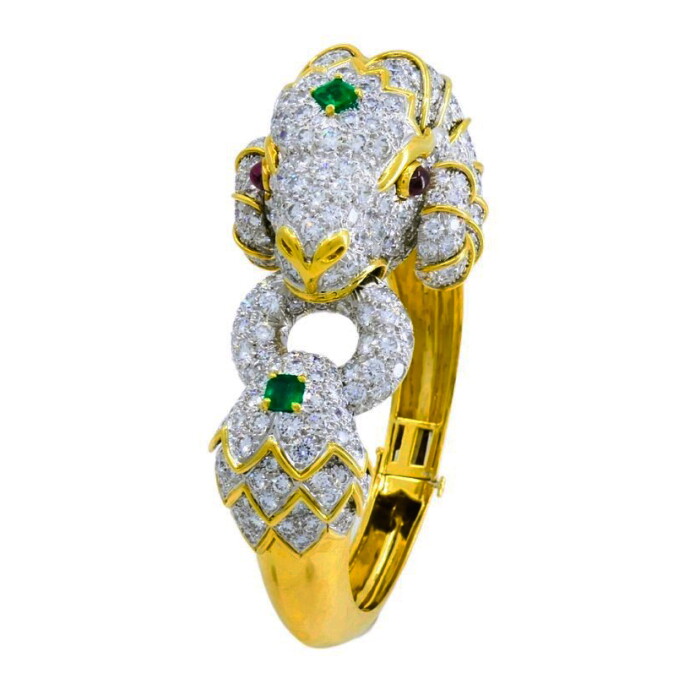
David Webb took figurative jewelry to a different scale. A circa 1980s Gold, Platinum, Emerald, Ruby and Diamond Ram’s Head Bracelet pairs a pavé-set ram’s head with a broad, highly polished yellow gold bangle. At 115 grams, the bracelet gives the animal motif a substantial physical presence rather than treating it as surface ornament. This approach helps explain why bold figurative jewels feel so relevant alongside today’s interest in vintage gold: they sit somewhere between jewelry and miniature sculpture.
Not every sculptural jewel is designed to create volume with less metal. Sometimes weight is part of the point. Broad links, dense chains and expanses of gold give a piece authority on the body, making mass as important to the design as decoration.
The Bvlgari Gold and Six Ancient Coins Monete Necklace takes this idea to an impressive scale. Six ancient coins are set within octagonal yellow gold stations connected by curb links, creating a continuous sequence of solid forms. At 390.50 grams, the necklace makes the quantity of gold impossible to ignore. Its material presence is fundamental to the way the design reads.
This offers another way to think about sculptural gold jewelry. Repoussé creates volume from relatively thin sheets of metal, while wirework builds form from finer elements. Here, scale comes from the accumulation of gold itself. The technique may change, but the underlying principle remains: how gold is constructed can matter as much as how it is decorated.
The renewed interest in yellow gold has come with an appetite for jewelry with greater presence. Wide cuffs, oversized earrings and substantial necklaces put proportion at the center of the design. Vintage gold fits naturally into this shift because many earlier pieces were conceived around the expressive possibilities of the metal itself.
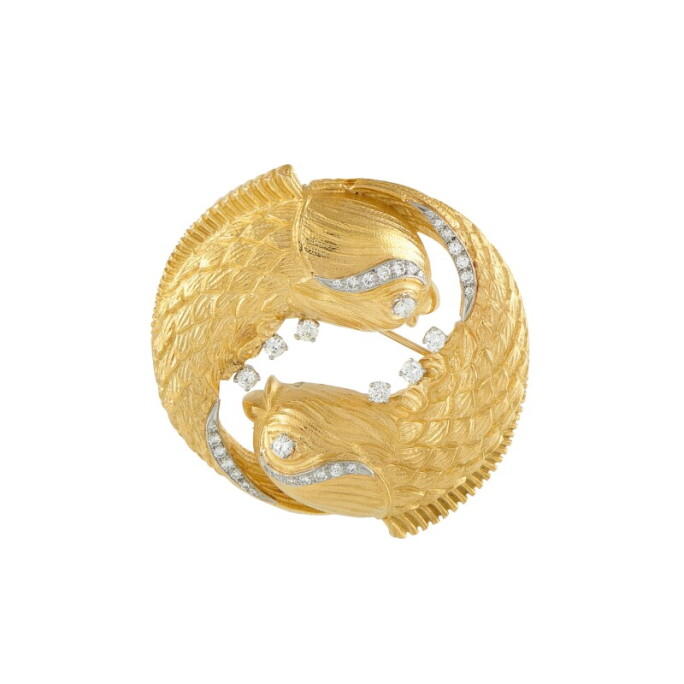
A David Webb Vintage Gold, Platinum and Diamond Pisces Zodiac Convertible Pendant Brooch captures that approach. Two confronting koi fish are modeled in yellow gold, their bodies defined by richly textured scales. Diamond-set eyes and platinum details introduce contrast, but the worked gold establishes the form and gives the composition its depth. As a convertible pendant-brooch, the piece can also move between different placements on the body.
What feels current is not yellow gold alone, but the willingness to let it take up space. Texture can become the decoration; weight can be intentional; an exaggerated silhouette can define the entire jewel. That helps explain the renewed relevance of vintage designs by David Webb, Bvlgari, Cartier and Tiffany & Co., where gold was often treated as the design rather than merely the setting.
Start with construction rather than size alone. Two cuffs with similar proportions can feel entirely different if one is hollow and repoussé while the other is made from substantial gold. Necklaces offer the same contrast: woven wire, articulated links and Tubogas each balance weight and movement differently. Understanding the construction helps explain how a jewel achieves its volume and how it sits on the body.
Surface is just as important. On a Buccellati jewel, engraving can be fundamental to the design rather than a final decorative layer. Hammering and chasing likewise create texture that shapes the way light moves across the gold. Condition matters here, since overpolishing can soften intentional texture and diminish the definition of engraved details.
The maker provides another point of reference, but the name should never replace a close look at the jewel. Consider whether the technique is characteristic of the jeweler’s work and how effectively it supports the overall form. Original surface detail matters, too. In the strongest examples, construction, finish and design work together so closely that separating one from another becomes difficult.
The renewed interest in bold gold jewelry has brought attention back to pieces that were never designed to disappear on the body. Their appeal can come from a deeply engraved surface, an ingenious flexible construction or the sheer presence of substantial yellow gold. Across periods and makers, the strongest examples show just how much can happen before a gemstone ever enters the picture.
Looking at technique makes these jewels more interesting. Repoussé can turn a thin sheet of gold into pronounced relief, while twisted wire creates volume through openness and movement. Tubogas solves a different problem entirely, engineering metal to wrap around the body. In each case, gold is doing more than providing color or value—it determines the form, texture and experience of wearing the jewel.
Not necessarily. Weight often reflects construction rather than quality. Repoussé and hollow techniques can create substantial volume with less metal, while solid links and dense chains naturally weigh more. How successfully the construction supports the design is more revealing than weight alone.
Intentional texture generally follows the logic of the design. Engraved lines, hammered surfaces and chased details tend to appear in deliberate patterns, while wear is more likely to affect raised areas and frequent contact points. Close inspection and detailed cataloguing can help distinguish between the two.
Repeated or aggressive polishing can soften engraving, diminish texture and reduce the definition of modeled forms. When the surface treatment is integral to the design, losing that definition can noticeably change the character of the jewel.
Tubogas uses tightly wound metal strips to create a flexible, continuous structure rather than a sequence of conventional links. This allows the jewel to conform to the body while retaining its broad, sculptural profile.
Yes. A signature provides useful context, but it is only one part of evaluating a jewel. An unsigned piece can still demonstrate sophisticated construction and strong design. Quality of execution, condition and the integrity of the form deserve close attention regardless of attribution.
Whether you're a seasoned collector or new to the world of luxury jewelry, Sotheby’s offers a trusted, seamless way to buy and sell fine jewelry on the secondary market.
Trust our worldwide network of leading jewelry specialists from a globally renowned auction house established in 1744.