What Makes Signed Jewelry Valuable? A Collector's Guide to Maker's Marks and Signatures
A jewel's signature can reveal its history. Examine Cartier, Tiffany & Co. and Van Cleef & Arpels marks and what they mean to collectors.

A Cartier signature engraved inside a bracelet or a Van Cleef & Arpels mark discreetly placed on a necklace clasp can reveal much about a jewel's origins. For collectors, these markings offer an important starting point for understanding who made a piece, when it was produced and how it fits within a jewelry house's history. Yet signatures vary across periods and workshops, and the name engraved on a jewel doesn't always tell the complete story of its creation.
The distinction matters in the secondary market, where signed jewelry by houses such as Cartier, Tiffany & Co. and Bvlgari can attract significant attention. A 1940s Van Cleef & Arpels necklace bearing a New York signature, for example, carries a different historical context from a contemporary Alhambra design. Other jewels may bear the name of one house alongside the maker's mark of the workshop that manufactured them. Understanding these differences requires looking beyond the signature itself to the construction and period of the piece.
A prestigious name can influence desirability, but it doesn't establish value on its own. Gemstone quality, originality and the significance of a particular design all contribute to how signed jewelry is assessed. Some unsigned period jewels can be equally noteworthy for their craftsmanship. From identifying French hallmarks to understanding designer signatures and serial numbers, knowing how to interpret these details is essential to collecting signed jewelry with confidence.
| Key Consideration | What Collectors Should Know |
|---|---|
| A signature doesn't guarantee authenticity | A house signature must be assessed alongside the jewel's construction, design and documented history. |
| Maker's marks and house signatures serve different purposes | A jewel may bear a jewelry house's name and a separate mark identifying the workshop responsible for its manufacture. |
| Period signatures can reveal historical context | Signatures such as Cartier London or Van Cleef & Arpels N.Y. can help establish a jewel's relationship to a house's regional operations. |
| Serial numbers are supporting evidence | Numbering may assist with identification and archival research, but it isn't independent proof of authenticity. |
| Designer signatures can influence collectibility | Jewelry associated with Paloma Picasso, Jean Schlumberger or David Webb may carry additional interest because of its design history. |
| The signature is only one factor in value | Gemstone quality, craftsmanship, condition and the significance of the design all influence prices on the secondary market. |
| Unsigned jewelry can still be exceptional | Important period jewels may be valued for their materials and execution even without a documented maker's signature. |
Signed jewelry bears a mark identifying the jewelry house or designer associated with its creation. These signatures may be engraved, stamped or incorporated into a discreet part of the setting, with their placement and appearance varying by maker and period. They should be distinguished from precious-metal hallmarks, which relate to metal fineness or assay requirements, and serial numbers, which may help identify an individual piece. A signature can provide valuable evidence of origin, but specialists also examine whether the mark is consistent with the jewel's age and construction.
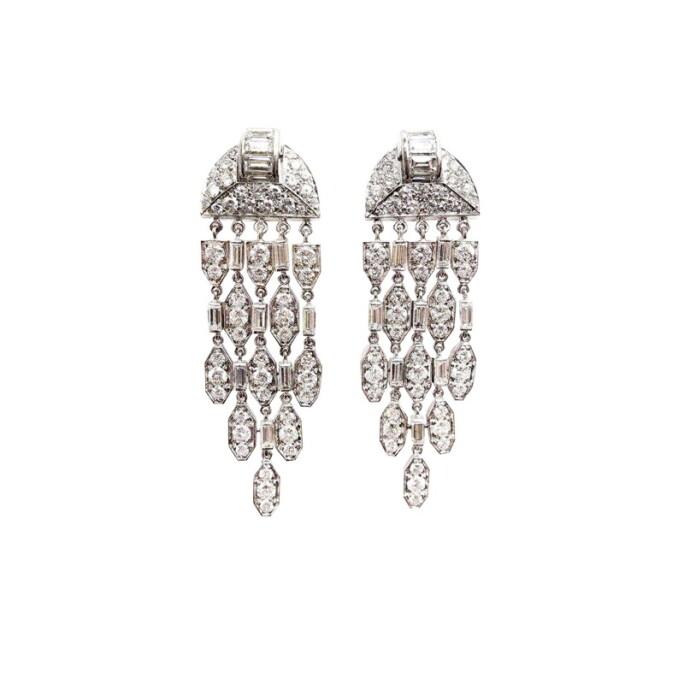
The Cartier Vintage White Gold and Diamond Dangle Earrings illustrate how several markings can appear on a single jewel. Composed of round brilliant-cut diamonds weighing approximately 6.50 carats in total, the earrings are signed Cartier and numbered, with an additional 750 stamp indicating 18-karat gold. Each marking serves a different purpose: the Cartier signature identifies the house, the number provides a potential reference for identification, and the fineness stamp identifies the gold standard. Considered together with the earrings' design and workmanship, these details help establish a fuller understanding of the piece.
A jewel can carry several marks that reveal different aspects of its manufacture. In French jewelry, a maker's mark traditionally identifies the workshop responsible for producing the piece, while assay hallmarks indicate the precious metal's fineness under the applicable marking system. The signature of a jewelry house may appear separately, reflecting the distinction between the firm that commissioned or retailed a jewel and the workshop that made it. These relationships were common in French jewelry production, where specialist workshops supplied established maisons.
The Vintage Gold, White Gold, Multigem and Diamond Brooch, dating to circa 1940, illustrates this distinction. Designed as two ceremonial guards with coral and turquoise faces, the brooch is signed Yaèche Frères Paris but also bears a maker's mark for Pery et Fils and French hallmarks. The separate markings identify different participants in the jewel's history, offering insight into how jewelry was produced and sold during the period. For collectors examining signed vintage jewelry, such details can help establish provenance and manufacturing context without relying solely on the name engraved on the piece.
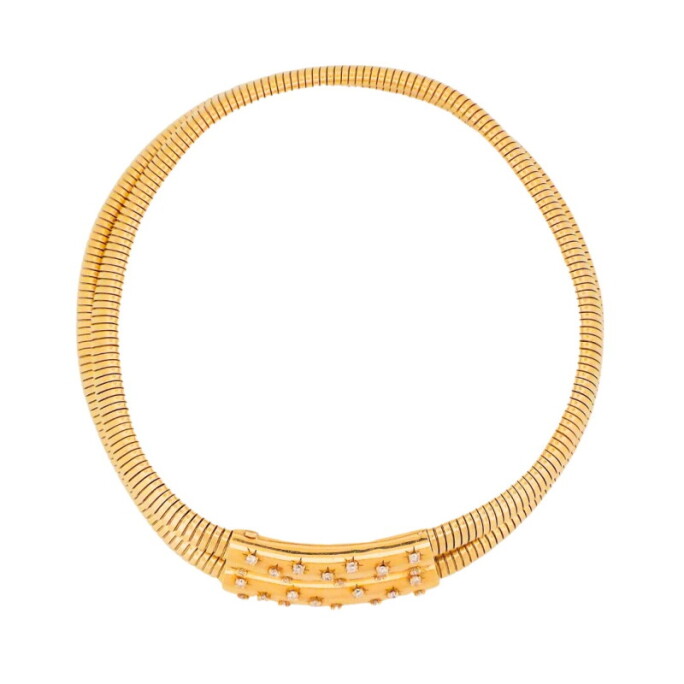
Jewelry houses have used different signatures across their histories, sometimes reflecting the cities in which they operated. Cartier London, Cartier Paris and Van Cleef & Arpels N.Y. are examples of markings that can help place a jewel within a particular historical context. Their significance depends on whether the signature is consistent with the piece's design, materials and documented period. The Van Cleef & Arpels Vintage Gold and Diamond Tubogas Necklace, dating to the 1940s, bears a Van Cleef & Arpels N.Y. signature and serial numbers. Its tiered gold chains and diamond-set star motifs reflect the house's work during the period, while the New York signature provides another detail for examining its history.
An important example of a period signature appears on the Cartier Emerald, Ruby, Diamond and Pearl ‘Tutti Frutti’ Clip-Brooch, circa 1930, signed Cartier London and numbered. Designed in a boteh shape, the brooch combines carved emeralds and rubies with diamonds of several cuts, reflecting the Indian-inspired designs associated with Cartier's Art Deco jewelry. The London signature places the piece within a specific branch of the house's history, while its gemstone carving and composition connect it to one of Cartier's most celebrated design traditions. The brooch is scheduled to appear in the Pauline Karpidas jewelry auction in New York on December 8, 2026.
A designer's signature can add another dimension to a jewel's history, especially when the piece belongs to a collection that helped define their work. At Tiffany & Co., collaborations with designers introduced distinct creative identities within the house's jewelry collections. Paloma Picasso's Graffiti collection, introduced in the 1980s, translated expressive, handwritten forms into gold jewelry. The Tiffany & Co. Vintage Gold, Platinum and Diamond Graffiti Bracelet exemplifies this approach. Shaped as an X in 18-karat yellow gold, the cuff features a platinum bezel-set diamond weighing approximately 0.45 carat. Signed Tiffany & Co. and Paloma Picasso, it connects the house's craftsmanship with a design attributable to a named artist.
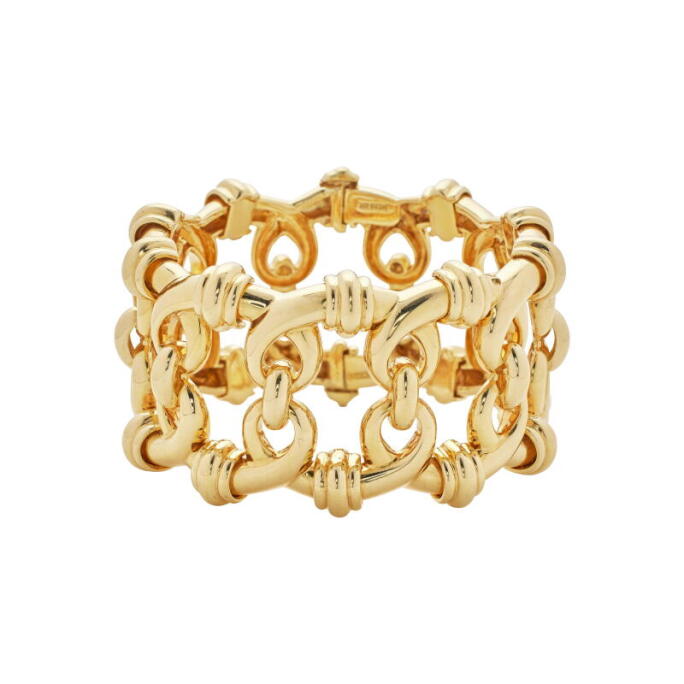
David Webb established his own jewelry house in New York in 1948, developing a distinctive approach to sculptural gold jewelry. His designs frequently emphasized substantial forms and bold surfaces, with the metalwork itself playing a central role. The David Webb Gold Bracelet, composed of interlocking polished 18-karat gold links and weighing approximately 154.63 grams, illustrates this approach without relying on gemstones. Its David Webb signature identifies the house, while the bracelet's proportions and construction reflect the design language associated with his work. In signed designer jewelry, that relationship between the mark and the object can be an important part of its collectibility.
A prestigious signature carries greater significance when it accompanies a design closely associated with the jewelry house. Bvlgari introduced serpent-inspired jewelry in the 1940s, initially incorporating the flexible Tubogas construction that allowed bracelets and watches to coil around the wrist. Later interpretations developed more elaborate serpent forms, with articulated scales and decorative enamelwork. These variations are important when assessing vintage Serpenti jewelry, as differences in construction and design can help distinguish pieces from different periods.
The Bvlgari Vintage Gold, Enamel and Diamond Serpenti Bracelet illustrates the craftsmanship behind the collection. Formed as a coiled serpent in 18-karat yellow gold, the bracelet features black and white enamel scales and marquise-cut diamond eyes, with diamonds totaling approximately 0.50 carat. Weighing 230.80 grams, it is signed Bvlgari and marked 750. Its appeal extends beyond the house signature to the execution of the serpent's form, the condition of the enamel and the quality of the goldwork. These characteristics help distinguish individual Serpenti designs on the secondary market.
In signed jewelry featuring important gemstones, the maker's name is only one consideration in assessing value. A diamond's cut and quality, or the color and treatment history of a colored gemstone, can have a substantial influence on its desirability. Laboratory reports provide information that a signature can't establish, making them an important part of evaluating gemstone-set jewelry. Even among pieces by the same house, differences in the principal stones can result in significant variations in price on the secondary market.
The Harry Winston Platinum, 9.15ct Aquamarine and Diamond Marquesa Ring illustrates how these factors intersect. Centered on a 9.15-carat emerald-cut aquamarine and accented by 1.39 carats of marquise- and pear-shaped diamonds, the platinum ring bears a Harry Winston maker's mark and serial number. An accompanying AGL report, dated March 1, 2024, states that the aquamarine has been heated and shows no clarity enhancement. The ring also comes with Harry Winston retail replacement paperwork. Together, the gemstone report and supporting documentation offer information beyond the signature, allowing the stone's characteristics and the jewel's documented history to be assessed independently.
An unsigned jewel can possess considerable historical and artistic significance, especially when its design and craftsmanship reflect an important period in jewelry making. Many antique pieces were never signed, while others have lost their original markings through alterations or repairs. Without a documented signature, attribution requires careful examination of construction techniques and stylistic details. Specialists may identify a jewel's period or probable origin without assigning it to a particular house. Exceptional unsigned pieces can command strong prices on the secondary market, although a documented maker may influence the value of otherwise comparable examples.
The Art Deco Platinum, Diamond and Synthetic Sapphire Bracelet, dating to the 1920s, demonstrates the appeal of period jewelry without a recorded house signature. Its geometric platinum setting incorporates approximately 17.55 carats of transitional- and single-cut diamonds, accented by calibré-cut synthetic sapphires. Synthetic stones were used deliberately in some Art Deco jewelry, valued for their consistent color and suitability for precisely fitted settings. Here, the arrangement of the stones and the bracelet's period construction provide a basis for appreciating its craftsmanship without relying on an association with a major jewelry house.
A signature can connect a jewel to an important designer or a specific chapter in a jewelry house's history, but its significance depends on the piece itself. The Cartier London signature on a circa-1930 Tutti Frutti brooch carries a different historical context from the dual Tiffany & Co. and Paloma Picasso signatures on a Graffiti bracelet. Maker's marks and regional signatures can also reveal how jewelry was commissioned and manufactured, offering details that might otherwise be overlooked.
When evaluating signed jewelry on the secondary market, collectors should consider whether the markings are consistent with the jewel's period and construction, alongside its condition and originality. Gemstone reports and archival documentation can provide further evidence, while exceptional unsigned pieces deserve consideration on their own merits. The most desirable examples combine a well-supported attribution with the craftsmanship and design qualities that distinguish the jewel itself.
No. Signatures can be reproduced or added later, so specialists examine their placement and execution alongside the jewel's construction and period. A signature alone isn't sufficient to establish authenticity.
A maker's mark generally identifies the workshop responsible for manufacturing a jewel, while a house signature identifies the brand or firm associated with it. Some pieces bear both, reflecting historical relationships between independent workshops and major jewelry houses.
Yes, when reliable archival records or documented numbering systems are available. However, numbering practices vary between houses and periods, and a serial number doesn't independently confirm a production date or authenticity.
It can. Replaced gemstones, modified settings or later-added components may affect originality and desirability, especially in important period jewelry. The extent of any alteration and the quality of restoration should be assessed individually.
Exceptional gemstones, period craftsmanship and historical significance can outweigh the absence of a signature. An unsigned Art Deco jewel with outstanding construction may command a higher price than a signed piece of more conventional design, depending on their respective qualities and market demand.
Whether you're a seasoned collector or new to the world of luxury jewelry, Sotheby’s offers a trusted, seamless way to buy and sell fine jewelry on the secondary market.
Trust our worldwide network of leading jewelry specialists from a globally renowned auction house established in 1744.