Specialist Picks: Shop the Best Editions to Buy Now
Picasso's linocuts, Miró's color lithographs and Hockney's etchings lead our latest selection of signed prints and limited editions.

This month's edition picks bring together five major figures of twentieth-century art whose printmaking practices extended well beyond their work on canvas. Salvador Dalí's surrealist imagery and David Hockney's engagement with poetry offer two approaches to narrative, while Joan Miró and Marc Chagall demonstrate the expressive possibilities of color lithography. Pablo Picasso's experiments with linocut round out the selection, highlighting his continued reinvention of traditional printmaking techniques.
Selected by our specialists, these five works also reflect the importance of the print workshop in modern art. From Mourlot's collaborations with Miró and Chagall to Picasso's work with printer Hidalgo Arnéra in Vallauris, each edition carries a history of technical experimentation. Signed impressions, limited editions and artist's proofs offer further distinctions, making the circumstances of production as relevant as the compositions themselves.
Salvador Dalí frequently placed Gala, his wife and longtime muse, at the center of his surrealist imagery, transforming her into figures drawn from mythology, religion and his own elaborate symbolic world. The Coronation of Gala (The Empress), from the 1976 portfolio Visions Surréalistes, continues this approach by presenting Gala through the elevated imagery of an empress. The title reflects Dalí's tendency to merge personal devotion with grand historical and ceremonial themes.
Executed as a lithograph, the work was published by Levine and Levine and printed by Torrents in Spain and Gordon in France. This impression is signed and numbered 100 from an edition of 150, connecting it to Dalí's extensive printmaking practice during the later decades of his career. The work also demonstrates how Gala remained a central figure in his artistic imagination long after their earliest collaborations.
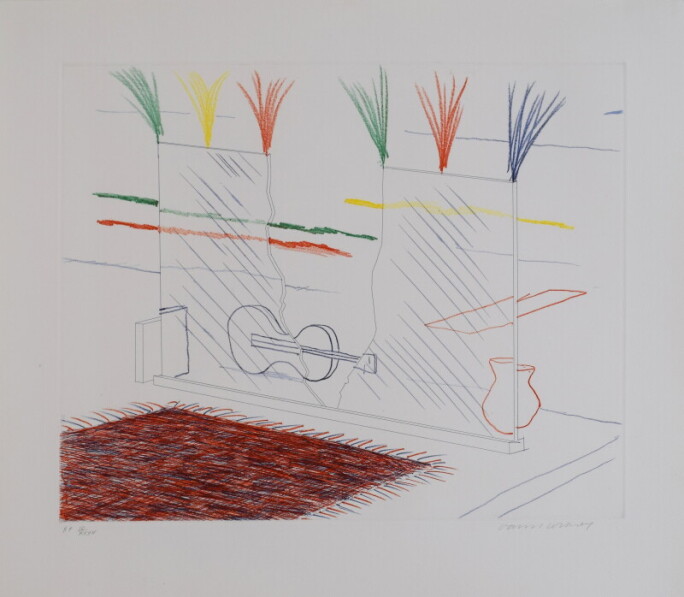
David Hockney's The Blue Guitar series grew out of his fascination with poetry and the relationship between artistic creation and interpretation. Inspired by Wallace Stevens' poem The Man with the Blue Guitar, itself a response to Picasso's The Old Guitarist, Hockney developed a portfolio of 20 etchings and aquatints that translate the poem's ideas into his own visual language. On it May Stay its Eye, created in 1976, is the seventeenth composition in the series, reflecting Hockney's interest in how images can transform the subjects they depict.
Printed by Maurice Payne for Petersburg Press in London and published in 1977, the work combines etching and aquatint in colors on Inveresk paper. This impression is hand signed and numbered 4 from a group of 35 artist's proofs, separate from the standard edition of 200. The artist's proof designation is an important distinction within the portfolio, identifying a smaller group of impressions produced alongside the principal edition. The title is also stamped on the reverse, a detail associated with the presentation of the series.
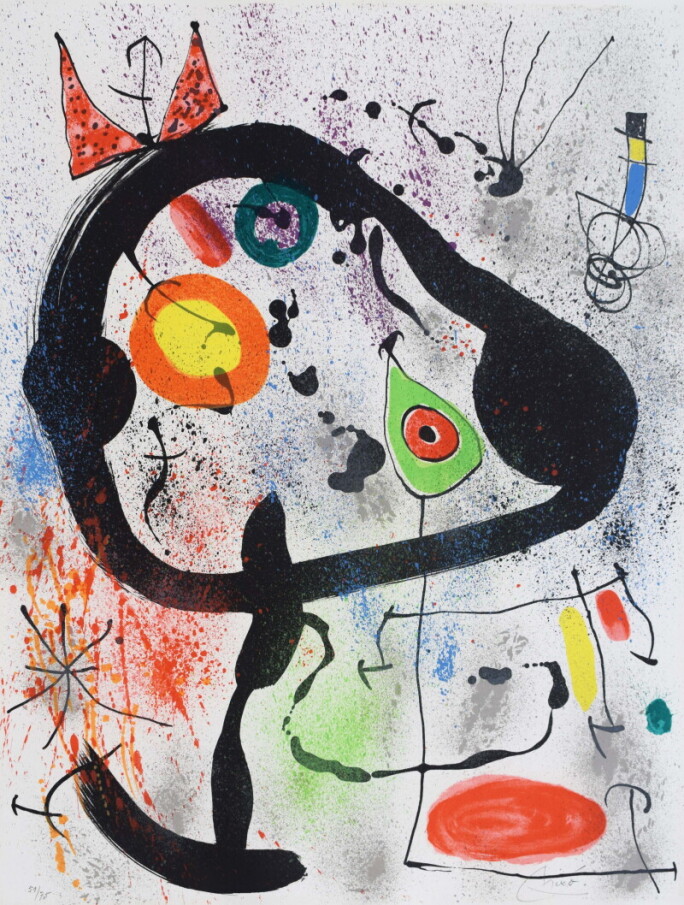
Joan Miró's printmaking practice became increasingly ambitious during the 1960s and 1970s, as he worked closely with master printers to translate his abstract vocabulary into lithography. Composition III, from the 1970 portfolio Les Voyants (The Seers), belongs to a group of six compositions that reflect his interest in spontaneous forms and expressive mark-making. Rather than depicting a conventional scene, Miró builds a visual language through abstract shapes and the relationship between color and space.
Printed by Mourlot in Paris and published by Louis Broder in 1970, the color lithograph was produced on BFK Rives wove paper. This impression is hand signed and numbered 51 from an edition of 75, with the publisher's L.B. watermark visible in the lower right corner. The collaboration with Mourlot is significant within Miró's printmaking history, as the Paris workshop played an important role in helping artists develop increasingly complex color lithographs during the twentieth century.
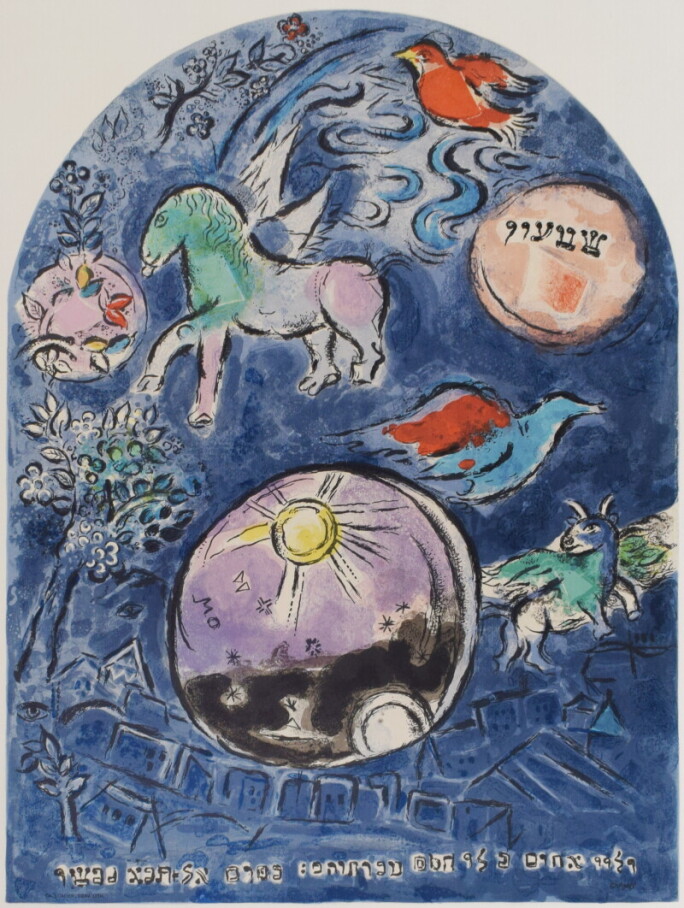
Marc Chagall's Jerusalem Windows originated in a commission to create twelve stained-glass windows for the synagogue of the Hadassah Medical Center in Jerusalem, each representing one of the twelve tribes of Israel. The project became one of his major achievements in stained glass, drawing on biblical imagery and his distinctive use of color. The Tribe of Simeon, produced in 1964, translates the second composition from the series into lithography, based on Chagall's final studies for the windows.
Printed by Charles Sorlier in Paris and published by Mourlot, this color lithograph was produced on Arches wove paper in an edition of 150 signed and numbered impressions. This example is numbered 67 and bears Chagall's pencil signature, along with his signature and Sorlier's inscription within the printed image. The edition also included artist's proofs and a separate group of Roman-numbered impressions. The Arches watermark and stamp on the reverse provide additional identifying details, while the composition preserves the connection between Chagall's original stained-glass project and his extensive work in printmaking.
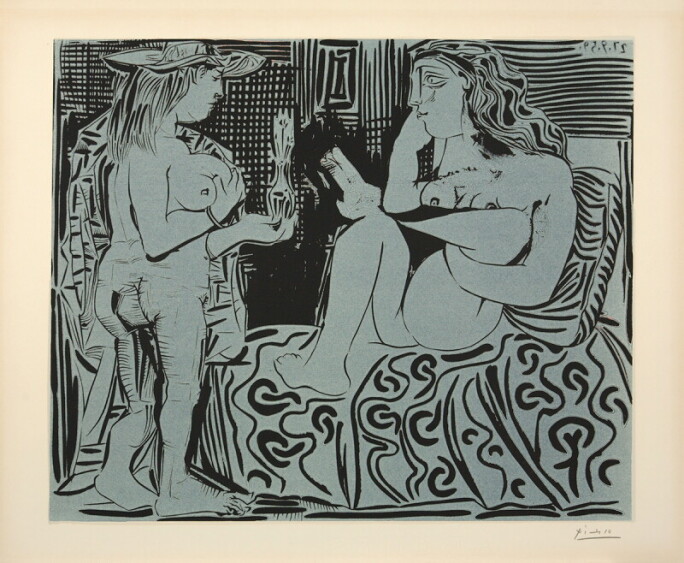
Pablo Picasso began experimenting extensively with linocut in the late 1950s, working with printer Hidalgo Arnéra in Vallauris to develop a technique that allowed him to create increasingly complex compositions through carved linoleum blocks. Deux Femmes Avec un Vase à Fleurs, conceived in 1959, belongs to this important period of experimentation. The composition places two female figures alongside a vase of flowers, revisiting subjects that appeared throughout Picasso's career while exploring the graphic possibilities of the linocut medium.
Printed by Arnéra in 1960 and published by Galerie Louise Leiris in Paris, the work was issued in a standard edition of 50, with an additional 20 artist's proofs. This hand-signed impression belongs to the artist's proof group, distinguished by its cream-white printing against a black ground, which produces a blue-gray tonality. The unusual color relationship gives the composition a different visual character from more conventional multicolor linocuts, while its limited artist's proof status adds another point of distinction within Picasso's printmaking output.
This selection brings together five artists who approached printmaking as an important extension of their broader artistic practices. Dalí used lithography to revisit the personal symbolism surrounding Gala, while Hockney translated poetry into a sequence of etchings and aquatints. Miró and Chagall worked with leading Parisian print workshops to develop their use of color, and Picasso pushed the technical possibilities of linocut through his collaboration with Arnéra.
The differences between these works also highlight the importance of understanding how an edition was produced. Paper, printing methods and the distinction between standard editions and artist's proofs all contribute to the identity of an individual impression. Across these five editions, those details offer a closer view of how major twentieth-century artists used printmaking to develop and extend their ideas.
Whether you’re an established collector or discovering fine art for the first time, Sotheby’s offers a trusted, seamless way to buy and sell editions on the secondary market.
Trust our worldwide network of leading fine art specialists from a globally renowned auction house established in 1744.