Sam Francis Editions: Where Color Becomes Motion
Sam Francis editions reveal how the postwar artist pushed color, light and open space across lithographs, aquatints and some of his most important late prints.

Color was never merely descriptive in Sam Francis’s work. It shaped space, created tension and gave his compositions their sense of motion. Across his career, Francis developed a form of abstraction known for its chromatic intensity and openness. His compositions rarely feel confined by the physical edge of the canvas or paper. Pigment spreads, pools and breaks apart across the surface, while untouched areas give it room to move.
Within postwar American art, Francis developed a visual language distinctly his own. Though often associated with Abstract Expressionism, his work moved in a different direction from many of his contemporaries. Dense, fully worked surfaces gave way to an increasing interest in luminosity and spatial tension. White space was not simply background. It shaped the composition alongside the pigment. His years in Paris and engagement with Japanese aesthetics pushed this approach further, strengthening his interest in balance and the expressive possibilities of empty space.
Sam Francis editions offer another way to see these ideas develop. Printmaking became an essential extension of his practice, giving Francis a format in which he could repeatedly reconsider color and composition. His lithographs, screenprints, etchings and monotypes retain much of the immediacy associated with his paintings while revealing how deliberately he used the technical possibilities of print.
| Category | What to Know |
|---|---|
| Why Editions Matter | Sam Francis treated printmaking as a significant part of his practice rather than simply a means of reproducing ideas developed in painting. |
| Market Demand | Major prints and portfolios connected to Francis’s best-known visual language continue to attract collector interest. |
| Types of Editions | Lithographs, screenprints, etchings, aquatints and monotypes all appear within Francis’s printed practice. |
| Collector Appeal | Francis editions combine bold color and strong visual presence with a direct connection to his experiments in postwar abstraction. |
Sam Francis expanded the possibilities of postwar abstraction through his treatment of color and open space. Gesture remained central to his practice, but he increasingly resisted filling the entire surface. Light and areas of untouched paper or canvas became part of the composition itself.
Color, in turn, rarely stays contained. It spreads across the surface, gathers in concentrated passages and then gives way to expanses of white. Those open areas create tension around each mark and prevent even his most active compositions from feeling crowded.
Francis carried this approach directly into printmaking. His editions are more than accessible counterparts to his paintings; many show him actively working through the same formal questions in another medium. That makes them useful for understanding how his visual language changed across different techniques and periods of his career.
Lithography was particularly well suited to Francis because it could accommodate both spontaneous marks and carefully controlled passages of color. Instead of forcing pigment into rigid forms, the medium allowed him to retain the looseness that characterized much of his painting while experimenting with how individual colors interacted on paper.
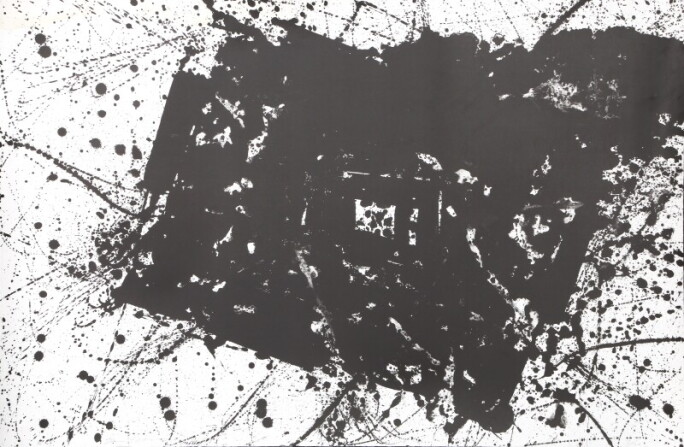
That balance appears clearly in Lover Loved Loved Lover, a 1960 lithograph in colors currently offered through Sotheby’s Buy Now marketplace. Printed by Emil Matthieu at Emil Matthieu Atelier in Zurich and published by Kornfeld and Klipstein in Bern, the work also has a close connection to Francis’s printmaking process. Hand-signed by the artist and inscribed pour M. Matthieu, this printer’s proof was dedicated to Emil Matthieu and exists outside the standard edition of 18.
The title suggests intimacy and exchange, while the composition depends on a much broader push and pull across the sheet. Recorded in the Sam Francis Archive as SF-14, Lover Loved Loved Lover shows Francis using lithography not as a reproduction technique but as a medium with its own expressive possibilities.
Light played a central role in Francis’s abstraction. His compositions can appear illuminated from within, with untouched areas of the sheet intensifying the surrounding color rather than simply sitting behind it. Even highly active passages retain room to breathe.
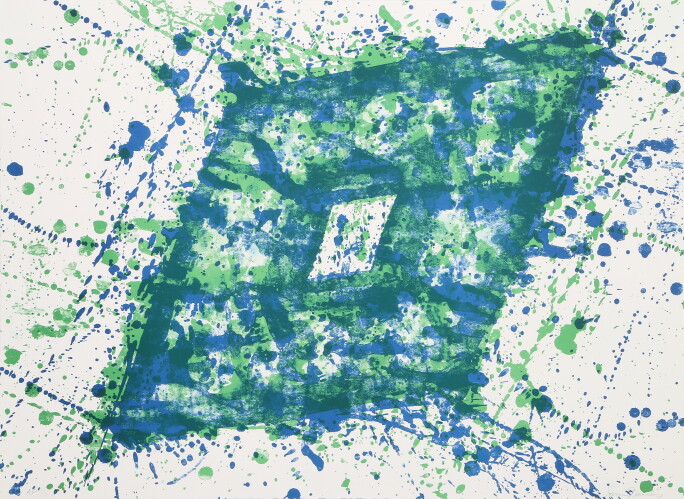
That relationship is especially apparent in Sun Up, a 1964 lithograph in colors currently offered through Sotheby’s Buy Now marketplace. Published by Kornfeld and Klipstein in Bern, the work is hand-signed by Francis and inscribed “artist’s proof” in pencil, produced outside the standard edition of 75. It is recorded in the Sam Francis Archive as SF-63.
Rather than relying on saturation alone, Francis builds the composition through contrast. The title reinforces the sense of emergence in the image, but it is the relationship between pigment and the exposed sheet that gives Sun Up much of its visual energy. Its artist’s proof designation also connects the impression more closely to the production history of the edition.
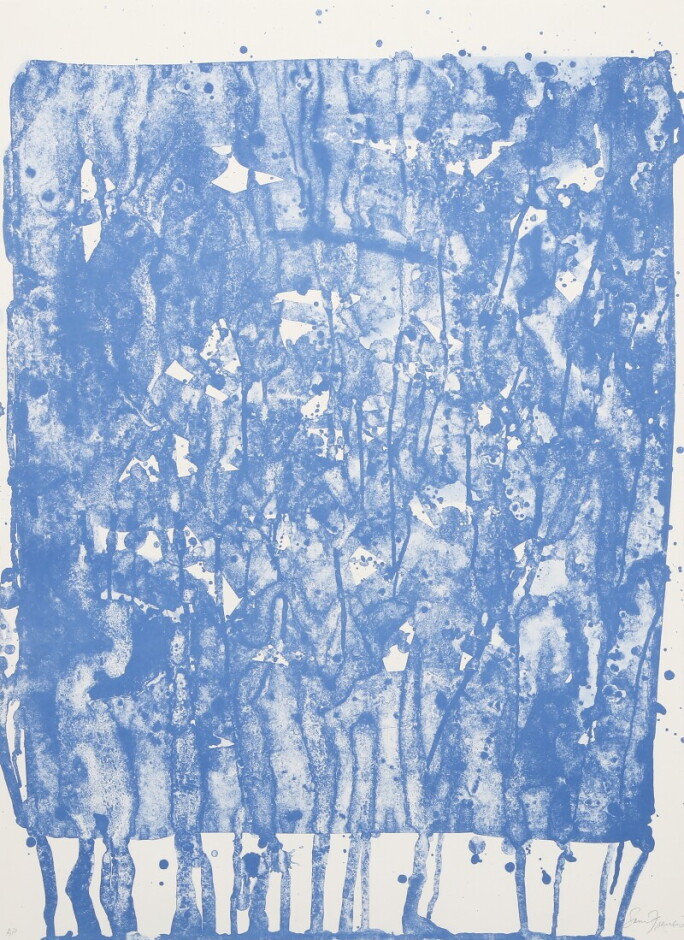
Sam Francis continued making prints into the final years of his career, and the Papierski Portfolio offers a strong view of his late lithographic language. Created in 1992, the works show a more distilled version of ideas he had pursued for decades. The explosive quality of his earlier abstractions remains, but individual marks carry more weight against larger expanses of untouched paper.
Several works from the Papierski Portfolio are currently offered through Sotheby’s Buy Now marketplace, including Untitled (SF 355), Untitled (SF 353) and Untitled (SF 351). Printed on BFK Rives paper and published by The Litho Shop, Inc. in Santa Monica, the lithographs also reflect the importance of Francis’s West Coast printmaking relationships during this period. Untitled (SF 355) and Untitled (SF 351) were issued as signed and numbered impressions from editions of 50, with artist’s proofs aside, while Untitled (SF 353) is signed and numbered in pencil and identified as an artist’s proof.
The tension between pigment and untouched paper becomes particularly pronounced in these late works. Marks appear more isolated, which gives each one greater visual weight. Seen together, the Papierski Portfolio shows Francis returning to longstanding concerns near the end of his career without simply repeating his earlier work.
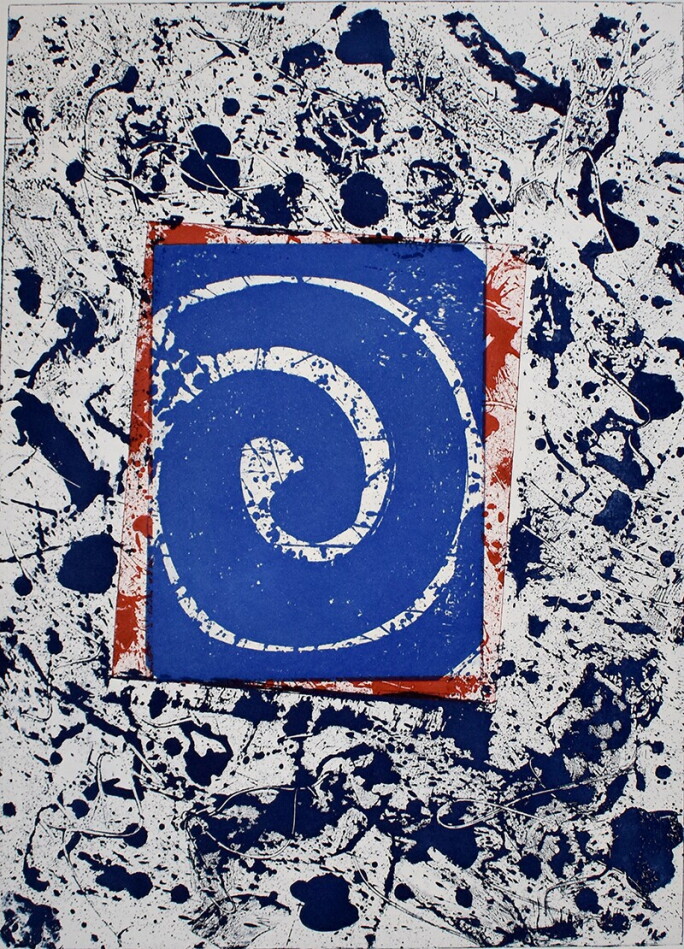
Lithography was central to Francis’s printmaking, but it was not his only area of experimentation. His late aquatints offer a noticeably different experience. They tend toward greater tonal depth and concentration, replacing some of the openness associated with his lithographs with denser passages and more atmospheric surfaces.
Francis continued moving between techniques rather than settling into a single formula. Aquatint gave him another way to control tone and depth, changing the relationship between pigment and paper. The results can feel quieter than some of his earlier prints without losing their visual force.
Untitled (SFE 118), created between 1993 and 1994 and currently offered through Sotheby’s Buy Now marketplace, is one example. Published and printed by The Litho Shop in Santa Monica, the work is numbered 4 from an edition of 20 and bears Francis’s embossed signature. Created at the end of his career, it shows that his experimentation with printmaking continued into his final years.
Printmaking gave Sam Francis something especially valuable: the ability to revisit an idea through variation. Lithography could retain the looseness of his gestures while giving him new control over layering and tonal relationships. Francis did not treat the medium as secondary to painting. He used editions as another arena for testing how pigment could change the experience of a surface.
Collaboration was also fundamental to this process. Francis worked with printers and publishers including Kornfeld and Klipstein, Emil Matthieu Atelier and The Litho Shop in Santa Monica. Their technical expertise helped translate his abstract language into print while allowing each medium to retain its own character. His editions consequently provide more than a connection to his paintings. They document decades of experimentation with the possibilities of print itself.
Sam Francis remains a significant figure in postwar abstraction. His work challenged the assumption that an abstract composition needed to be densely worked to command attention, instead using pigment and untouched space in equal measure. His editions carry that approach across several printmaking techniques and periods of his career.
Francis developed a visual language in which the unprinted sheet could matter as much as the marks placed upon it. In his strongest editions, neither element functions independently: the white space changes how the color is perceived, while pigment determines how the surrounding emptiness behaves.
Proof status can add another layer of interest to Francis editions. Works such as Lover Loved Loved Lover and Sun Up demonstrate how printer’s proofs and artist’s proofs can connect an impression to the production history of an edition. In the case of Lover Loved Loved Lover, the dedication to printer Emil Matthieu makes that relationship particularly explicit.
Francis editions sit at the intersection of postwar abstraction and the broader market for works on paper. They range from highly open lithographs to more concentrated late aquatints, giving buyers considerable choice within a single artist’s printed output. Individual impressions can also differ in edition size, proof status and production history, making close comparison especially important.
Sam Francis editions remain closely connected to the ideas that defined his broader practice. Francis demonstrated how much visual tension could be created without recognizable imagery or a fully worked surface. His prints make that approach particularly easy to trace because they span different techniques and several decades of his career.
They also deserve to be considered on their own terms. Francis used printmaking to test ideas that could change from one medium, printer or period to another. From the early lithographs to the Papierski Portfolio and late aquatints, his editions show an artist continually reconsidering what color could do on paper.
Significance can depend on the period, image, technique, edition size and an impression’s relationship to Francis’s broader practice. Major portfolios, early lithographs and works closely associated with his best-known approach to color and open space can warrant particular attention.
It can. Artist’s proofs and printer’s proofs sit outside the standard numbered edition and may have a closer connection to the production process. Proof status should still be considered alongside the quality and importance of the image itself.
The Papierski Portfolio is a group of Sam Francis lithographs from 1992. Works including Untitled (SF 355), Untitled (SF 353) and Untitled (SF 351) show how Francis’s treatment of gesture and open paper developed late in his career.
Francis’s lithographs often emphasize loose gesture and expanses of open paper, while his late aquatints can have greater tonal density and surface depth. Looking across techniques shows how he adapted his abstract language to the particular possibilities of each printmaking process.
Start with the image itself and where it sits within Francis’s career, then consider the printing technique, edition size and proof status. Printer, publisher and catalogue references can provide further context for the individual impression.
Whether you are beginning a contemporary art collection or expanding an established one, Sotheby’s offers a trusted, seamless way to buy and sell Sam Francis editions on the secondary market.
Trust our worldwide team of leading contemporary art specialists at a globally renowned auction house established in 1744.