
Nina Chanel Abney’s Radical Clarity
Photography by Miranda Barnes
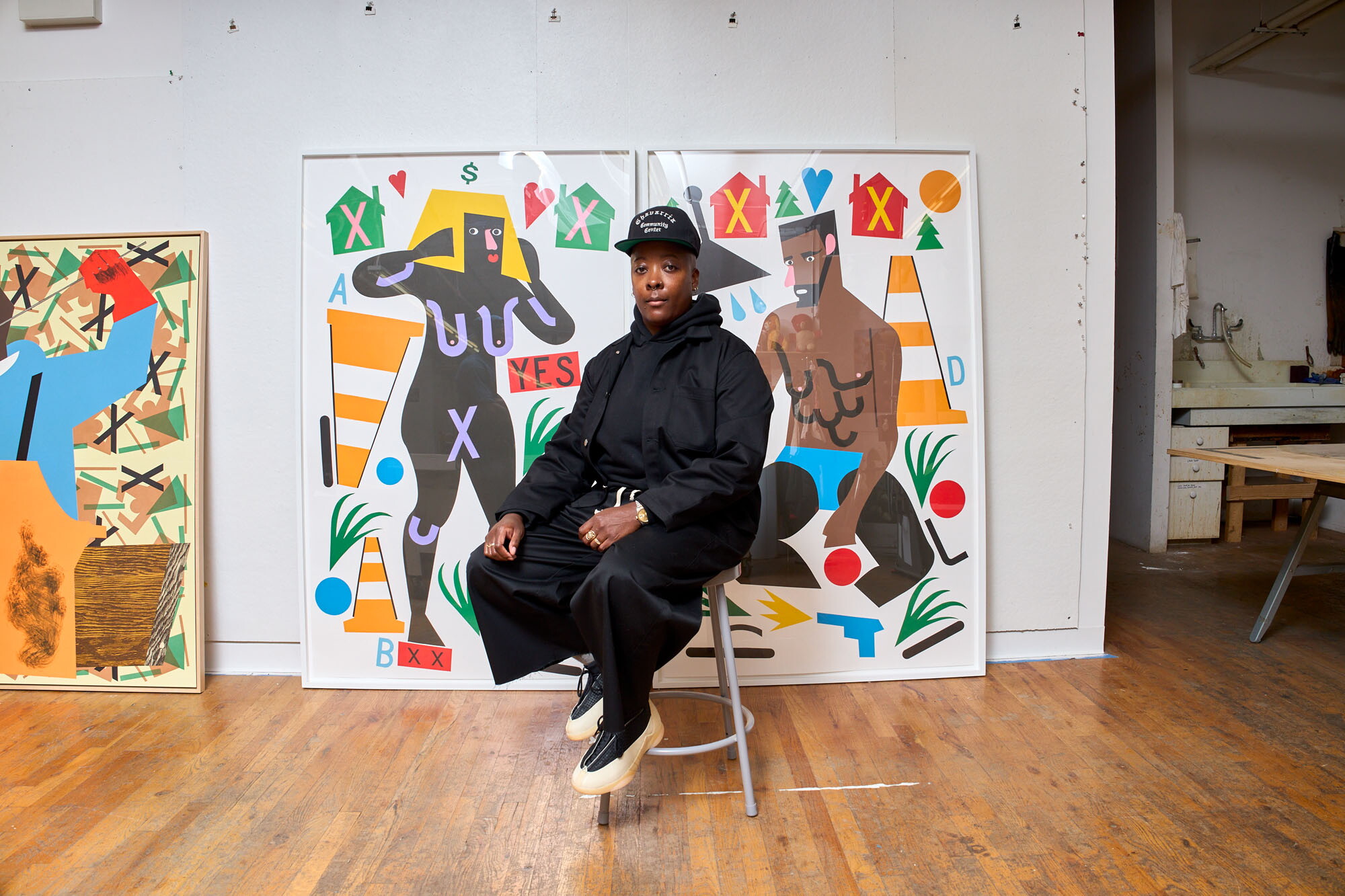
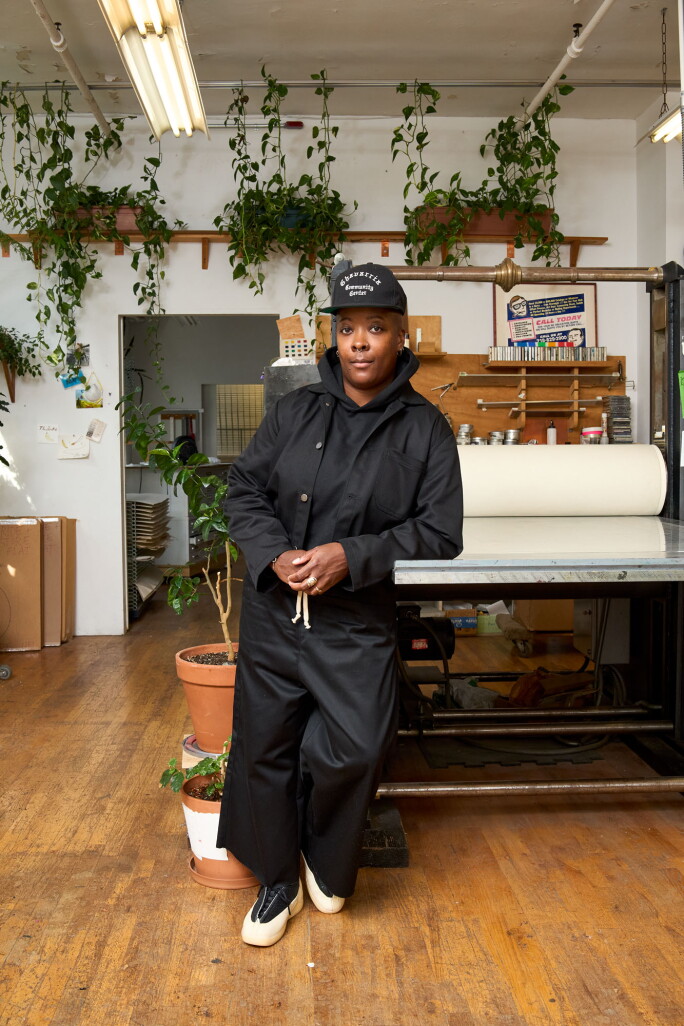
P reparedness makes poetry in Nina Chanel Abney’s practice. “My process usually begins with me jotting down ideas and then immediately going into research mode. I start looking for references, images and media that relate to whatever I am thinking about,” says the New York-based artist. “By the time I begin actually making the work, I have built a pretty large arsenal to work with. It’s what allows me to be intuitive.”
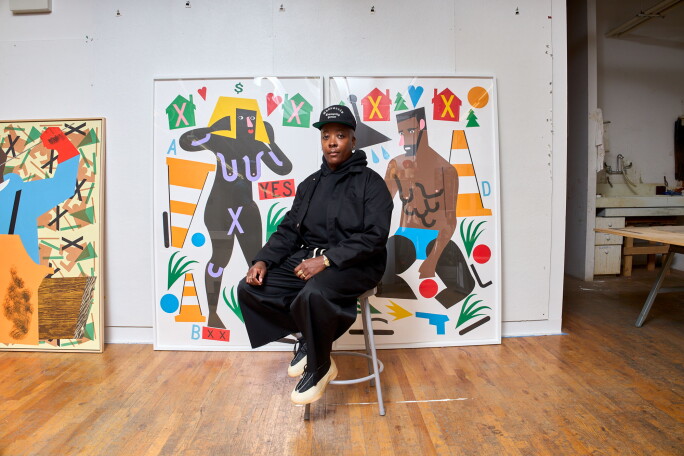
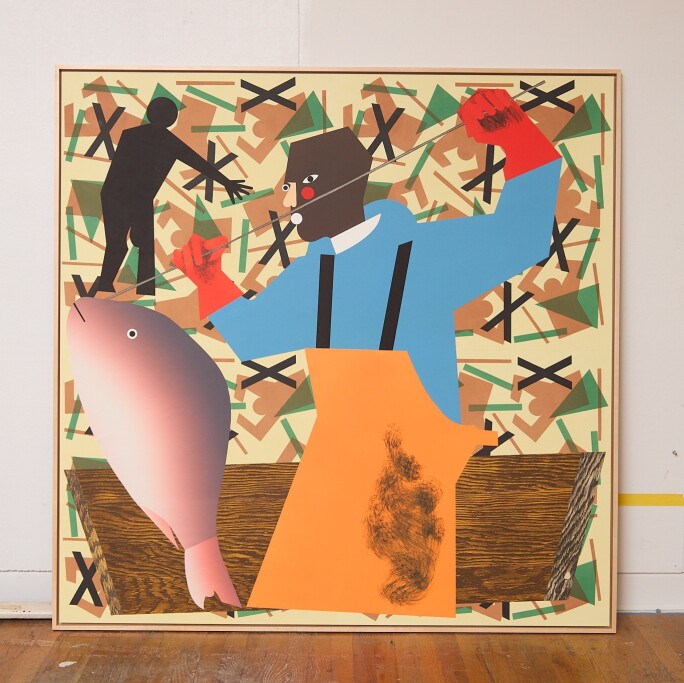
Across myriad mediums—spray paint and acrylic paint; collage; prints; large-scale murals; sculptures made of steel, aluminum and vinyl; digital media; installation; and stained glass—Abney’s visual language remains consistent. Her formal language is simple, straightforward, often created through the use of stencils, reflecting her preference for pre-planning. “No matter what medium I work in, cutouts or their inverse, stencils, have become central to my approach,” says Abney. Her palette is almost shocking in its radiance, with her graphic, intentionally one-dimensional style further emphasizing the impact of her color spectrum, the multi-dimensionality of her subjects and the dynamic scenes she sees fit to imagine.
The prevailing spirit is as expansive as her bright, joyous palette, tackling experiences as wide ranging as eating, attraction or the climate. “If you Google my work, it will probably say [it’s about] race, gender, sexuality, politics and pop culture,” Abney says. “Those things certainly exist, but I don’t think of my practice as being restricted to a fixed set of subjects.”
“Any and everything about the subject matter at hand consumes my thoughts.”
“I enjoy distilling complicated subjects through imagery,” she continues. “I can make work about politics, environmental instability, desire, fishing, food, sports, technology or something completely mundane.” The emphasis on variety is important, as Abney, like many Black American artists, has been subjected to a flattening of her personhood and practice in the press. Her images might be easy to read, but they are never simple. “I am not interested in restricting myself,” she says. “The subject can change completely and the work can still be mine.”
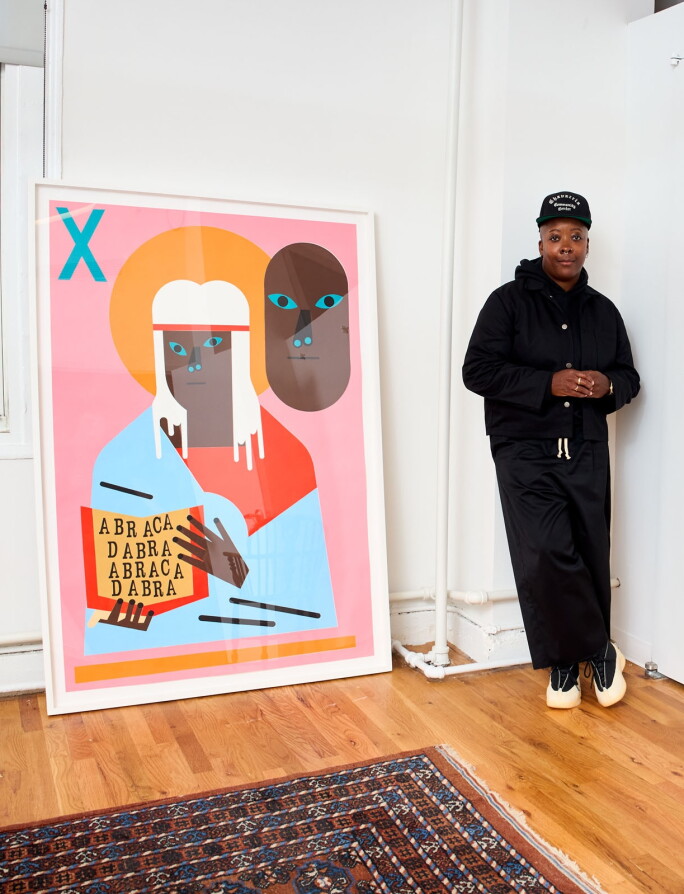
Initially the conceptual tissue that connected all of Abney’s work was its responsiveness. “[It] became a record of what I was paying attention to at different moments of my life,” she says. Her most pressing and intense concerns at any given moment served as fodder for her early pieces. But then she grew.
“As headlines change, many of the underlying issues we deal with as the human race do not. They just continue to reappear in different forms,” says Abney. “As I have matured and my practice has evolved, I have become less interested in simply responding to individual events and I have become more interested in the larger systems underneath them.”
Apart from all her research, Abney also spends much time in contemplation. She moved her studio to upstate New York a few years ago, in search of better focus and more space. But she’s since come to realize that distractions are integral to her creative process. “I’m like the final boss of multitasking,” she jokes. “I can be painting while watching TV, talking to a friend on the phone and thinking through three other projects. My creative practice at times is a direct reflection of how I consume information: disjointed, scattered, disparate elements forced into cohesion.”
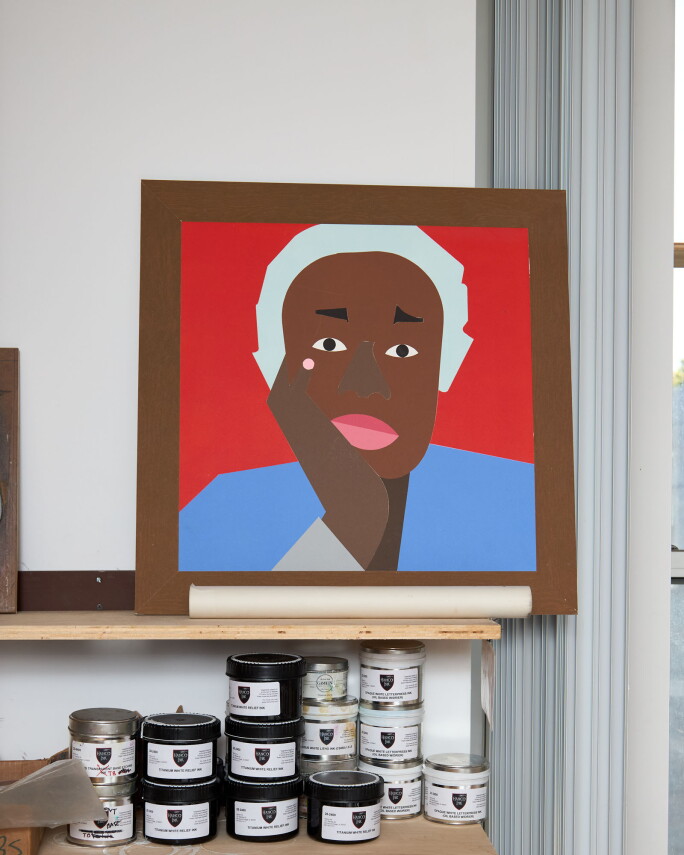
Perhaps Abney manages this balance so elegantly because of the stability with which she was raised in the south suburbs of Chicago. “It was actually a pretty great experience,” she says of her childhood. The communities she lived in had some of the highest rates of Black homeownership in the United States. “I grew up seeing Black life occupy a version of American suburbia that popular culture has often coded as white. It shaped my sense of what was possible and gave me a certain confidence about what I could achieve. I didn’t fully understand the significance of that until I was older.”
As most young adults do, Abney yearned for the opposite of her childhood experience: exposure to urban life. But as she settled into adulthood her preferences shifted and she came to appreciate the peace of what she had previously considered a “mundane suburban existence.” Bridging that realization were four years studying studio art and computer science at Augustana College, in western Illinois, followed by a master’s degree in fine arts at Parsons School of Design in New York City. Since graduating from Parsons in 2007, Abney has gone on to show robustly around the country and is currently represented by Jack Shainman, Perrotin and Pace Prints.
A first solo museum exhibition opened at the Nasher Museum of Art in Durham, North Carolina, in 2017. Her solo show at Palais de Tokyo opened a year later, followed by “Safe House” at the Institute of Contemporary Art in Boston, “Big Butch Energy” at the Institute of Contemporary Art in Miami and “Fishing Was His Life” at the Gordon Parks Foundation in New York City. “The Pursuit of Happiness” closed in August following a successful run at the Virginia Museum of Contemporary Art in Virginia Beach. And then there are the auction records, which luckily never burst Abney’s bubble. Her work “Paradise Found” sold for more than a quarter of a million dollars at Sotheby’s in 2019, a decade after it was made. Only two years later her auction record more than tripled. This is the trajectory of someone who likes to be prepared.
Abney’s work falls comfortably within the lexicon of contemporary American visual art. She is plugged into what her peers are doing, citing Arthur Jafa, Theaster Gates, Derek Fordjour, Rashid Johnson, Tschabalala Self, Lauren Halsey, Torkwase Dyson, Tom Sachs, David Hammons, Derrick Adams and Alex Da Corte as working artists she respects. “I am completely inspired by artists whose magic screams no matter what medium they work in,” Abney says. “You can recognize the mind behind the work whether they are making film, music, performance, painting, sculpture, writing, fashion or something else entirely. What interests me now is seeing artists build worlds.”


Abney strips many of her subjects of identifiable symbols or traits. Their anonymity and ambiguity allows for a larger group of people to connect with the work without categorizing it, its maker or its subject. “I want my work to be accessible enough that you can enter it immediately, but layered enough that you won’t be able to resolve it in one encounter,” says Abney. “Color, humor, familiar iconography and environments may draw you in, but once you are there, things become much more complicated.” The accessibility that Abney mentions inhabits a conscious position in her practice, far past what is expected of contemporary artists today.
Abney’s priority is to elicit emotion and a response, any response, from as wide of an audience as possible. “Her work is joyful, playful and really smart,” says Diane Brown, a former gallerist and the founder of RxART, a non-profit that brings together contemporary artists with hospitals to install art that enhances and eases the patient experience. Abney partnered with RxART in 2022, creating “Fun #1,” a mural for the Pediatric Ambulatory Clinic at NYC Health + Hospitals/Elmhurst in Queens. At the time of writing, she’s working on “Fun #2,” a second project for the hospital, which carries particular cultural resonance as the epicenter of New York City’s first COVID wave. Installation will take place next year.
“Diane approached me many years ago about doing a project with RxART, and there has been a real synergy ever since,” Abney says. “Working with RxART is amazing because there is a clear shared mission: creating a sense of joy, wonder, curiosity and inspiration for patients.”
Brown recalls when Abney started her first RxART project: “She came out all the way from Newark [where she was living then] and spent a lot of time looking and talking to the staff and patients. She really considered the kids who are going to be living with this art.”
“I automatically wanted to go above and beyond expectations,” Abney recalls. “No one really enjoys going to the hospital. I knew that children and their families were entering a typically stressful environment under difficult circumstances, and I wanted to give them something immersive and pleasant; something they could explore, discover and escape into.” The result is its own reward. “To see a child respond to my work by pointing something out, or become curious about or connected to an image because they see a representation of themselves in it, is incredibly moving,” Abney says.
Abney’s values dovetailed with RxART’s agenda even before their collaboration. Her work has served as a catalyst for connection and community in both Memphis, Tennessee, and Brooklyn, New York, where she designed bright basketball courts for children, and in her massive “NYC LOVE” mural from the same year for the High Line. Her multipanel “San Juan Heal” mural enlivened the facade of David Geffen Hall at Lincoln Center when the concert venue reopened in 2022—paying homage to San Juan Hill, the Black and brown neighborhood destroyed during the 1940s and ’50s, in part to make way for the building of the arts complex itself.
Abney’s openness to collaboration connects deeply with the desire for her work to be as accessible as possible and for that accessibility to never come at the cost of quality. She has partnered with Mattel on an UNO deck, designed her own Air Jordans and worked with Tiffany & Co., Beats by Dre and Timberland. “Commercial collaborations with artists can feel like an afterthought, where an existing artwork or graphic is simply reproduced on a product,” Abney says. “That does not interest me.”
These projects are very deliberate choices for Abney and allow her to thoroughly explore new ways and means of making. “I like to immerse myself in whatever specific medium I am working in,” Abney says. “When I am in the zone I become obsessive about whatever I am working on. Any and everything about the subject matter at hand consumes my thoughts.” While designing her UNO deck, Abney thought about the game, what the cards mean, how they are held in a hand, the rules and so on.
“I want any fan of my work to have the same quality of experience whether they encounter it through a sneaker or a painting,” Abney says. Brown points out that many of the patients who will see her work in Elmhurst might not have the means or time to see art in a museum. “Accessibility should not mean a lack of intention,” says Abney, and that is the thread that runs through it all: her purpose, her style, her partnerships and her practice at large.

