When Watches Became Jewelry: The History of the Women's Jewelry Watch
Trace the history of women’s jewelry watches, from Art Deco cocktail watches and hidden dials to Piaget gold cuffs and Bvlgari Serpenti.

Long before wristwatches became standard accessories for men, women were wearing timepieces as jewelry. Early examples took the form of decorative bracelets, with miniature watch movements incorporated into gold and gemstone-set designs. By the early 20th century, houses such as Cartier and Tiffany & Co. were creating watches that belonged as much to the world of fine jewelry as they did to traditional watchmaking. The bracelet was often the main attraction, while the dial could be small enough to disappear into the design.
The history of women's jewelry watches is closely tied to changing tastes in fashion and decorative arts. Art Deco brought geometric diamond settings and contrasting materials to the wrist during the 1920s, while cocktail watches made timekeeping part of evening jewelry. Secret watches took the idea further by concealing the dial altogether. By the 1960s and 1970s, Piaget and Bvlgari were exploring a different direction, incorporating watches into substantial gold cuffs and sculptural bracelets.
Vintage women's watches are receiving renewed attention for the inventiveness of these designs. A diamond-set Cartier cocktail watch works very differently from a Piaget cuff with a hardstone dial or a coiled Bvlgari Serpenti. Together, they trace a history in which the wrist became a testing ground for ideas that crossed watchmaking and jewelry design
| Key Development | What Collectors Should Know |
|---|---|
| Women wore wristwatches before they became standard men's accessories | Early bracelet watches incorporated miniature movements into decorative gold and gemstone-set designs, establishing a close relationship between women's watchmaking and jewelry. |
| Art Deco transformed women's watches in the 1920s | Geometric cases and platinum settings reflected the period's jewelry design, with Cartier and Tiffany & Co. among the important makers. |
| Cocktail watches made timekeeping part of evening jewelry | Popular during the early and mid-20th century, these watches featured small dials and elaborate bracelets, often set with diamonds or pearls. |
| Secret watches concealed the dial within a jewel | Hinged covers and decorative elements allowed watches to resemble bracelets until the time was revealed, making concealment part of the design. |
| Gold cuffs and bangle watches introduced bolder proportions | By the 1960s and 1970s, makers such as Piaget were incorporating ultra-thin movements into substantial gold designs, often featuring colorful hardstone dials. |
| Jewelry houses developed distinct watchmaking identities | Bvlgari's Serpenti, Chopard's Happy Diamonds and Van Cleef & Arpels' decorative bracelet watches approached the relationship between jewelry and timekeeping in markedly different ways. |
| Vintage jewelry watches offer a distinct collecting category | Period-specific designs and unusual construction help distinguish historical jewelry watches from conventional wristwatches. |
The history of women's wristwatches begins well before the wristwatch became a practical necessity. In 1810, Caroline Murat, Queen of Naples, commissioned Abraham-Louis Breguet to create a watch designed to be worn on the wrist, completed in 1812. By the late 19th century, miniature movements were being incorporated into decorative bracelets, allowing women to wear timepieces alongside other fine jewelry. Men's watches, meanwhile, remained largely associated with the pocket until military use and changing habits helped popularize the wristwatch in the early 20th century.
These early women's watches often borrowed their construction from jewelry rather than conventional watchmaking. Gold links and decorative settings framed small dials, while the bracelet could account for much of the piece's visual character. A Patek Philippe lady's gold wristwatch, sold for €8,400 EUR in October 2024, shows how closely the two disciplines could overlap. Its rectangular gold case is integrated into a bracelet of openwork square links, with a cream dial featuring Roman numerals and a manually wound movement. Although its production date is not established in the catalogue information, the bracelet is integral to the watch's identity rather than merely supporting the case.
The distinction between a watch and a jewel was already fluid. A timepiece could be valued for its movement while being worn primarily as an ornament, a relationship that became more elaborate with the arrival of Art Deco.
By the 1920s, women's watches had become an important expression of Art Deco jewelry design. The flowing ornamentation of earlier periods gave way to sharper geometry, with platinum settings and contrasting materials creating new possibilities for watchmakers. Dials were integrated into elaborate compositions of diamonds and colored enamel, often with little distinction between the watch case and the surrounding bracelet. Timekeeping became one element within a larger jewelry composition.
The Tiffany & Co. Diamond Watch, circa 1930, sold for £18,000 GBP in May 2024, captures this aesthetic. Its geometric case incorporates diamonds in several cuts, while a black-and-white enamel dial with blue steel hands provides graphic contrast. The mesh bracelet softens the angular case, setting rigid geometry against the flexibility of fine jewelry.
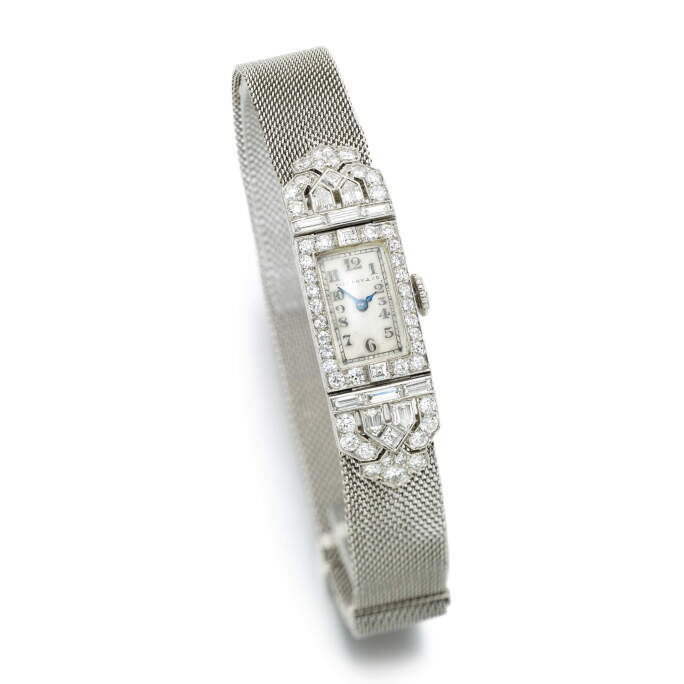
As women's evening jewelry became more elaborate, the cocktail watch emerged as a decorative alternative to the conventional wristwatch. Typically distinguished by a small dial and an ornamental bracelet, these watches were designed to complement formal dress. Diamonds often surrounded the case, while pearls and intricate metalwork could make the timepiece appear closer to a bracelet than a watch.
A Cartier Diamond Cocktail Watch, circa 1920s, sold for £20,000 EUR in April 2013, offers an early example of this approach. Its rectangular Roman numeral dial is framed by diamonds and attached to a delicate seed pearl mesh bracelet with a Cartier clasp. Platinum and gold support the diamond setting, but the seed pearls give the watch much of its character as an evening jewel. The dial remains discreet within the composition.
As jewelry watches became more elaborate, some makers began concealing the dial entirely. Secret watches, also known as hidden-dial watches, incorporated miniature movements beneath hinged covers or decorative elements that could be lifted or moved aside to reveal the time. The concept developed during the early 20th century and became an important expression of high-jewelry watchmaking. A functioning watch could effectively disappear inside a bracelet until its wearer chose to reveal it.
The Patek Philippe Lady Ellipse Reference 4105/1, circa 1970, shows how far the concept moved beyond the diamond-set designs of the Art Deco period.
Sold for €44,800 in October 2026, this yellow gold secret bracelet watch incorporates rubies and diamonds into its design, with a gilt hammered dial and manually wound calibre 13.5 movement. Its substantial gold construction belongs firmly to the 1970s, while the concealed dial connects it to a much earlier jewelry-watch tradition.
Concealment also created a technical challenge. Fitting a mechanical movement within a bracelet required careful consideration of proportions and construction, often producing designs that differed considerably from conventional wristwatches. Vintage secret watches reveal how differently makers could resolve the balance between ornament and function.
By the mid-20th century, women's jewelry watches were moving beyond the delicate diamond-set designs associated with the cocktail watch. Gold became a more prominent feature, with textured surfaces and substantial bracelets taking the place of intricate platinum settings. The bracelet was no longer supporting the watch; its shape and construction increasingly defined it. This shift became especially pronounced during the 1960s and 1970s, alongside the rise of bolder gold jewelry.
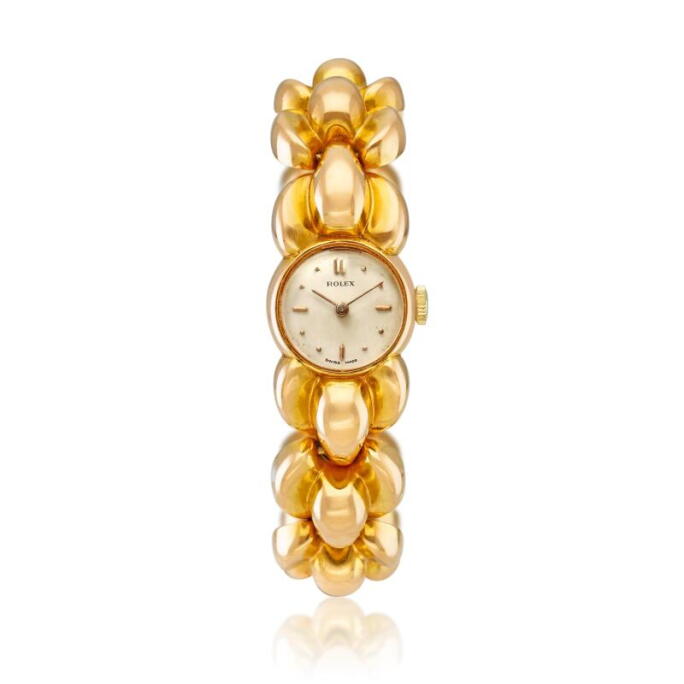
The Rolex Cellini Lady's Gold Bracelet Watch, circa 1975, captures that change in proportion. Sold for €22,680 EUR in September 2022, the watch features an oval case in textured 18-karat gold, paired with a bracelet composed of broad oval links in the same finish. The gold dial continues the effect rather than interrupting it. With a gross weight of approximately 142 grams, the watch has the physical presence of the substantial gold jewelry favored during the period.
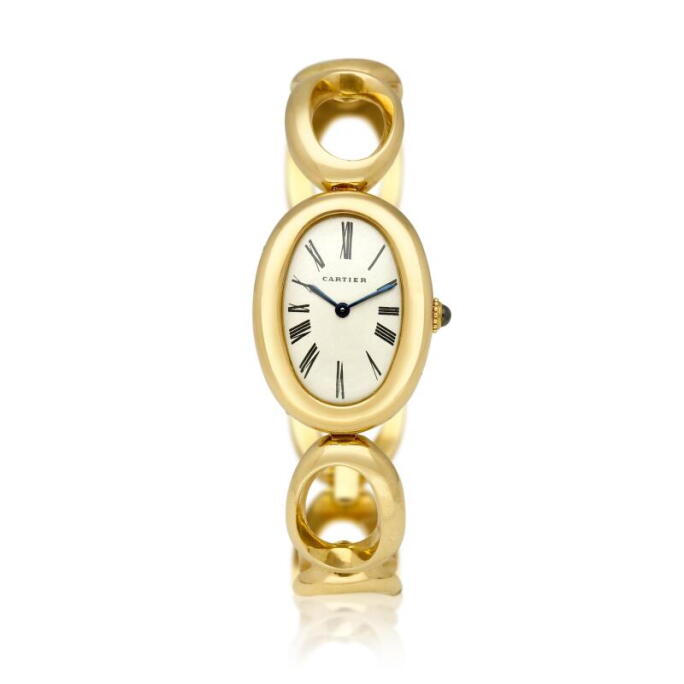
Cartier approached the jewelry watch through a different design language. The Cartier Baignoire Yellow Gold Bracelet Watch, circa 1990, currently offered through Sotheby's Buy Now marketplace, features the elongated oval case associated with the Baignoire collection. Its origins trace to an oval watch design created by Louis Cartier in 1912, although the Baignoire name was adopted later. Where the Rolex Cellini builds its character through textured gold and articulated links, the Baignoire depends on the elongated case and the continuity of its curves. Gemstones are unnecessary to give either watch the presence of a jewel.
During the 1960s and 1970s, Piaget pushed women's jewelry watches into more experimental territory. The introduction of its ultra-thin calibre 9P in 1957 gave the house greater freedom to incorporate mechanical movements into elaborate gold designs. Ornamental stone dials became a signature of the period, with materials such as lapis lazuli and malachite bringing vivid color to watches that often resembled sculptural bracelets. The movement's slim profile gave the surrounding jewelry room to become more ambitious.
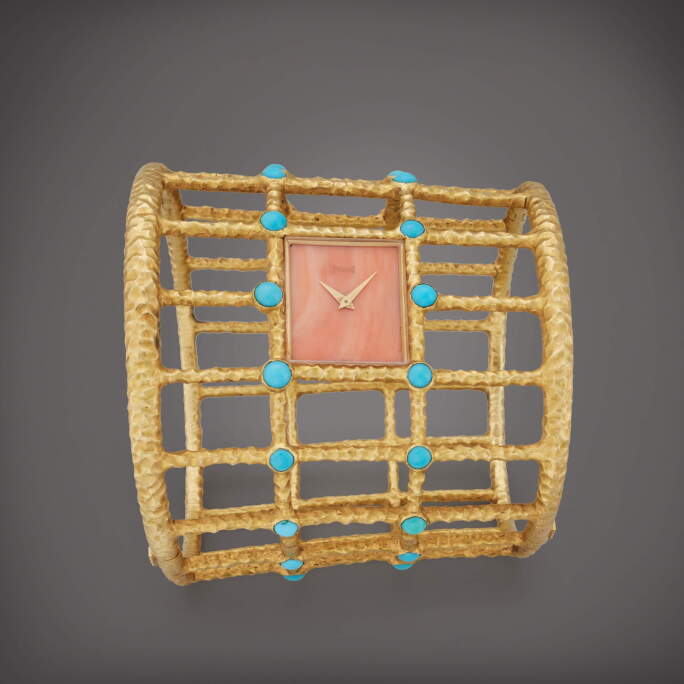
The Piaget Reference 9150 D 93, sold for $50,800 USD in December 2023, captures this period of experimentation. Its coral dial is surrounded by an 18-karat yellow gold cuff bracelet set with 32 turquoise cabochons, placing two saturated materials in direct contrast. Inside is Piaget's manually wound calibre 9P. Because the movement required relatively little space, the broad cuff and ornamental stones could dominate the composition without a bulky watch case at the center.
Piaget's vintage jewelry watches often depend on this close relationship between movement and material. Hardstone dials require careful cutting and finishing, while elaborate gold bracelets introduce construction challenges of their own. The exact pairing of dial material and bracelet design can separate one reference from another even within the same period.
Bvlgari approached the jewelry watch through the serpent motif, which became central to the house's designs during the 20th century. Introduced in the late 1940s, early Serpenti watches featured flexible bracelets inspired by the Tubogas technique, allowing them to coil around the wrist. Later versions incorporated sculpted serpent heads and gemstone settings, with dials either concealed within the design or integrated into the head. Serpenti was conceived around the body and movement of the serpent, with the watch incorporated into that larger form.
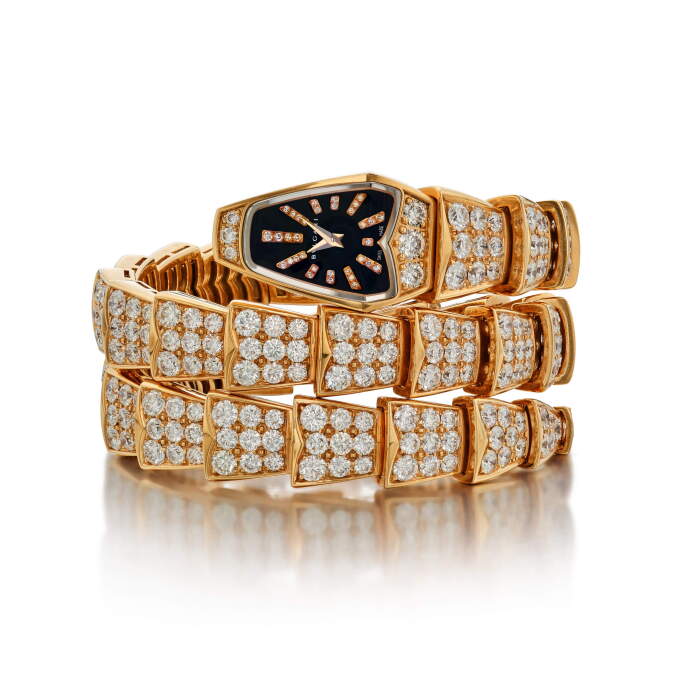
The Bvlgari Pink Gold and Diamond Serpenti Viper Wristwatch, sold for $76,200 USD in December 2025, offers a later interpretation of the idea. Its expandable pink gold bracelet forms a stylized serpent, with diamonds set along the body and a black dial positioned within the head. The quartz movement allows the watch to maintain its compact proportions. Compared with the early Tubogas examples, the Viper abstracts the serpent further while preserving the coiled architecture that defines Serpenti on the wrist.
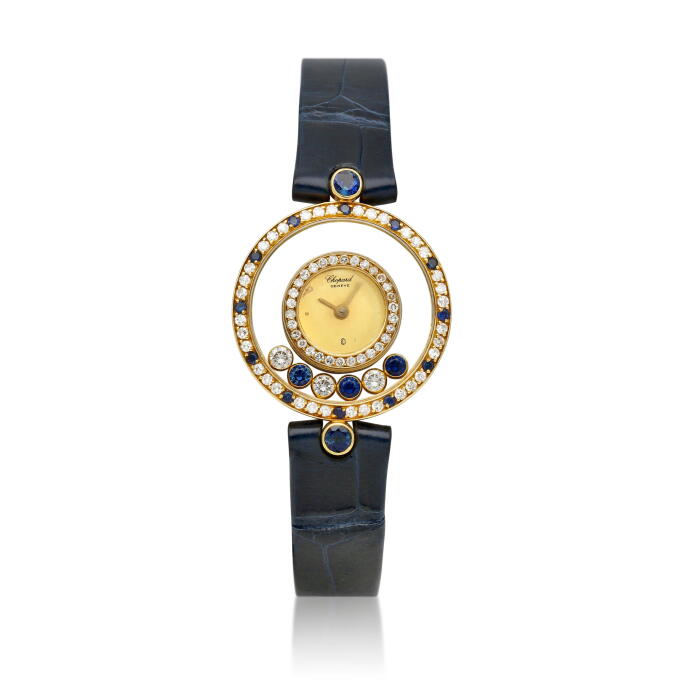
In 1976, Chopard introduced Happy Diamonds, a design that brought a new kind of movement to jewelry watches. Diamonds were placed between two transparent sapphire crystals, allowing them to move freely rather than remain fixed within traditional settings. The stones became active elements of the design, changing position with the movement of the wrist. It marked a departure from earlier cocktail watches, where diamonds were generally arranged in fixed decorative patterns.
The Chopard Happy Diamonds Reference 218837, circa 1990, develops that idea within a 23mm yellow gold quartz watch. Sapphire and diamond settings surround the case, while Chopard's signature moving diamonds occupy the center of the design. Here, movement is not confined to the watch mechanism itself; it becomes part of the jewelry.
Van Cleef & Arpels has long approached watchmaking through the traditions of fine jewelry, developing timepieces in which the bracelet and decorative setting are integral to the design. While the house's historical secret watches concealed their dials beneath jeweled covers, later creations have also embraced more visible forms of timekeeping. Diamond settings and jewelry-led bracelet construction continue to connect these watches to the house's broader design vocabulary.
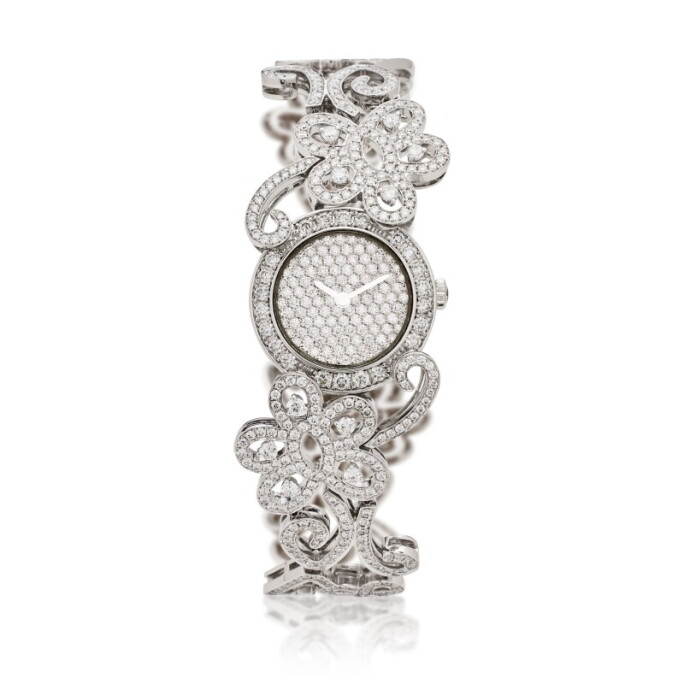
The Van Cleef & Arpels Dentelle Reference ARD66200, dating to 2014, takes that approach to an elaborate scale. Crafted in 18-karat white gold, the watch features approximately 795 round brilliant-cut diamonds totaling 8 carats, extending across the dial, bezel and bracelet. Its floral-inspired links and concealed clasp give the piece the appearance of a continuous diamond bracelet. The quartz movement sits discreetly within the composition, allowing the jewelry design to remain visually dominant.
The history of women's jewelry watches shows how closely jewelry design and watchmaking developed alongside one another. The geometric diamond settings of 1920s cocktail watches gave way to Piaget's sculptural gold cuffs, while Bvlgari built an entirely different kind of watch around the Serpenti form. These pieces also challenge the assumption that women's watches were scaled-down counterparts to men's designs. Many required movements and construction conceived around decorative forms rather than conventional watch cases.
Vintage jewelry watches offer a different way of looking at watchmaking, one in which design can carry as much significance as the movement. Integrated gold bracelets and hardstone dials can distinguish important examples, as can concealed mechanisms. Condition deserves equally close attention, especially when original decorative elements are integral to the construction. Whether considering an Art Deco Cartier cocktail watch or a 1970s Piaget cuff, the relationship between the timepiece and the jewel is what gives this category its character.
Women wore wrist-mounted timepieces by the early 19th century. Abraham-Louis Breguet created one for Caroline Murat, Queen of Naples, in 1812, with decorative bracelet watches becoming more established later in the century.
A cocktail watch is a small, decorative wristwatch designed as jewelry. A secret watch conceals its dial beneath a cover or decorative element. Some historical watches fit both categories.
Piaget combined ultra-thin movements with sculptural gold bracelets and ornamental stone dials. The specific pairing of materials and bracelet design can distinguish one reference from another.
Not necessarily. Movement matters, but construction and jewelry design can be equally significant. Quartz examples from Bvlgari or Van Cleef & Arpels can still represent distinctive periods or designs.
Look closely at the dial, bracelet, gemstone settings and overall condition. Original components and documented alterations are especially important for watches with integrated bracelets or concealed mechanisms.
Whether you're a seasoned collector or searching for your first luxury watch, Sotheby’s offers a trusted, seamless way to buy and sell women’s watches on the secondary market.
Trust our worldwide network of leading watch specialists from a globally renowned auction house established in 1744.