
225 Years in Motion: Breguet Celebrates the Tourbillon
Four new watches revisit Abraham-Louis Breguet’s celebrated invention, combining historic watchmaking ideas with contemporary design and technical innovation.


I f you’re a hardened horophile, the word “tourbillon”—which translates as “vortex” in English—will be familiar. If not, you may have wondered what one is and why it still matters.
For watchmakers of the late 18th century, gravity posed a practical problem. A pocket watch carried in a waistcoat could spend hours in much the same upright position, affecting the regularity of its timekeeping. Abraham-Louis Breguet, the Neuchâtel-born watchmaker who established his workshop in Paris in 1775, found a solution: placing the balance wheel and the escapement—the mechanism that releases the watch’s stored energy in measured steps—inside a rotating cage. As the cage turns, it carries those components through different vertical positions, averaging out errors that might otherwise persist.
Breguet patented the mechanism on June 26, 1801, but conceiving the tourbillon was one thing; making it was another. Only 35 were sold during Breguet’s lifetime. Yet an invention born of the search for precision remains, for many collectors, the ultimate expression of the horologist’s art.
More than 160 years later, a tourbillon became available in a Breguet wristwatch thanks to a young and brilliant maker called Daniel Roth, who helped to return the revered name to the spotlight after a long period during which it was known mainly to collectors of the best antique pocket watches. Working at Breguet in the 1970s and 1980s, Roth helped translate the founder’s visual language—such as fluted cases, engine-turned dials and Breguet’s characteristic blued hands and screws—into watches for a new era. In 1989, the Reference 3350 Classique brought the tourbillon into a wristwatch made by the modern-day Breguet. Its direct descendant, the Classique Tourbillon 7357, is one of four models marking the patent’s 225th anniversary.

The 7357 offers a more contemporary aesthetic and can be had in either 950 platinum or 18K Breguet gold. Both are powered by the hand-wound Calibre 187B, an optimized successor to the original’s Calibre 588 movement. It retains the earlier movement’s frequency and extends the power reserve to 60 hours, while a Breguet Nivachron balance spring and silicon escapement components provide greater resistance to magnetism. The lugs of the beautifully restrained 35 mm case have also been redesigned to better follow the curve of the wrist, while the watch remains rich in Breguet signatures throughout—from the fluted case band and traditional Breguet hands to an engine-turned dial combining Clous de Paris at the center with a barleycorn pattern at the edge. The tourbillon itself sits slightly below the dial at six o’clock.
A look through the sapphire crystal case back, meanwhile, reveals a superbly finished movement baseplate carrying a new guilloché pattern inspired by the Dent de Vaulion in the Vallée de Joux. “Everything about this creation is directly linked to the Tourbillon’s amazing history,” says Breguet CEO Gregory Kissling.
The second anniversary piece is a new version of the Classique Tourbillon Sidéral 7255, first introduced in 2025 as Breguet’s first flying-tourbillon wristwatch. It also brings back the “mysterious” display, a construction the house had not used for nearly 20 years. The use of the word “mysterious” refers to the fact that the tourbillon cage appears to revolve without being connected to the movement. In reality, it is connected by gears made from anti-reflective sapphire crystal that render them all but invisible. The tourbillon, meanwhile, is of the “flying” variety—meaning it is held in place only by a lower bridge to give the impression that it is floating freely within its aperture.

Limited to 50 examples, the watch combines a platinum case with a black aventurine Grand Feu enamel dial flecked with green, suggesting a night sky around the moving tourbillon. The effect also recalls Breguet’s interest in astronomy: Kissling describes the tourbillon as “a direct evocation of the solar system as it was mapped in the 18th century.”
The third anniversary piece is the platinum-cased Tradition Tourbillon 7047, which sets the watchmaker’s genius alongside that of Leonardo da Vinci, whose late-15th-century drawings record the geometry of the fusee-and-chain system, although the principle itself predates him. Here, the tourbillon and fusee-and-chain perform different jobs: the rotating cage averages positional errors associated with gravity, while the chain winds around a cone-shaped fusee to help maintain consistent torque as the mainspring unwinds.
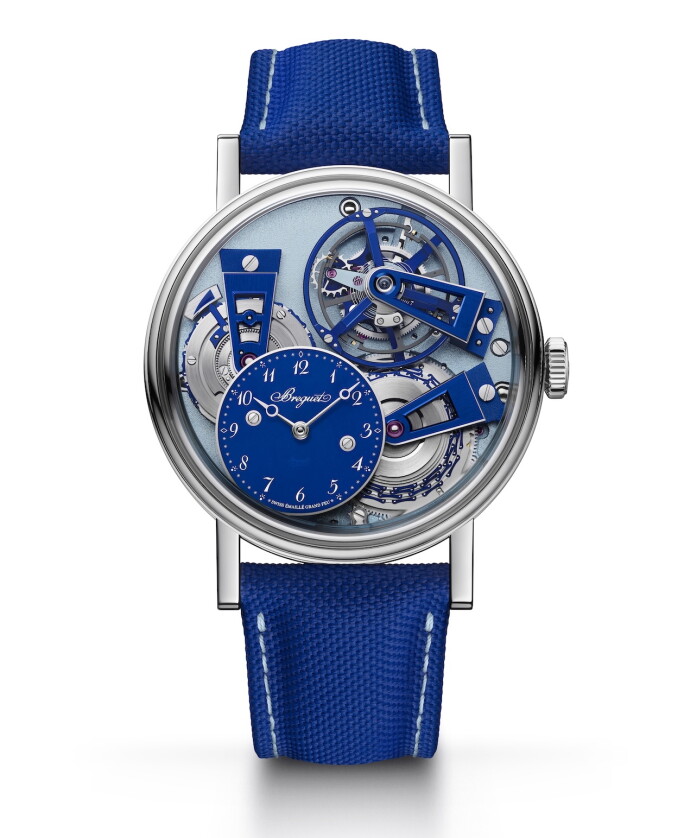
The beauty of the system is highlighted by the use of Breguet’s own Bleu de France across the dial, bridges and sections of the chain, contrasting with the glacier-blue hue of the sandblasted mainplate. Even the usual ruby-red jewel on the tourbillon bar has been replaced by a blue spinel to preserve the color scheme. Just 25 examples will be made.
Finally, the Marine Tourbillon Équation Marchante 5887 recalls Abraham-Louis Breguet’s appointment as Watchmaker to the French Royal Navy on October 27, 1815. Vital for the accurate calculation of longitude on the oceans, a marine chronometer was long regarded as an essential piece of operational equipment for any significant voyage, and Breguet’s appointment speaks volumes for the respect in which he was held. The 5887 pays homage to this historical association and is the most complicated wristwatch in Breguet’s contemporary collection, combining the tourbillon with a perpetual calendar and a running equation of time display. The latter shows true solar time alongside the regular mean time by which we set our clocks, the difference between the two varying through the year as a result of Earth’s elliptical orbit and axial tilt. The difference is displayed through an additional minute hand.

The astronomical aspect is enhanced by a two-part dial whose sapphire center is meticulously decorated with an exact representation of the night sky as seen from Paris at midnight on June 26, 1801—the date on which Breguet was granted a patent for the tourbillon. The 25 watches being made can, however, be personalized to depict the sky at another place, date and time, while Breguet’s maritime heritage is recalled on the case back by a hand-engraved image of the 18th-century ship Royal Louis sailing across oceans rendered in Breguet gold.
A rosette motif decorates the drum containing the mainspring, while a platinum self-winding weight runs around the edge of the movement and features a blue “Quai de l’Horloge” motif inspired by the address of Breguet’s Paris workshop. “The Marine Équation Marchante 5887 is the strongest tribute we have ever paid to this extraordinary journey,” says Kissling.
The tourbillon began as a solution to a problem of timekeeping. Across these four watches, Breguet treats it not simply as an achievement to look back on, but as an invention with possibilities still to explore.

