The Art of the Jewelry Stack: How Collectors Mix Cartier, Van Cleef & Arpels and More
See how collectors mix Cartier, Van Cleef & Arpels, Bvlgari and Tiffany & Co. to build jewelry stacks with contrast and individual character.

The jewelry stack has moved well beyond piling bracelets onto one wrist. Today, combinations often bring together designs with distinct identities: a Cartier Love bracelet beside a Van Cleef & Arpels Alhambra bracelet, rings from different collections worn across the hand or necklaces that mix chains with gemstones and motifs. Each jewel still needs to stand on its own. What changes is the way it becomes part of a larger composition.
That makes stacking less about following a formula and more about understanding what each design contributes. Cartier Juste un Clou brings a different line and weight than Love, while Van Cleef & Arpels Alhambra introduces repeated motifs and hardstones. Bvlgari can shift the proportions entirely. Mixing houses works precisely because the pieces do not need to match; contrast can give the stack its character.
The same approach extends to rings and necklaces. A stack might stay within one collection, introducing variations in metal, width or stone setting over time. It can just as easily bring together different decades and makers. Both approaches depend on knowing what defines each design and choosing what strengthens the composition around it.
| A jewelry stack can be a collection in miniature | Bracelets, rings and necklaces can bring together different makers, periods and design ideas. Each piece retains its own identity while becoming part of a larger collection. |
| Icons offer more range than one design might suggest | Cartier Love, Van Cleef & Arpels Alhambra and other established collections span different metals, gemstones, proportions and periods, giving collectors considerable depth within a single design family. |
| Vintage variations can change the conversation | Earlier or discontinued versions of well-known designs can introduce details no longer associated with current examples, making age and iteration worth considering alongside the collection name. |
| Mixing houses introduces different design languages | The geometry of Cartier, repeated motifs of Van Cleef & Arpels or sculptural forms of Bvlgari can coexist without losing their individual character. Contrast can be as meaningful as continuity. |
| Bracelets, rings and necklaces build differently | A bracelet stack emphasizes construction and form, while rings concentrate those ideas at a smaller scale. Necklaces introduce another consideration: how chains, pendants and repeated motifs occupy space across the neckline. |
| The strongest stacks start with the individual jewel | Maker, period, construction and variation matter before a piece ever joins another. A stack becomes more interesting when each component would merit attention on its own. |
A jewelry stack often develops gradually, as individual pieces enter a collection over years or even decades. A current Cartier design might sit beside an earlier version, while a Van Cleef & Arpels motif introduces a different visual language. Worn together, those distinctions become part of the composition rather than something to smooth away.
Collecting within a single house can offer just as much range as mixing several. Cartier Love and Juste un Clou approach form differently despite sharing the same maker. At Van Cleef & Arpels, the repeated motifs of Alhambra create a different effect from the house’s more geometric gold and diamond designs. A successful stack does not depend on uniformity. Each piece can retain its own identity while contributing something different to the whole.
That leaves room for the stack to evolve. A diamond-set interpretation might eventually join a plain gold design; a vintage example can introduce details no longer found in current production. Rather than arriving at one finished combination, the stack becomes a record of the pieces someone has chosen to collect and how those choices have changed over time.
Cartier shows how much range a bracelet stack can have without leaving a single house. Love and Juste un Clou are often worn together, yet they approach the bangle very differently. Love is structured around a rigid form and recurring screw motif. Juste un Clou bends the shape of a nail around the wrist, replacing repetition with a more continuous, sweeping line.
Love itself offers more variation than its best-known iterations might suggest. A Vintage Cartier Gold and White Gold Love Series Bangle Bracelet dating to the 1970s features white gold open hexagons set across a yellow gold bangle. The design presents an earlier expression of Love and shows how vintage examples can introduce details that differ considerably from current versions of the collection.
A classic Cartier Gold Juste un Clou Bangle Bracelet shifts the composition again through its high-polished yellow gold and nail-inspired form. Worn together, pieces like these do not need matching proportions to make sense. Instead, the stack brings different periods and design ideas from Cartier into conversation on the wrist.
Alhambra offers many ways to build within one collection. Since its introduction in 1968, the motif has appeared across different scales, metals and materials, giving individual pieces a shared visual language without making them identical. The Van Cleef & Arpels White Gold and Diamond Sweet Alhambra Six Motifs Bracelet takes a diamond-forward approach, spacing six smaller motifs along a white gold chain.
But collecting Van Cleef & Arpels does not have to mean accumulating variations of Alhambra. A Van Cleef & Arpels Gold and Diamond Bracelet composed of polished chevron links alternating with hexagonal pavé-set diamond stations moves in another direction. The geometry is sharper and the gold more prominent, while the diamonds become part of the bracelet’s structure rather than sitting within a repeated signature motif.
Bringing these designs into the same collection broadens the picture of Van Cleef & Arpels beyond its best-known motif. Alhambra creates a point of connection; a less expected design can introduce a different construction or period of the house’s work. The result is a collection shaped by the breadth of the maker rather than repetition of a single icon.
Once several houses enter the same bracelet collection, contrast can matter more than coordination. A rigid Cartier bangle establishes a clear line around the wrist. Bvlgari Serpenti changes that architecture completely, wrapping around the body rather than following a fixed circular form. The pieces do not need the same construction to work together.
The Bvlgari Rose Gold and Diamond Serpenti Bracelet makes the point. Its coiling rose gold form, set with approximately 4.67 carats of diamonds, brings volume and movement to the wrist. A Tiffany & Co. Platinum and Diamond Victoria Bracelet takes a very different approach. Pear, marquise and round brilliant-cut diamonds form clusters along a flexible platinum setting, making the stones themselves central to the bracelet’s silhouette.
Put Serpenti beside Love or Victoria beside Alhambra and each design should still read clearly. That individuality is what gives a multi-house collection its range. Rather than making every bracelet conform to the same metal, proportion or motif, the stronger approach is to let each design contribute something the others do not.
Ring stacks bring the same collecting approach to a smaller format, where subtle differences can become more pronounced on the hand. Established collections also allow a design to move from the wrist to the fingers without simply repeating the same jewel in another size.
The Cartier White Gold and Eight Diamond Small Model Love Band Ring translates the Love vocabulary into a narrow white gold band punctuated by eight round brilliant-cut diamonds. The connection to the broader collection is clear, but the smaller scale changes the balance between the screw motif, diamonds and polished gold. It reads as its own design rather than a miniature Love bracelet.
A circa-1970s Van Cleef & Arpels Gold, White Gold and Diamond Ring moves away from a current house icon altogether, with three rows of pavé-set round diamonds bringing yellow and white gold together. Pairing a ring like this with a design still produced today allows different periods to coexist on the hand. One provides continuity with a current collection; the other introduces an earlier design that is less likely to be encountered in the same form again.
Necklaces give individual designs more room to establish their identity. A pendant can create a clear focal point, while an articulated chain draws attention to construction across the neckline. This makes layering less dependent on variations of the same design. Very different pieces can work together because each occupies its own visual space.
The Van Cleef & Arpels Gold Magic Alhambra Guilloché Pendant Necklace centers the design on a single enlarged Alhambra motif. Guilloché creates a radiating texture across the yellow gold surface, offering another expression of the motif for a collection that might already include Alhambra bracelets or smaller-scale interpretations.
A Bvlgari Gold and Stainless Steel Necklace shifts the emphasis from motif to structure. Articulated yellow gold and stainless steel links carry the design around the neckline rather than directing attention toward a single focal point. Layered together with other necklaces, pieces like these show that contrast can come from the architecture of the jewel itself, not just differences in length, metal or gemstone.
Cartier Love and Van Cleef & Arpels Alhambra can anchor a jewelry collection, but collecting does not have to become a checklist of signature designs. Less expected pieces can introduce a different point of view, whether through an unfamiliar construction or a gemstone-led design that sits outside the established icons already in the collection.
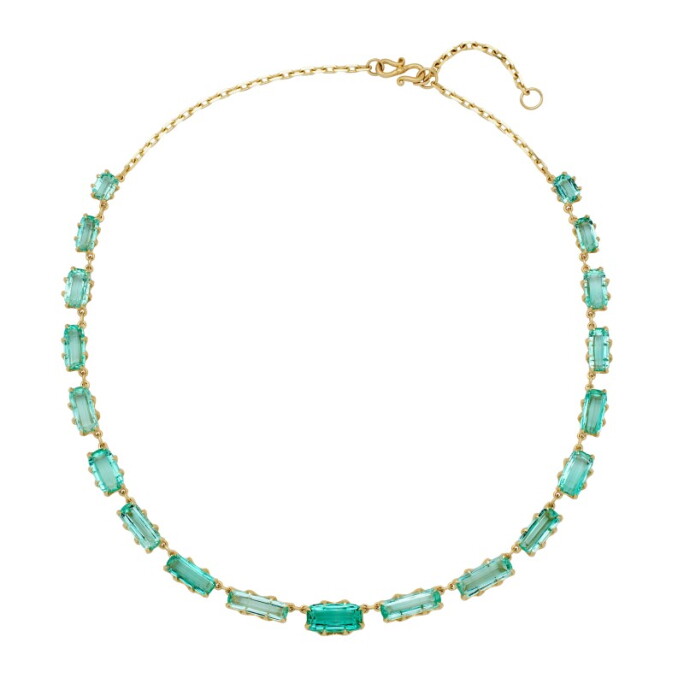
A Jogani Gold and Emerald Necklace offers that kind of departure. Nineteen elongated cushion-shaped emeralds extend across the neckline before giving way to an 18-karat yellow gold chain. There is no repeated signature motif directing the design. Instead, the sequence and shape of the emeralds create its rhythm.
Making room for those differences can give a layered collection a more individual character. An Alhambra pendant carries the visual language of an established design, while a necklace built around individually shaped emeralds brings another sensibility to the mix. Icons can provide points of continuity without dictating what comes next.
Building depth does not require acquiring every version of an iconic design. It can come from noticing the differences within a collection: how proportions change, how an earlier example departs from current production or how a diamond-set interpretation alters a design originally conceived in plain gold. Those distinctions make it possible to keep returning to a favorite collection without simply repeating the same idea.
Stacking gives those choices a way to be seen together. Vintage and contemporary pieces can share the wrist, while different houses or jewelry categories introduce their own design languages. As the collection grows, the combinations can change with it rather than settling into one prescribed formula.
Completeness is not the goal. A jewelry collection becomes personal through the choices made within and beyond the icons—what is repeated, what provides contrast and what unexpected piece earns a place beside an established design. Looking closely at those differences is what turns a group of recognizable jewels into a collection with a point of view.
Neither approach is inherently stronger. Staying within one house can highlight how its designs have evolved, while mixing makers introduces contrast in construction and proportion. The stronger consideration is what each jewel contributes to the collection.
They can be. Proportions, construction and decorative details may change over time, and some earlier variations are no longer produced. Evaluate a vintage jewel according to its specific period and execution rather than assuming it matches a current version.
Not necessarily. Diamonds may distinguish one variation, but they do not determine collectibility on their own. The specific reference or iteration, period and how it fits within the broader history of the design can be more meaningful than the presence of diamonds.
Yes, when the versions offer meaningful distinctions. Different metals, earlier iterations or gemstone-set examples can show how a design has developed over time. Collecting variations works best when each adds something beyond repetition.
No. A Cartier bracelet does not need to resemble a Bvlgari or Van Cleef & Arpels design to belong in the same stack. Allowing each piece to retain its identity can make the overall collection more considered than matching everything by metal, motif or period.
Whether you're a seasoned collector or new to the world of luxury jewelry, Sotheby’s offers a trusted, seamless way to buy and sell fine jewelry on the secondary market.
Trust our worldwide network of leading jewelry specialists from a globally renowned auction house established in 1744.