
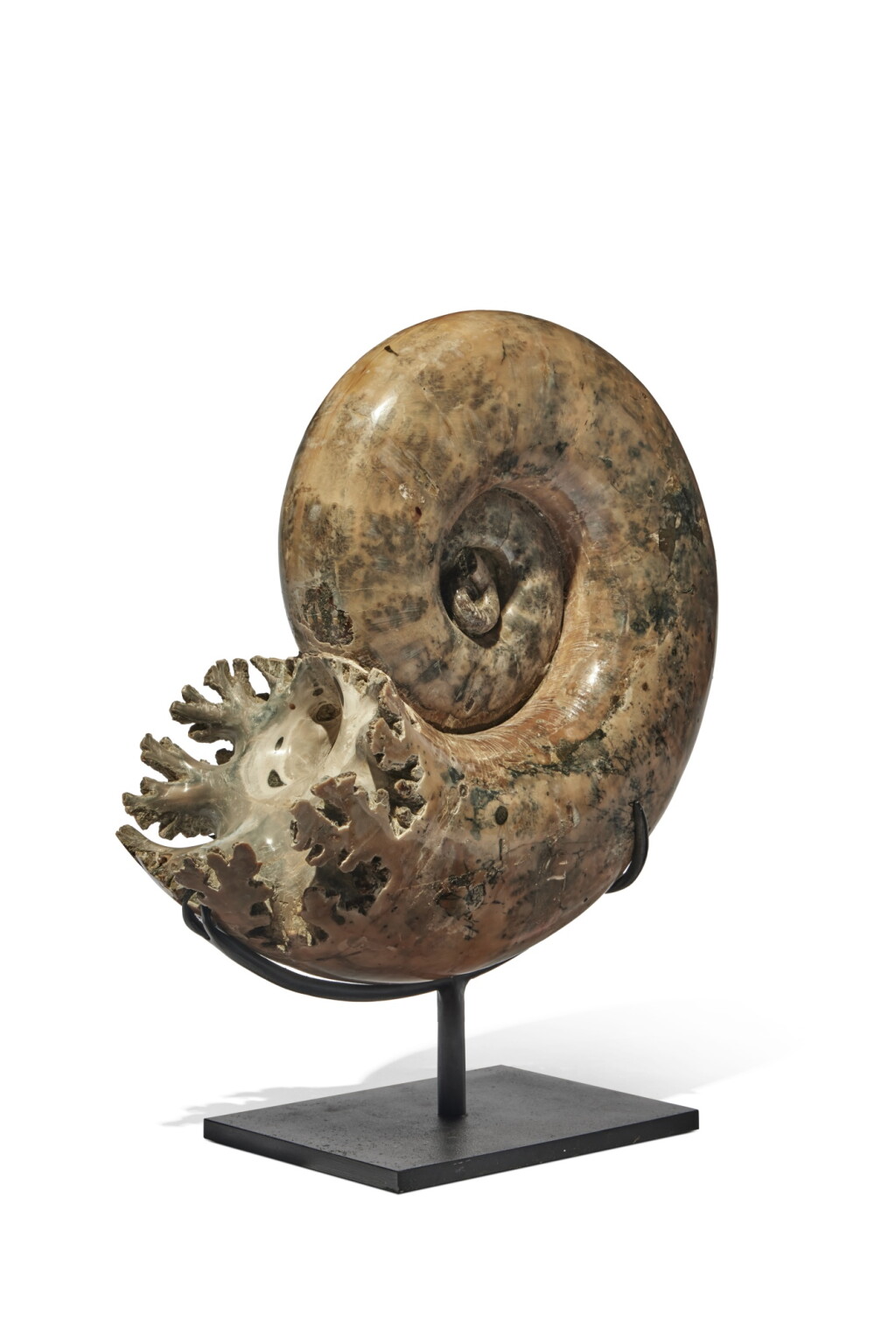
Mounted Cretaceous Ammonite
Early Cretaceous, Albian Stage (approx. 110 million years ago), Madagascar
Auction Closed
July 14, 07:13 PM GMT
Estimate
6,000 - 9,000 USD
Lot Details
Description
Mounted Cretaceous Ammonite
Eogaudryceras sp.
Early Cretaceous, Albian Stage (approx. 110 million years ago)
Madagascar
14½ x 12 x 5¾ inches (36.8 x 30.5 x 14.6 cm), 18 inches (45.7 cm) tall on stand. 40 pounds (18.1 kg).
This ammonite specimen is complete, beautifully cleaned, and in very good condition. Its surface is polished to reveal sutures and inner construction. The construction of the outer suture at the mouth of the shell is nicely preserved.
Alongside trilobites and dinosaurs, ammonites are among the most iconic fossils. Ammonites swam the seas freely during the Jurassic and Cretaceous Periods, evolving rapidly and leaving abundant examples in the fossil record. Scientists estimate that there were at least 10,000 species of ammonite during their roughly 150-million-year reign on Earth, and possibly up to 20,000 species.
The outermost layer of ammonite shells was made up of aragonite, a type of calcium carbonate, which provided strong protection and allowed ammonites to fossilize much more readily than animals that either had a soft shell or lacked a shell. Because ammonites rapidly evolved into new species and their shells were prone to fossilization, they have been crucial for scientists interested in dating the Earth's layers: finding the same species of ammonite in layers of soil thousands of miles apart implies that those layers are from the same time period in Earth's history.
Ammonites were cephalopods, a class of mollusk that includes present-day nautilus, octopus, and squid. Eogaudryceras lived during the Albian Stage of the Early Cretaceous Period, roughly 110 million years ago. This ammonite fossil shell features an extremely well-defined and intricate aperture, out of which the extinct animal's tentacles would have captured prey. This ammonite was also fossilized with a much smaller ammonite at the central whorl, a fascinating addition to this fossil.
You May Also Like


