
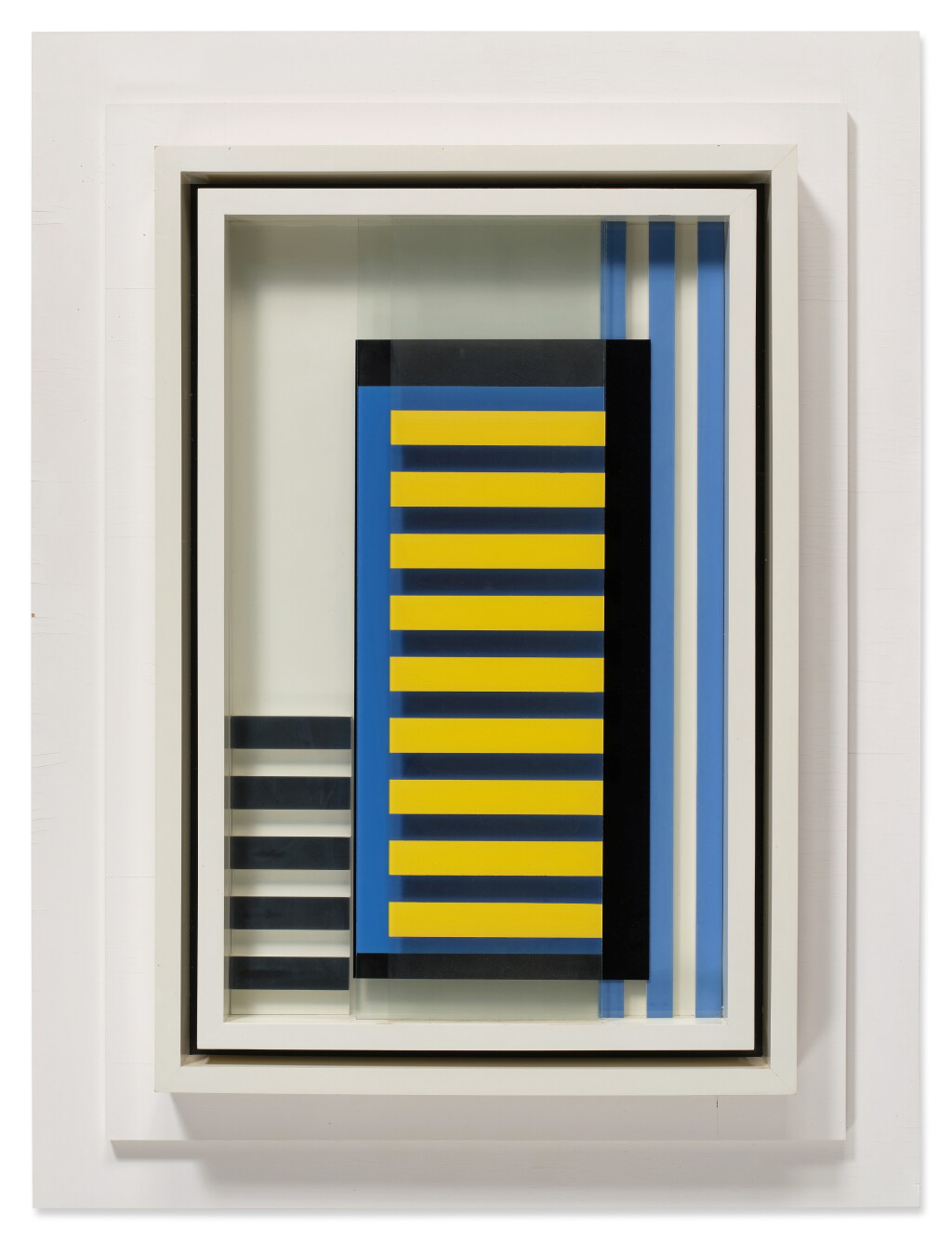
Circuits of Modernism: The Collection of Vicki and David Cox
Charles Biederman
Construction 4/40 (4)
Session begins in
November 19, 07:00 PM GMT
Estimate
40,000 - 60,000 USD
Bid
35,000 USD
Lot Details
Description
Circuits of Modernism: The Collection of Vicki and David Cox
Charles Biederman
1906 - 2004
Construction 4/40 (4)
painted wood and glass
image: 26 ⅜ by 16 ⅜ in. 67 by 41.6 cm.
overall: 40 by 30 ⅛ in. 102 by 76.5 cm.
Executed circa 1940.
Private Collection, Minnesota
Bockley Gallery, Minneapolis
Acquired from the above in December 2004 by the present owner
Charles Biederman, Art as the Evolution of Visual Knowledge, Red Wing, Minnesota, 1948, no. 203, p. 605, illustrated
Best known for his vibrant geometric relief constructions and the theory of “Structurism,” Charles Biederman occupies a distinctive place within the history of American abstraction. Born in Cleveland, Ohio, in 1906, Biederman studied at the School of the Art Institute of Chicago before rejecting academic conventions in pursuit of an independent artistic vision.The artist spent meaningful time in New York and Paris during the 1930s, where he encountered leading modernists including Pablo Picasso, Piet Mondrian, Joan Miró, and Fernand Léger. Following a pivotal stay in Paris in 1936-37, he abandoned painting in favor of three-dimensional relief constructions, creating dynamic works that integrated color, form, and space through rigorously geometric compositions.
After settling in Red Wing, Minnesota in 1942, Biederman increasingly looked to the natural world as a source of artistic and intellectual inquiry, formulating a theory of art rooted in nature’s underlying structural order. During the 1950s he coined the term “Structurism” to distinguish his work from Constructivism and De Stijl, and he went on to publish extensively on art theory while maintaining a notable correspondence with physicist David Bohm on creativity in art and science. Through both his relief constructions and his influential writings, Biederman emerged as a singular voice in twentieth-century art, advancing a vision of abstraction that sought to bridge the disciplines of art, science, and nature. His work was the subject of a major retrospective at London’s Hayward Gallery in 1969 and has been featured in important exhibitions at the Whitney Museum of Art.
You May Also Like


