
Circuits of Modernism: The Collection of Vicki and David Cox
Burgoyne Diller
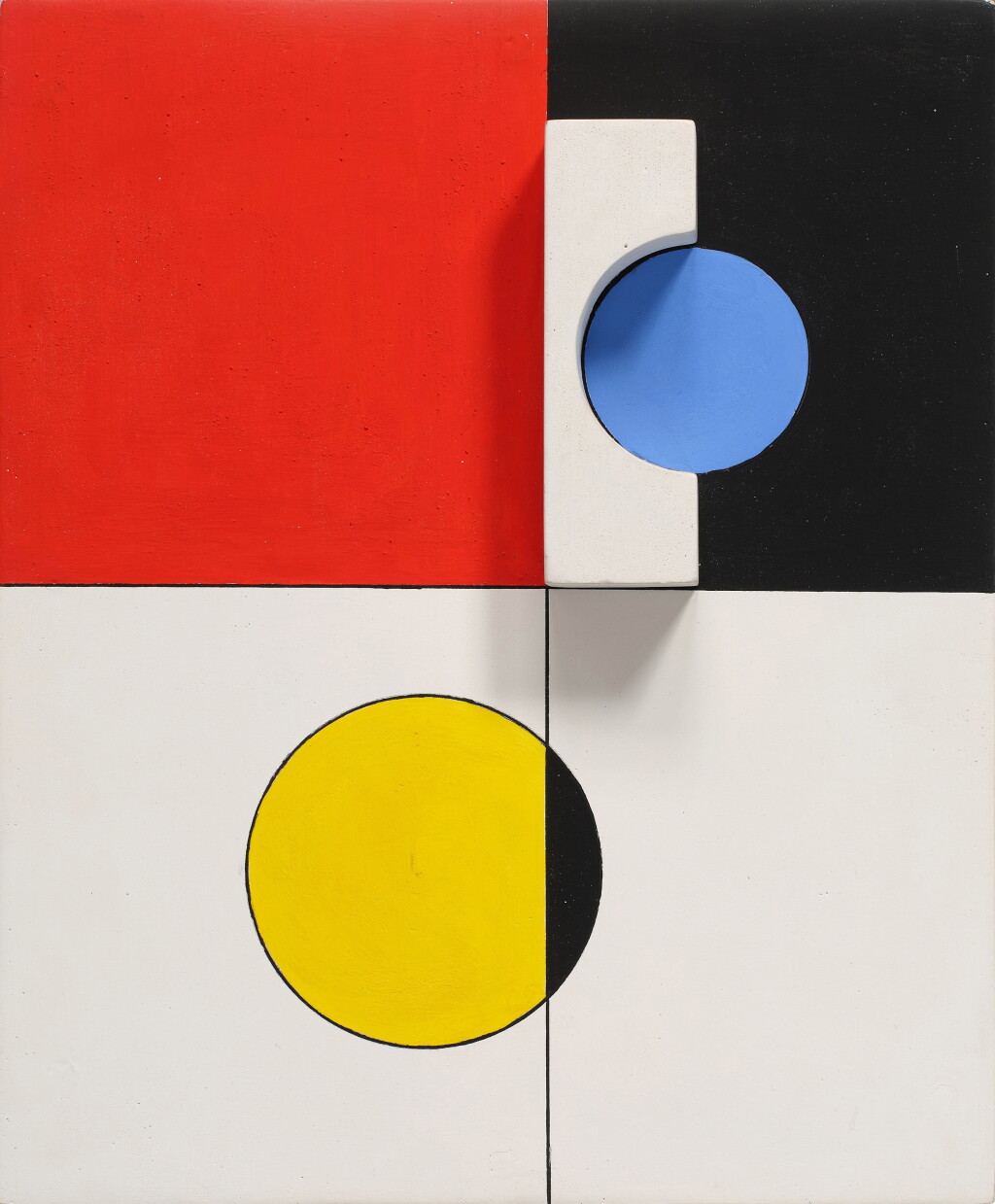
Composition 10
Session begins in
November 19, 07:00 PM GMT
Estimate
15,000 - 25,000 USD
Bid
13,000 USD
Lot Details
Description
Circuits of Modernism: The Collection of Vicki and David Cox
Burgoyne Diller
1906 - 1965
Composition 10
signed twice Diller, titled comp.10 and dated 1934 and restored - 1960 (on the reverse)
tempera and painted wood on board
11 ⅞ by 9 ¾ in.
30.2 by 24.8 cm.
Executed in 1934 and reworked in 1960.
Galerie Chalette, New York
Frances Leventritt, New York (acquired from the above in 1960)
Christie’s, New York, 16 March 2006, lot 239 (consigned by the estate of the above)
Private Collection, New York (acquired from the above)
Private Collection, New York
Martha Parrish & James Reinish, Inc., New York
Acquired from the above in November 2009 by the present owner
Among the earliest American artists to fully embrace geometric abstraction, Burgoyne Diller developed a rigorous visual language rooted in the principles of De Stijl and Neo-Plasticism. Born in the Bronx in 1906, Diller studied at the Art Students League in New York, where he was influenced by the world of artists such as Hans Hofmann, Jan Matulka, Piet Mondrian and Kazimir Malevich. By the early 1930s, Diller abandoned Cubism in favor of a nonobjective style characterized by precisely balanced arrangements of lines, rectangles, and planes of primary color.
A committed advocate for abstract art, Diller was a founding member of the American Abstract Artists in 1936 and played a central role in promoting nonobjective painting in the United States at a time when representational art dominated public taste. Alongside his studio practice, he served in leadership positions within the WPA Federal Art Project, supervising the execution of hundreds of public murals and providing opportunities for a generation of American artists. Following his service in the U.S. Navy during World War II, Diller joined the faculty of Brooklyn College, where he continued to influence younger artists through both his teaching and example. His paintings, reliefs, and later sculptural “color structures” helped establish a distinct approach to geometric abstraction and anticipated many of the formal concerns of Minimalism. Today, his work is held in the permanent collections of the Museum of Modern Art, New York; Whitney Museum of American Art, New York; The Metropolitan Museum of Art, New York; National Gallery of Art, Washington, D.C. and the Smithsonian American Art Museum, Washington, D.C.
You May Also Like


