
Circuits of Modernism: The Collection of Vicki and David Cox
Frederick Kann
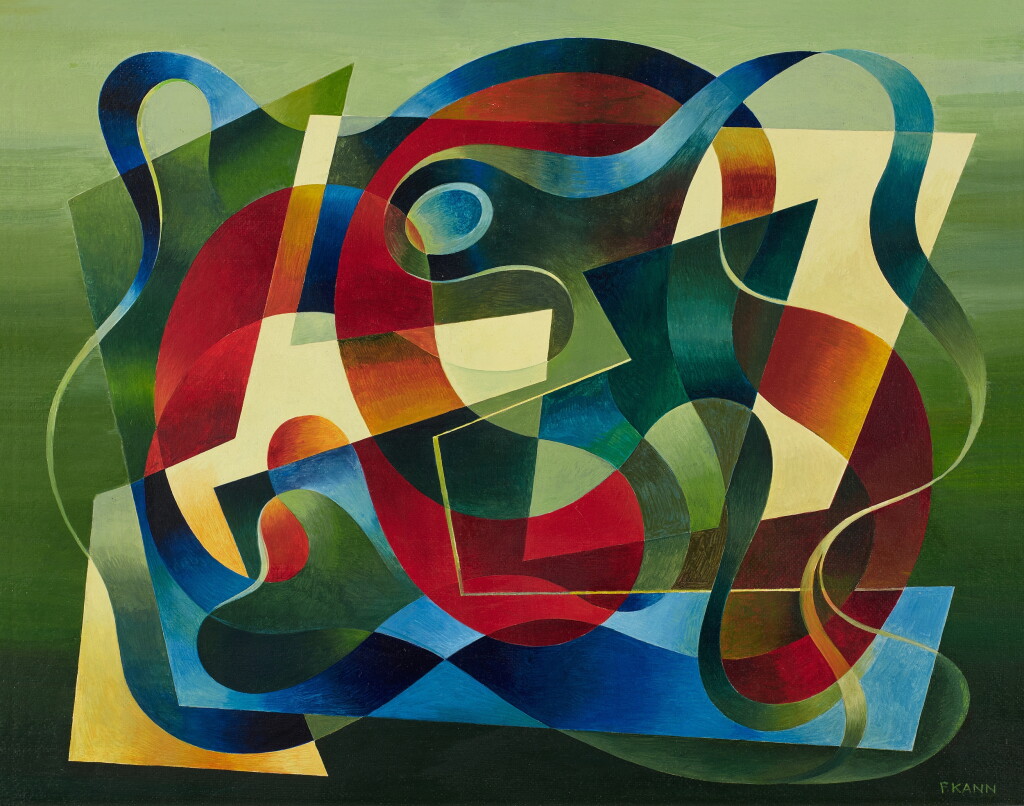
Untitled
Session begins in
November 19, 07:00 PM GMT
Estimate
10,000 - 15,000 USD
Bid
9,000 USD
Lot Details
Description
Circuits of Modernism: The Collection of Vicki and David Cox
Frederick Kann
1886 - 1965
Untitled
signed F. Kann (lower right); signed Fred. I. Kann (on the reverse)
oil on Masonite
21 ⅞ by 28 in.
55.6 by 71.1 cm.
Executed circa 1941.
Private Collection, Kansas City, Missouri and California (acquired directly from the artist)
Private Collection, Kansas City, Missouri and California (acquired from the above)
Private Collection, California (acquired by descent from the above)
Michael Rosenfeld Gallery, New York
Acquired from the above in November 2003 by the present owner
New York, Michael Rosenfeld Gallery, The 1940s: Modern American Art & Design, 2003, p. 53, illustrated in color
A tireless advocate for abstract art on both sides of the Atlantic, Frederick Kann played a significant role in shaping the development and institutional support of American abstraction during the twentieth century. Born in the Czech Republic in 1884, Kann studied architecture, painting, sculpture, and design in Prague and Munich before immigrating to the United States in 1910. After nearly two decades working as a commercial artist in New York, he moved to Paris in 1928, where he became associated with the Surindépendants and Abstraction-Création, exhibiting alongside leading modernists including Wassily Kandinsky, Piet Mondrian, László Moholy-Nagy, and Arshile Gorky.
Influenced by European geometric abstraction, Kann developed a precise visual language that reflected both his artistic training and design background. Returning to the United States in 1936, he became a co-founder of the American Abstract Artists group, alongside Josef Albers, Ray Kaiser, Burgoyne Diller as well as others, and emerged as a leading spokesman for nonobjective art, arguing that abstraction offered artists the opportunity to become creators rather than imitators of nature. After relocating to Los Angeles in 1943, Kann further advanced modern art through the establishment of the Circle Gallery, the Modern Institute of Art with Vincent Price, and the Kann Institute of Art. Through his paintings, writings, teaching, and institution-building efforts, Kann helped lay the foundation for the acceptance and growth of abstract art in America. His works are represented in prominent museum collections, such as The Museum of Fine Arts, Houston, and The Los Angeles Museum of Art.
You May Also Like


