Playing Cards — Proverbs
(London: John Lenthall, c. 1745)
Auction Closed
October 22, 08:33 PM GMT
Estimate
8,000 - 12,000 USD
Lot Details
Description
Playing Cards — Proverbs
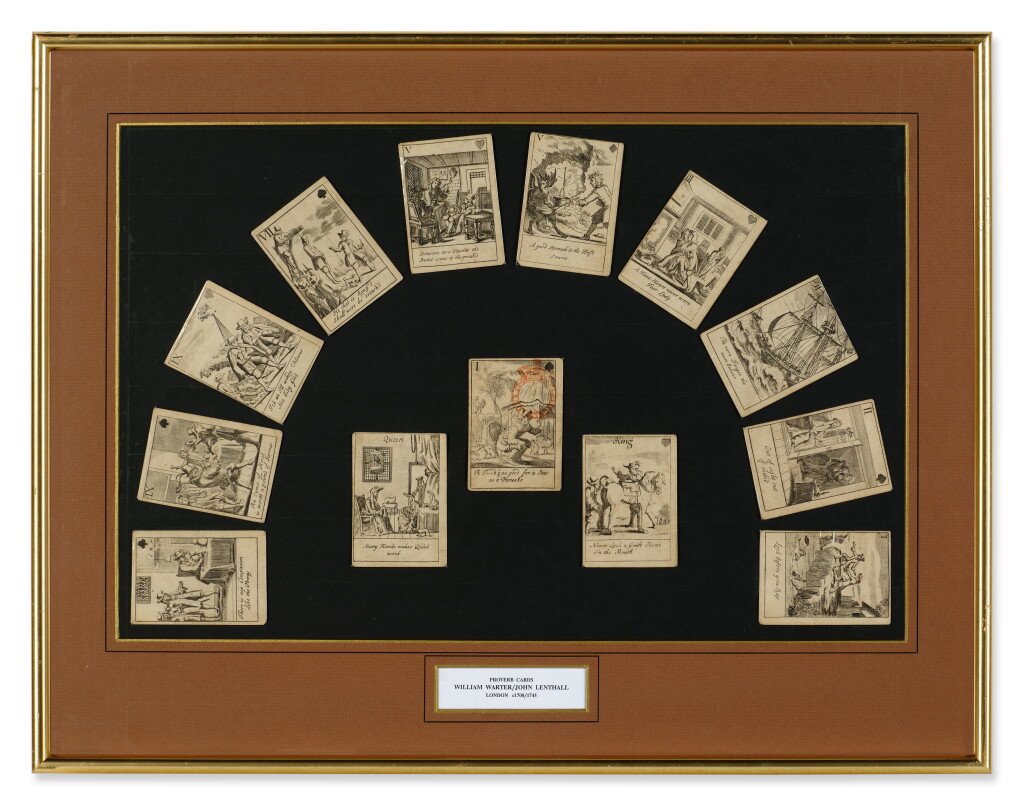
52 playing cards. Engravings on paper, the ace of spades with a red garter tax stamp (in use circa 1711-56), plain versos, accompanied by a 1-page manuscript description; very lightly toned with a few instances of mild soiling, the knave of spades with a small loss at upper left-hand corner and a short tear at lower edge. 13 of the cards are mounted in a frame, the rest are housed in a folder attached to the back of the frame.
3 ⅝ by 2 ½ in. (card); 20 by 26 in. (frame)
9.25 by 6.5 cm; 51 by 66 cm
Jaime Ortiz-Patiño (Sotheby's, London, 10 December 2013, English literature, history, children's books and illustrations, lot 237)
Acquired at the above sale by the present collector
Jaime Ortiz-Patiño Collection of Early Playing Cards, #35;
Mann, Sylvia. All Cards on the Table, #266 (a set by Bowles circa 1730, with some proverbs translated into French or Italian)
A rare, complete deck of humorous playing cards, each featuring a different proverb.
Each playing card includes a suit and rank in the upper corners, a short proverb at the bottom, and a large central illustration that depicts the proverb. Unlike many similarly illustrated decks from this period, which could educate players, or sought to comment on politics and history, this deck's sole purpose was amusement. This deck was first issued in 1698 by William Warter but, due to the offensive, oftentimes crude, nature of many of the illustrations, it was quickly withdrawn from sale. The offending imagery includes defecating men and dogs, love affairs, and numerous public executions. The proverbs, some of which are still in use after over 350 years, include "Look before you leap," "Never look a gwift horse in the mouth," "a good stomack is the best sauce," and "Men and Dogs may goe Abroad but women and Catts, must stay at home." This example, with its red tax stamp on the ace of spades, is from the circa 1745 re-issue by William Warter's successor, John Lenthall.
You May Also Like