A Monumental Decorated Ashkenazic Pentateuch with Targum Onkelos, the Five Megillot, and Haftarot, Germany, circa 1300
Estimate
2,000,000 - 4,000,000 USD
Lot Details
Description
A Monumental Decorated Ashkenazic Pentateuch with Targum Onkelos, the Five Megillot, and Haftarot
Germany, circa 1300
Manuscript on parchment, 336 folios, 451 × 318 mm
A masterpiece of medieval Ashkenaz.
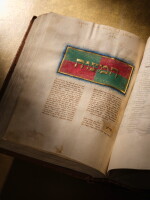
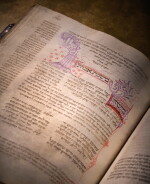
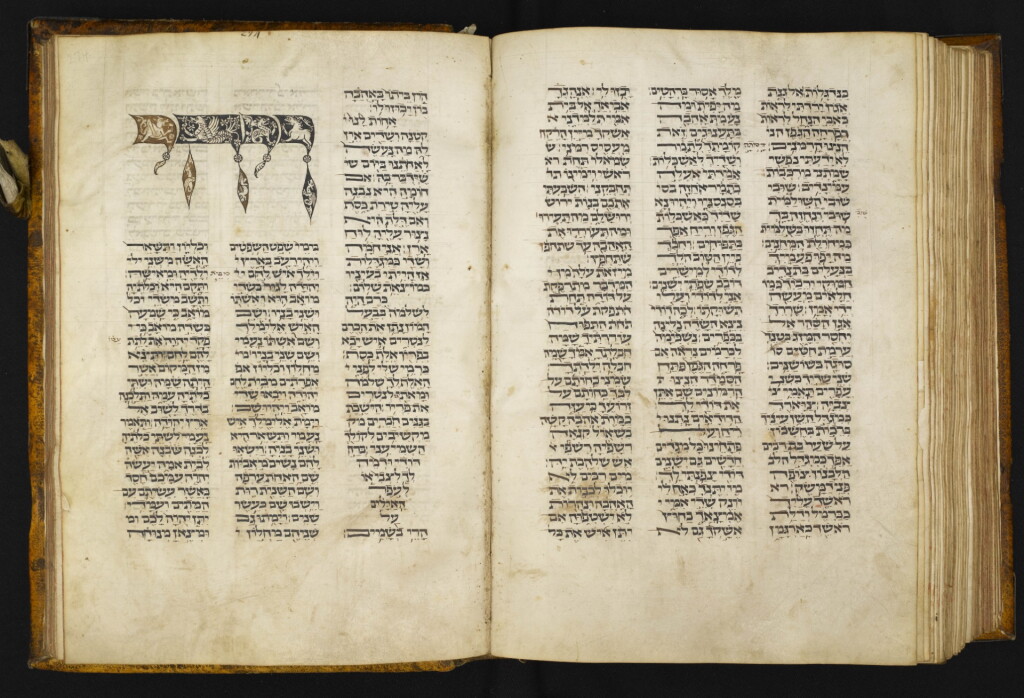
Created in Germany around 1300, this monumental Bible vividly evokes the grandeur of medieval Ashkenaz. More than seven centuries after its creation, its vast parchment folios preserve stately columns of biblical text accompanied by imaginatively decorated opening words in which hounds pursue stags, fantastic hybrids confront dragons, and human-headed creatures inhabit the Hebrew letters. Executed in the dramatic spare-ground technique characteristic of Ashkenazic manuscript art of the late thirteenth and fourteenth centuries, the decoration brings the visual imagination of Gothic art into direct conversation with the sacred Hebrew text. This codex stands as an exceptional witness to the learning, craftsmanship, artistic imagination, and extraordinary resources devoted to the Hebrew book in medieval Germany.
The manuscript contains the Pentateuch accompanied by Targum Onkelos (an Aramaic translation of the Pentateuch), followed by the Five Megillot and the haftarot (readings from the Prophets) according to the Ashkenazic rite. Throughout the Pentateuch, each Hebrew verse is followed by its Aramaic translation, except in the poetic passages, where the Targum is arranged in a separate column. The Hebrew text and the Targum are both vocalized and supplied with cantillation marks. The Five Megillot and haftarot are copied in Hebrew without Targum. The codex thus brings together the biblical text, its traditional Aramaic translation, the Megillot read on festivals, and the annual cycle of prophetic readings in a single substantial volume organized around study and liturgical use.
This combination of texts is found in a genre of Hebrew manuscripts known as “liturgical Pentateuchs.” Such Pentateuchs, often with alternating verses of Hebrew and Targum as in this manuscript, are particularly characteristic of medieval Ashkenaz (the Franco-German region). The Pentateuchal text in such a codex did not replace the Torah scroll required for the formal public reading, but the volume could serve for study and for preparation for the weekly parashah (Torah portion). Codices of this size were very expensive to produce; they demanded skilled scribal labor and required vast quantities of costly parchment—for this manuscript alone,160 or more animal skins would have been necessary. Monumental Ashkenazic Bibles were commissioned by affluent individuals for their personal use and served as an expression of wealth and prestige. The imposing size and weight of the present volume would have made it impractical to carry to and from the synagogue, strongly indicating that it was kept in the owner’s home for private study.
Targum Onkelos is the standard Jewish Aramaic translation of the Pentateuch, traditionally attributed to Onkelos, a second-century convert to Judaism. Already authoritative among the rabbis of late antique Babylonia, it became the principal Aramaic version of the Torah in most medieval Jewish communities. Although generally close to the Hebrew wording, it also incorporates interpretations that clarify and expand upon the biblical text. It served as an important guide to Scripture and a major source for medieval biblical commentary.
The close coordination of Hebrew and Aramaic reflects the enduring authority of Targum Onkelos in communities whose everyday language was no longer Aramaic. In antiquity, the Targum had functioned as a translation and explanation of Scripture in the synagogue, but regular public recitation of the Targum on the Sabbath during the reading of the Torah was no longer customary in medieval Europe. The Talmud directs an individual to complete each weekly portion by reading it twice in Hebrew and once in the Aramaic translation (shenayim mikra ve-ehad targum), a practice that was maintained by private individuals in the medieval period and codified in Jewish law. The alternating layout was thus especially convenient for this weekly recitation, allowing the reader to move directly from each Hebrew verse to its Aramaic counterpart. While this may not have been the manuscript’s primary function, the title page added in 1765 explicitly invokes this practice, suggesting that this medieval arrangement of Hebrew and Aramaic still had a recognizable and practical purpose for its later owner.
Preliminary comparison reveals that the manuscript’s Targum contains numerous readings differing from the form of Onkelos familiar from later printed editions. These variants make the codex a valuable witness to the medieval transmission of Targum Onkelos.
The text is written in a square Ashkenazic hand in three columns of thirty-three lines. The parchment was ruled throughout for the biblical text and for the Masoretic notes that would have appeared in the upper and lower margins of the folios. However, the Masoretic notes were entered only on ff. 3v–4r and were then discontinued, leaving the upper and lower margins unused through the remainder of the manuscript. Visible prickings near the gutter, consistent ruling, catchwords at the ends of the quires, and the regular use of quaternions preserve evidence of the codex’s construction.
The manuscript’s artistic features are concentrated at the beginnings of the biblical books. The enlarged opening words are decorated in the spare-ground technique: animals, hybrid creatures, and foliate forms are outlined on bare parchment and set off against a dark penwork background. The opening word of Leviticus is embellished by a hunt scene, as a pack of hounds surrounds and pursues a stag. The opening word of Numbers incorporates fantastic creatures, including a bearded human-headed hybrid wearing a Jews’ hat. In Deuteronomy, the opening word is filled with scrolling foliage and floral motifs. Other decorated opening words with inhabited initials introduce several of the Five Megillot. The opening word of Song of Songs is decorated with an eagle, a hound, a lion, a dragon, and a hybrid creature, accompanied by foliate forms. The first word of Ruth is inhabited by multiple dragons, some with feathers and scales, one breathing fire, and the most prominent with a tail and bifurcated tongue composed of flowers; one hybrid creature is shown drinking from a cup. The opening word of Lamentations features a stag pursued by six fierce-looking hounds; also included are eight menacing hybrids, two pairs of which are amusingly confronting each other with flowers. The first two letters of the opening word of Ecclesiastes depict yet another hunt scene featuring a man with a horn accompanied by four collared hounds pursuing a fleeing stag, as well as a hippocampus (a hybrid with a horse’s forelegs and a fish’s tail) shooting an arrow at a bearded, human-headed dragon wearing a Jews’ hat; the final two letters contain a lion and two winged dragons set amid foliate forms. Exodus and Esther are introduced more simply by enlarged opening words penned in black. This technique of inhabited initials is found most frequently in decorated prayer books from Ashkenaz. It is extremely rare to find this decorative technique employed in a biblical text.
Nearly five centuries after its production, a title page was added to the manuscript in 1765 recording its owner, Zalman Wiesel of Karlsruhe, who is described as a leading communal official and a shtadlan, an advocate who represented Jewish interests in dealings with secular authorities. Although comparatively little is known about his personal life, contemporary sources attest to his affluence and influence. His ownership of a lavishly illustrated eighteenth-century manuscript Haggadah and his support of a study hall (beit midrash) further reflect both his considerable means and his commitment to Jewish learning and book culture. A signature by his son, Moses Meir, on the rear flyleaf indicates that the Pentateuch remained within the Wiesel family for at least a second generation. Moses Meir was himself an author: his Iggereta Rehata-Hashavya, an Aramaic work accompanied by a Judeo-German translation, was printed in Karlsruhe in 1773.
Physical Description
336 folios on parchment, with paper flyleaves at the front and rear. 451 × 318 mm.
The medieval text is written in three columns of thirty-three lines. Hebrew in square Ashkenazic script, vocalized and supplied with cantillation marks; Targum Onkelos vocalized and supplied with cantillation marks. Throughout the Pentateuch, the Hebrew and Targum generally alternate verse by verse, except in poetical passages, where the Targum follows in a separate column. Occasional marginal annotations and corrections.
Contents: Pentateuch, ff. 1–271v; Song of Songs, ff. 271v–274r; Ruth, ff. 274r–276v; Lamentations, ff. 276v–279r; Ecclesiastes, ff. 279v–284v; Esther, ff. 284v–290r; haftarot according to the Ashkenazic rite, ff. 290v–336v.
As presently constituted, the manuscript begins with Genesis 1:1, but the original medieval portion commences in the middle of Genesis 2:2. The eighteenth-century additions comprise eleven leaves, containing a title page and supplied passages from Genesis, Exodus, Numbers, and the haftarot.
The first supplied text page, containing the decorated opening, appears to be written in a hand distinct from the other eighteenth-century additions, suggesting that at least two scribes participated in the later restoration. Several lines on this opening page lack vocalization and cantillation. The medieval portion begins in the middle of Genesis 2:2 and extends to near the end of the haftarah of Jonah read on the afternoon of Yom Kippur. The supplied eleven folios include: a decorated title page and Genesis 1:1–2:2 (ff. 1–2); Exodus 18:10–22:10 (ff. 90–93); Numbers 3:1–31 (f. 165); haftarot from parashat Ki Tavo through Nitzavim (f. 319); the final verse and a half of the Jonah haftarah, followed by the haftarot for Sukkot through Simhat Torah (ff. 334–336).
Collation: Predominantly in quaternions of eight leaves, with catchwords at the end of each quire. The quire now comprising ff. 89–95 contains seven leaves, including the four later insertions ff. 90–93. A single leaf is missing between ff. 115 and 116, with loss of Exodus 36:34–37:19. The final quire comprises ten leaves (apparently in a 7+3 structure). At the junction between the supplied f. 165 and the medieval f. 166, several verses are repeated.
Prickings remain visible close to the gutter, and ruling is visible throughout. Additional registers were ruled above and below the main text block for the Masorah. Masorah magna and parva were entered only on ff. 3v–4r and were not continued.
Decoration: Large, decorated opening words at the beginnings of three of the books of the Pentateuch and four of the Five Megillot: Leviticus (f. 121v), Numbers (f. 161v), Deuteronomy (f. 207v), Song of Songs (f. 271v), Ruth (f. 274r), Lamentations (f. 276v), Ecclesiastes (f. 279v). Decoration in dark penwork, with animals, birds, fantastic or hybrid creatures, human-headed figures, flowers, and leaves reserved in the parchment against the black ground. A more modestly decorated opening to Genesis belongs to the eighteenth-century additions.
Condition: Staining, soiling, spotting, cockling, occasional edge tears, and a few losses at corners; marginal wear consistent with age and use. Repairs to parchment, in one instance affecting the text on f. 8v. Small hole in f. 161 affecting the text and illustration.
Binding: Late fifteenth-century, pigskin over beveled wooden boards; boards and turn-ins decoratively tooled in blind with foliate stamps and rolls; decorative brass catches and corner-pieces; spine in six compartments; edges stained red. Boards with rubbing, scuffing, and staining, more pronounced on the lower board; one corner-piece lacking from the lower board; clasps lacking, with rounded nails and half of one leather strap remaining; small crack in the front joint at the tail of the spine; hinges cracked, but boards firmly attached.
Provenance
- Zalman Wiesel of Karlsruhe, his by 1765; identified on the supplied title page as the owner.
- Moses Meir, his son; signature on rear flyleaf.
- Stadtbibliothek Frankfurt am Main.
- Transferred post-World War II by the City of Frankfurt, as compensation for expropriated property owned in Frankfurt; thence by descent within the family to the present owners.
Literature
Élodie Attia, “Targum Layouts in Ashkenazi Manuscripts: Preliminary Methodological Observations,” in Alberdina Houtman, Eveline van Staalduine-Sulman, and Hans-Martin Kirn, eds., A Jewish Targum in a Christian World (Leiden: Brill, 2014), 99–122.
Javier del Barco, “On the Typology of Medieval Hebrew Bibles: New Insights,” in Naftali S. Cohn and Katrin Kogman-Appel, eds., Beloved David—Advisor, Man of Understanding, and Writer: A Festschrift in Honor of David Stern (Providence, RI: Brown Judaic Studies, 2024), 399–418.
Judith Olszowy-Schlanger, “Hebrew Books,” in Erik Kwakkel and Rodney Thomson, eds., The European Book in the Twelfth Century (Cambridge: Cambridge University Press, 2018), 159–174.
Gabrielle Sed-Rajna, The Hebrew Bible in Medieval Illuminated Manuscripts (New York: Rizzoli, 1987).
David Stern, “The Hebrew Bible in Europe in the Middle Ages: A Preliminary Typology,” Jewish Studies, an Internet Journal 11 (2012), 235–322.
Photographs courtesy of Ardon Bar-Hama
You May Also Like