A Richly Illuminated Mahzor According to the Italian Rite, [Ferrara], Italy, circa 1500
Estimate
2,000,000 - 4,000,000 USD
Lot Details
Description
A Richly Illuminated Mahzor According to the Italian Rite
[Ferrara], Italy, circa 1500
Manuscript on parchment, 457 folios, 148 × 105 mm
A sumptuous Hebrew prayer book for the full year, combining Jewish liturgical tradition with the rich ornamental language of Renaissance Italy.
The Italian or Roman rite (minhag Benei Roma) is one of Europe’s oldest Jewish liturgical traditions. Developed within Italy’s ancient Jewish communities, it preserves elements of older traditions from the Land of Israel alongside the influence of Babylonian rabbinic teaching. Later contact with Ashkenazic and Sephardic communities enriched its repertoire without erasing its singular character. The present manuscript unites this distinctive liturgical tradition with an extensive program of Renaissance illumination.
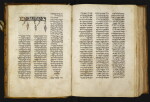
The volume opens with introductory devotional material, including Solomon ibn Gabirol’s celebrated poem Keter Malkhut (Crown of Kingship). Its prominent place at the beginning of the mahzor reflects the incorporation of Spanish Hebrew poetry into Italian Jewish devotion. The principal prayer cycle begins on f. 23r and encompasses weekday and Sabbath worship, Hallel and the prayers for Rosh Hodesh (the New Month), Passover and the Haggadah, the High Holidays, and the remaining annual festivals. It is thus a mahzor (literally “cycle”) in the broader sense of the term: a comprehensive liturgical compendium for the annual cycle, rather than a book restricted to festival services. Its compact dimensions, less than fifteen centimeters in height, indicate a prayer book created for an individual’s use, while the sustained expenditure on parchment, gold, and painted ornament points to a patron of substantial means.
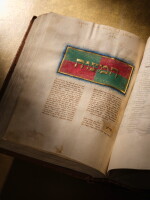
The manuscript is splendidly ornamented throughout, and the opening decoration is especially elaborate. An architectural composition (f. 4r) takes the form of a Renaissance aedicule, with a stepped green base and cornice, a red-edged pediment flanked by blue dolphins, and wine-red pilasters enriched with gold foliage. Within this framework rises a candelabrum-like ornament, surmounted by a crown and hung with jewel-like pendants. The opening text of the liturgical hymn, Keter Malkhut (f. 4v), is enclosed on all four sides by a gold-ground border incorporating grotesques, candelabra, gemstone pendants, masks, shells, vases, and fruit. This vocabulary of architecture, precious objects, and antique-inspired ornament places the Hebrew manuscript within the visual culture of Renaissance luxury book production.
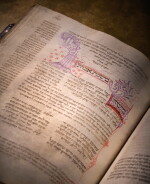
The scheme of decoration continues throughout the manuscript, with gold-lettered titles and opening words appearing on nearly every page, set within vibrantly colored borders embellished with delicate white and yellow penwork. Symmetrical leaves and flowers extend toward the margins in green, red, blue, and gold, accompanied by fine violet tendrils, often terminating in elongated, looped flourishes. These alternate with lace-like patterns, rounded colored forms enclosed within intricate networks of gold spirals, and more restrained gold linear ornamentation. The result is a remarkably sustained sequence of embellished text openings that both articulates the liturgy and gives visual distinction to its successive sections.
The manuscript includes several decorations that engage directly with the ritual content. In the liturgy for Rosh Hashanah (ff. 292v, 297r, 300r, and 302r), the instructions for sounding the shofar are accompanied by graphic indications, penned in gold beneath the letters of its three distinct calls: a single long line for tekiah, the sustained blast; a wavy line for teruah, the rapid, staccato sounds; and three short vertical strokes for shevarim, the three broken blasts. These visual renderings of sound emphasize the manuscript’s practical role as a guide to the performance of the holiday ritual. In addition, the Haggadah features an illustration of a bowl containing verdant bitter herbs highlighted in gold, accompanying the text on f. 151v. A blank space on the preceding page was apparently intended for a representation of the matzah.
The decoration was executed by a Christian artist and is characteristic of illuminated manuscripts created in Ferrara. Throughout, the Christian illuminator follows the textual hierarchy established by the Jewish scribe. The combination of Jewish scribal work and Christian painting exemplifies the artistic exchanges of Renaissance Italy, bringing the sacred Hebrew text into the same visual world as the luxury manuscripts commissioned by contemporary Christian patrons.
The Este court in Ferrara was a major center of fifteenth-century manuscript illumination, attracting painters and illuminators engaged in the production of luxurious devotional and humanist books. This manuscript’s artistic elements—an elaborate architectural opening, jewel-like forms, and densely worked ornament—are consistent with that environment. Several known illuminated Hebrew manuscripts from Ferrara attest to an active tradition of Hebrew book production there in the decades surrounding this volume’s proposed date.
This prayer book was produced not long after the publication of the first printed mahzor, issued by the Soncino family at Soncino and Casalmaggiore in 1485–1486. Its extensive illumination exemplifies the continuing appeal of the individually crafted luxury prayer book even when the same liturgical tradition was available in print. The lavish use of gold and painted ornament distinguishes the volume as both a book for worship and an elaborate work of art.
Physical Description
457 leaves, including three preliminary and six terminal blank leaves; 148 × 105 mm. Hebrew in Italian square script, with additional text in semi-cursive script; single column, 19 lines to the page; horizontal ruling throughout. Ink, gouache, and gold leaf; gilt edges.
Collation: Three preliminary blank leaves; three gatherings of ten leaves (ff. 4–33); one gathering of eight leaves (ff. 34–41); forty-one gatherings of ten leaves (ff. 42–451); and six terminal blank leaves. Catchwords present at the ends of the first three gatherings; their absence elsewhere may reflect cropping.
Decoration: One principal architectural composition (f. 4r), one complete ornamental border surrounding the opening of Keter Malkhut (f. 4v), and gold-lettered headings or opening-word panels on painted grounds on nearly every page. A bowl of bitter herbs appears on f. 151v. Openings on ff. 192v, 232v–233r, and 310r have gold linear ornament. A space apparently reserved for a representation of the matzah on f. 151r remains blank; spaces reserved for several opening words also remain undecorated.
Textual features: The morning blessings include shelo asani bor (“who has not made me an ignoramus”), a formulation attested in early rabbinic literature, but neither shelo asani goy (“who has not made me a gentile”) nor she-asani yisrael (“who has made me an Israelite”) is present. This omission may reflect an attempt to avoid wording potentially objectionable to Christians.
Censorship: The censorial signatures of Domenico Gerosolimitano and Fra Hippolytus Ferrarensis, dated 1601, on f. 451v. Censorial intervention is also visible in two occurrences of the Aleinu prayer (ff. 53r and 295v), where a sentence referring to those “who used to bow down to idols and pray to a god who cannot save” has been erased. Such references to idolatry were a recurrent target of Christian censorship.
Condition: Manuscript in fine condition, with very mild soiling and toning, and a few pale spots. Margins cropped, touching some illuminations. Small area of water damage to the illumination at f. 150v, with some offsetting to the facing page. Slight worming from f. 445 onward, not affecting the text. Overopened in a few places, notably at f. 342.
Binding: Sixteenth-century Italian binding, brown calf, richly gold-tooled with a large diagonally set central panel and fine foliate scrollwork in the corners. Brass and leather clasps. All edges gilt. Light rubbing and wear to extremities, two small surface losses on the lower board, vertical cracking and a small wormhole in the spine, the joints just starting, the leather straps tender, the tailband coming loose at the lower board end.
Provenance
- Stadtbibliothek Frankfurt am Main, acquired before 1920; (library stamps on the front flyleaf and ff. 2r and 451r.) Exhibited as no. 10 in the library’s permanent exhibition (exhibition label “10” pasted to the rear flyleaf) and cataloged by Sarnow (1920), no. 10; described by Schilling (1929), p. 256, no. 232.
- Transferred post-World War II by the City of Frankfurt, as compensation for expropriated property owned in Frankfurt; thence by descent within the family to the present owners.
Literature
Robert Bonfil, ed., Mahzor ke-minhag Roma, facsimile of the Soncino–Casalmaggiore edition of 1485–1486 (Jerusalem: Magnes Press, 2012).
Evelyn M. Cohen, “Mahzor (Prayer Book),” in Vivian B. Mann, ed., Gardens and Ghettos: The Art of Jewish Life in Italy (Berkeley and Los Angeles: University of California Press, 1989), p. 213, no. 47.
Nurit Pasternak, “Marchion in Hebrew Manuscripts: State Censorship in Florence, 1472,” in Joseph R. Hacker and Adam Shear, eds., The Hebrew Book in Early Modern Italy (Philadelphia: University of Pennsylvania Press, 2011), pp. 26–55.
Angelo Mordechai Piattelli, ed., Kovets mehkarim al mahzor ke-minhag Benei Roma (Jerusalem: Magnes Press, 2012).
Emil Sarnow, Handschriften, Einbände, Formschnitte und Kupferstiche des 15. Jahrhunderts, Druckwerke und Einblattdrucke des 15. bis 20. Jahrhunderts: Katalog der Ständigen Ausstellung, 2nd printing (Frankfurt am Main: Joseph Baer & Co., 1920), no. 10.
Rosy Schilling, Die illuminierten Handschriften und Einzelminiaturen des Mittelalters und der Renaissance in Frankfurter Besitz, ed. Georg Swarzenski (Frankfurt am Main: Joseph Baer & Co., 1929), no. 232.
David Stern, with Evelyn M. Cohen and Emile G. L. Schrijver, Chosen: Philadelphia's Great Hebraica, ed. Judith M. Guston (Philadelphia: Rosenbach Museum & Library, 2007), pp. 24–25.
Photographs courtesy of Ardon Bar-Hama
You May Also Like