A Mahzor Decorated by Joel ben Simeon with the Text of the Pentateuch, Psalms, Job, Proverbs, and the Five Megillot, Northern Italy, circa 1475
Estimate
3,000,000 - 5,000,000 USD
Lot Details
Description
An Illustrated Mahzor with the Text of the Pentateuch, Psalms, Job, Proverbs, and the Five Megillot
Copied by Ephraim ben Yoav
Decorated by Joel ben Simeon
Northern Italy, circa 1475
Manuscript on parchment, 295 folios, 180 × 128 mm
One of only three profusely decorated manuscripts by the renowned fifteenth-century Jewish artist, Joel ben Simeon, in private hands.
This richly illustrated manuscript brings together the annual cycle of prayers according to the Italian, or Roman, rite (minhag Bnei Roma) with the Pentateuch and much of the Ketuvim (Writings) copied in the outer and lower margins. The text was copied by the scribe, author, and poet Ephraim ben Yoav of Modena, and the manuscript was decorated by Joel ben Simeon, one of the most celebrated artists in the history of the Hebrew book. The opening words of hundreds of passages are ornamented throughout; their red and violet penwork frames are enlivened by human faces, animals, birds, and illustrations responding to the adjacent prayers and readings.
The scribe, Ephraim, was active in northern and central Italy in the second half of the fifteenth century. Remarkably, he opens the volume with a poem in which he invokes divine assistance in the copying of the Mahzor. The initial letters of each line of the poem form an acrostic spelling out the name Ephraim. His documented career as a copyist extended from at least 1463 to 1501. Among his surviving manuscripts is the splendid Gallico Siddur, completed in Florence in 1487 (JTS Library MS 8224). Ephraim was also the author of the ethical treatise Sefer ha-Musar (Book of Ethics) and the Hebrew poem Ha-Zero‘a ve-ha-Lehayayim ve-ha-Kevah (The Foreleg, the Jaw, and the Maw). The opening poem in the present manuscript thus reflects his activity as a poet as well as a scribe. This Mahzor belongs to a significant body of work by an accomplished scribe and literary figure who worked within the same flourishing environment of Hebrew book production as Joel ben Simeon.
The lavish decoration is the work of the celebrated artist Joel ben Simeon, also known as Feibush Ashkenazi. Joel occupies an exceptional position in the history of illustrated Hebrew manuscripts as one of the very few known scribe-artists. Twelve signed manuscripts preserve direct testimony to his career, while twenty-five further works have been attributed to his hand. His surviving signatures and colophons permit a reconstruction of his career unusual among medieval Jewish artists, and some explicitly identify his contribution as an illustrator as well as a scribe. He was probably born in Cologne around 1420, but his family fled to nearby Bonn when the Jews were expelled from Cologne in 1424. The Jews were subsequently driven out of Bonn in 1445, after which Joel may have lived in southern Germany for a few years. He moved across the Alps to Italy no later than 1449 and worked as an itinerant scribe for wealthy Italian patrons. Joel returned to Germany on several occasions, copying and illustrating manuscripts there. His career thus unfolded across two important centers of late medieval Hebrew manuscript production.
These journeys were fundamental to his artistic development. He carried the German traditions of Hebrew book illustration into Italy while absorbing approaches to figurative representation, costume, and spatial design encountered south of the Alps. His later work combines an inherited repertoire of Jewish imagery with close attention to the appearance and gestures of contemporary people. Rather than belonging exclusively to a German or an Italian school, his manuscripts bear witness to a sustained exchange between the two artistic environments.
The decorative elements in this volume are closely integrated with the organization of the text. Rectangular initial-word panels, often surmounted by architectural ornamentation, extend into lateral flourishes and foliate borders. Human profiles, bearded heads, women’s faces, and birds emerge from the narrow edges of the frames, while animals, crowns, and towers accompany the openings of individual sections. The decoration ranges from elaborate introductory compositions to playful visual imagery throughout the course of the prayers.
Among the hundreds of decorated folios are some forty illustrations that respond directly to the words of the liturgy. Highlights include two hands emerging from clouds beside the reference to the mighty hand that brought Israel out of Egypt (f. 13r); a suspended Sabbath lamp accompanying the passage concerning the kindling of the Sabbath lights (f. 17v); a Hanukkah lamp marking the corresponding festival prayers (f. 33r); a running red heifer illustrating the service for Shabbat Parah (f. 44r); and a crescent moon accompanying Shabbat ha-Hodesh on the following verso. Within the Haggadah, a tendril terminates in a hand holding a Passover basket (f. 48v).
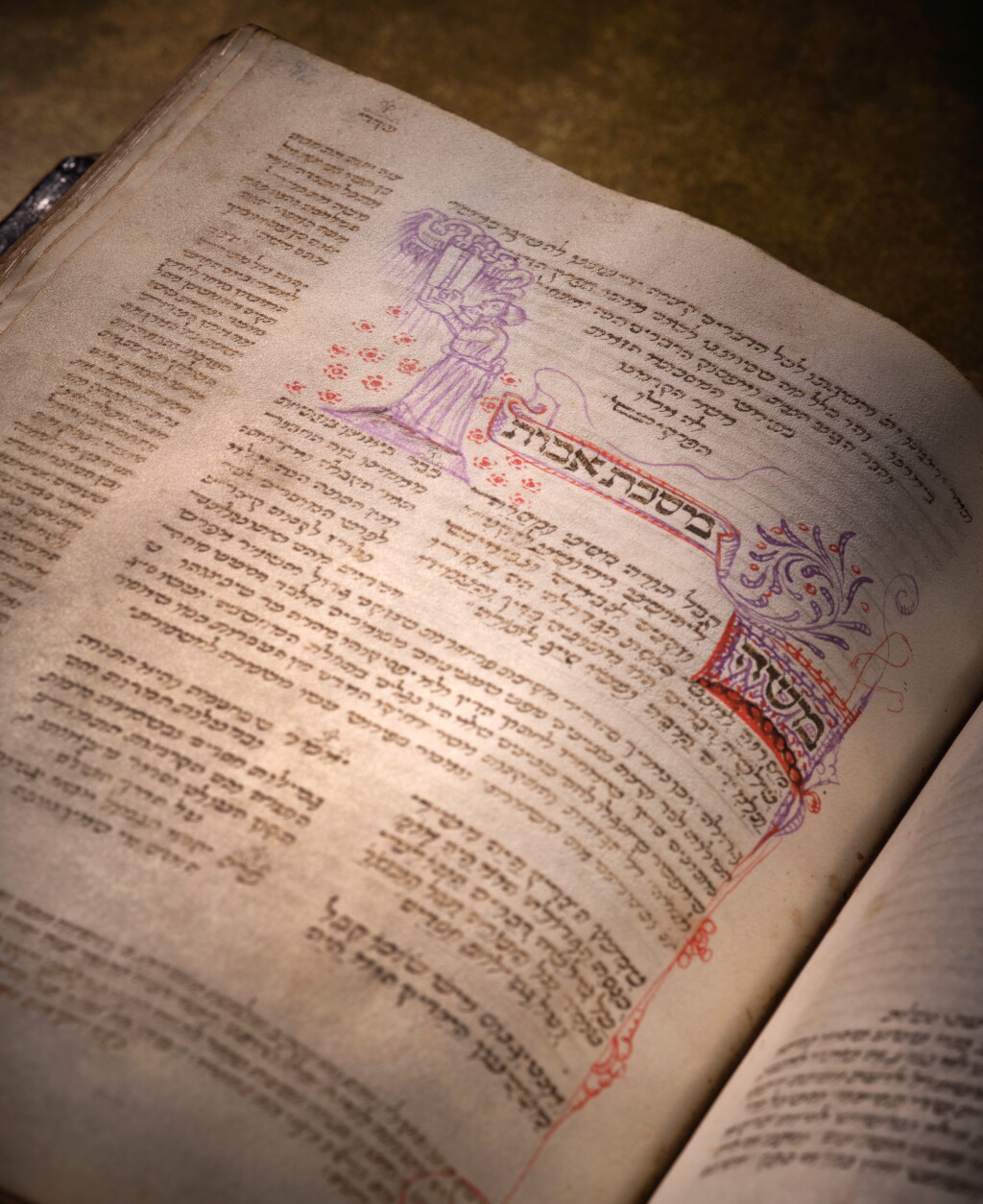
Human figures and fantastic creatures further enliven the pages. Moses receives the Torah at Sinai at the opening of Pirkei Avot (Ethics of the Fathers) on f. 92r, and a man blows the shofar beside the order of its sounding on f. 185r. The imagery also includes more whimsical illustrations. A reclining unicorn appears on f. 18r, an elephant with a howdah on its back on f. 85v, and the Sukkot prayers are accompanied by a faun (a mythological creature with a human upper body and goat legs) holding the Four Species (f. 265r): the lulav (palm branch), etrog (citron), hadassim (myrtle boughs), and aravot (willow branches).
The manuscript’s contents extend well beyond the sequence of annual prayers. The liturgy is accompanied by biblical readings, the Passover Haggadah, and ethical and philosophical material. Particularly noteworthy are Pirkei Avot with Maimonides’ introduction, known as the Shemonah Perakim (Eight Chapters), together with prefatory material by Samuel ibn Tibbon. The Shavuot liturgy includes Solomon ibn Gabirol’s versified enumeration of the commandments, introduced by a representation of the poet speaking. After the liturgical text was written by Ephraim ben Yoav, the manuscript was decorated by Joel ben Simeon. Following that, the biblical texts were added to the margins in Ephraim’s own hand; his name is marked within the biblical text on ff. 49v, 51v, 182v, 183r, and 200v. The marginal biblical texts comprise the Pentateuch, Psalms, Job, Proverbs, and the Five Megillot: Song of Songs, Ruth, Lamentations, Ecclesiastes, and Esther. The inclusion of the biblical texts in this personal prayer book made it especially useful for following along during the public reading of the Torah in the synagogue.
This Mahzor is important not only as a superbly penned Hebrew book of prayers, but also as a surviving work associated with Joel ben Simeon, one of the defining artistic personalities of the medieval Jewish book.
List of Illustrations:
The opening words are primarily decorated with rectangular frames employing red or purple pen and ink. The frames are filled with floral scrollwork patterns, often featuring a roof-like top section and lateral flourishes that frequently extend along the entire length of the text. Grotesques, bearded men’s heads, women’s faces, and bird heads appear along the narrow borders of the rectangular panels. In addition, scrolling foliage frames the opening words. Finally, animals—stags, lions, storks, hares, herons, partridges, hounds, dragons, an elephant, and a unicorn—enliven the pages. Forty textual illustrations reflect the artist’s deep knowledge of the book’s contents. One further illustration (no.22) appears to have been created by the scribe, Ephraim.
1. A crown illustrating the opening word of Kedusha: “A crown will be given to You” (f. 12v).
2. Two hands (of God) emerging from the clouds, referencing the text that highlights the “mighty hand” that led Israel out of Egypt (f. 13r).
3. A Sabbath lamp hanging from a tendril beside the opening of Bameh Madlikin (“With What May One Kindle?”), the chapter of Mishnah Shabbat concerning the kindling of Sabbath lights, recited as part of the Friday night Sabbath service (f. 17v).
4. Initial word panel with male and female profile heads depicting closed mouths—referencing the opening words of the Mussaf prayer—asking God to open the reader’s mouth so that one may praise God (f. 26v).
5. A crown illustrating the opening word of Kedusha: “A crown will be given to You” (f. 26v).
6. A radiant moon with a face, referencing the opening section of the text for the blessing over the new moon (f. 30r).
7. A radiant moon with a face, referencing the Mussaf prayers for the new month (f. 30v).
8. An exceedingly rare image of a fifteenth-century Hanukkah lamp corresponding to the text for the prayers for Hanukkah (f. 33r).
9. A scale at left and a hand pointing to a group of shekel coins at right, illustrating the liturgical hymn recited on Shabbat Shekalim, the first of four special Sabbaths that lead up to the holiday of Passover. Shabbat Shekalim commemorates the annual half-shekel tax every adult Israelite man paid to support the Holy Temple in Jerusalem—rich and poor alike gave the same amount (f. 43r).
10. A hand holding a sword illustrating the liturgical hymn recited on Shabbat Zakhor (the Sabbath of Remembrance), the second of the four special Sabbaths preceding Passover. Shabbat Zakhor is associated with the command to remember Amalek’s attack on Israel and blot out Amalek’s memory (f. 43v).
11. A red heifer illustrating the liturgical hymn recited on Shabbat Parah (the Sabbath of the Red Heifer), the third of the four special Sabbaths preceding Passover. The liturgical hymn concerns purification from ritual impurity associated with contact with the dead through the use of the ashes of a red heifer (f. 44r).
12. A crescent moon illustrating the liturgical hymn recited on Shabbat ha-Hodesh (the Sabbath of the Month observed on or before the first of Nisan). This is the last of the four special Sabbaths preceding Passover (f. 44v).
13. An illustration for the Passover Haggadah depicting a hand holding aloft a basket filled with items for the Passover Seder table according to the Italian custom. The basket includes, among other things, matzah, a leafy bitter herb, and, as per the custom of Italian Jews, the head of a fish symbolizing the Leviathan and the messianic era (f. 48v).
14. Hands holding the symbolic foods of the Seder—the bitter herbs, a matzah, and a portion of a lamb (f. 50v).
15. A potted plant, corresponding to the liturgical hymn for Passover, Gan Naul (A Locked Garden) (f. 55v).
16. Moses as a bearded man with a cap pointing at the lamb corresponding to the text for the Torah reading for the first day of Passover when Moses enjoined the Israelites to procure a lamb and prepare for the Paschal offering (f. 59v).
17. A crescent moon with a face, referencing the text for the maftir (biblical reading) for the first day of Passover that opens with a description of the sacrifices offered on the fourteenth of Nisan (f. 60v).
18. An illustration of King Josiah, who commanded the nation of Israel to celebrate Passover, referencing the text of the haftarah (portion of the Prophets) read on the second day of Passover (f. 63v).
19. An illustration for the blessing of the counting of the Omer—a man kneeling on the right brings the Omer offering, shown as a basket at left. The Omer was a special grain sacrifice of freshly harvested barley that Jewish priests brought to the Temple in Jerusalem on the second day of Passover. The custom of counting the Omer begins on the second day of Passover (f. 73v).
20. An illustration for Maimonides’ commentary on Pirkei Avot (Ethics of the Fathers), depicting two men (perhaps Maimonides and the contemporary Italian reader?) facing each other in conversation (f. 77r).
21. Moses receiving the Ten Commandments on Mount Sinai—an illustration of the opening words of the corresponding text from Pirkei Avot (Ethics of the Fathers), “Moses received the Torah at Sinai” (f. 92r).
22. An illustration of the way in which the waters parted into twelve paths at the Red Sea—this drawing was likely penned by the scribe of the text and not by Joel ben Simeon (f. 110r).
23. An illustration of the eleventh-century poet, Solomon ibn Gabirol, to accompany his text of Azharot, a monumental poem enumerating all 613 commandments, recited on the holiday of Shavuot (f. 131v).
24. A drawing of a face that is “aflame” illustrating the words boshet panim ("shame of the face”) in the accompanying penitential prayer (f. 164v).
25. A figure of a man with hands clasped in prayer illustrating the opening lines of the text which beseeches God to hear our prayers (f. 169r).
26. An illustration of Elkanah, husband of Hannah, whose story from the Book of Samuel is read as the haftarah (the prophetic reading) on the first day of Rosh Hashanah (f. 183v).
27. An illustration of a man blowing the shofar to accompany the text for the order of the blowing of the shofar (f. 185r).
28. A crown illustrating the opening word of Kedusha: “A crown will be given to You” (f. 186r).
29. A drawing of a castle-like tower illustrating the liturgical hymn Ki Anu Ame-kha (For We Are Your Nation) acknowledging God as King (f. 219r).
30. A crown illustrating the opening words “Our Father, our King” (f. 223r).
31. An image of a bearded man in a tent illustrating the opening words of the Yom Kippur hymn “Your Tent” (f. 228r).
32. An image of the sun with rays emanating—illustrating the opening word of the text “a radiant light” (f. 230v).
33. A crown illustrating the opening word of Kedusha: “A crown will be given to You” (f. 232v).
34. A crown illustrating the opening word of Kedusha: “A crown will be given to You” (f. 246r).
35. Image of an outstretched hand illustrating the opening words of the Yom Kippur hymn “Your Hand Is Outstretched and Open to Your Nation” (f. 248v).
36. Profile of a young woman whose face is “aflame,” illustrating the opening words of the Yom Kippur hymn Bat Ami (Daughter of My People) and the words boshet panim ("shame of the face”) in this penitential prayer (f. 249v).
37. A crown illustrating the opening word of Kedusha: “A crown will be given to You” (f. 255v).
38. Image of a faun (a mythological forest spirit with a human upper body and goat legs) holding the Four Species, which comprise a lulav (palm branch), etrog (citron), hadassim (myrtle boughs), and aravot (willow branches) used on the holiday of Sukkot. This image accompanies the prayers for the second day of the Sukkot holiday (f. 265r).
39. A tower decorates the opening word of the hymn recited on Shemini Atzeret, Om ke-Ishon Nintzeret (A Nation Guarded Like the Pupil of an Eye), illustrating the opening phrase of the hymn (f. 273r).
40. Profile of a young woman’s head illustrating the opening word of the hymn Bat Berurah (Pure Daughter) sung on the holiday of Simhat Torah (f. 276v).
41. Profile of a crowned woman illustrating the opening words of the Aramaic hymn Adrianus Malka (Hadrian the King) recited on the holiday of Simhat Torah. Here, however, the artist apparently mistook the Aramaic word malka for the Hebrew word for queen and depicted a woman, when in fact he should have depicted a man (f. 279v).
Physical Description
295 parchment leaves, 180 × 128 mm. Hebrew text in cursive and semi-cursive scripts, with headings and opening words in square script; 34 lines to the page; ruled throughout. Biblical texts written along the outer and lower margins. Catchwords at the ends of quires. Additional prayers on the opening leaves and later entries at the end testify to the continued use and adaptation of the volume after its original production. The manuscript bears the censor’s signature of Camillo Jaghel, dated 1619 on f. 284v. Physical evidence of censorship survives elsewhere in the volume, including the erasure of the word “gentile” from the morning blessings “who has not made me a gentile” on f. 3v, as well as erasures on ff. 15r and 187r of passages in the Aleinu prayer denigrating idolatrous worship.
A faded inscription added in a later hand on f. 1r purports to date the writing of the manuscript, giving the Hebrew year 5272 (1511–12) alongside the Christian year 1522. The two dates are themselves incompatible by a decade, and the inscription is clearly not in the hand of the original scribe. It therefore cannot be regarded as a contemporary colophon or reliable evidence for the date of production. Whether the annotation was intended to refer to some later stage in the manuscript’s history—possibly the addition of the biblical texts in the margins—cannot now be determined.
Three loose items accompany the manuscript: a red-and-white exhibition label, inscribed “Ausst. 8”; a folded printed manuscript-consultation sheet of the Stadtbibliothek Frankfurt am Main, likewise marked “Ausst. 8,” bearing a signed entry recording use by Dr. Rosy Schilling on November 6, 1928, for catalog work; and an unused printed German library loan slip, marked “8” in red and blue pencil on the back.
Collation: Quires generally of ten leaves; opening quire of three leaves; a four-leaf quire beginning at f. 283; and a final quire beginning at f. 287, mostly blank; ff. 285–295 are ruled but otherwise left blank, with the exception of f. 287r, which originally contained the opening of the Book of Esther through the middle of Esther 1:15; the first several lines of this text were subsequently deliberately erased.
Condition: Infrequent light toning, soiling, and staining; intermittent ink-fading, though the text remains largely legible. Trimmed close, in a few instances touching marginal illumination or headings.
Binding: Sixteenth-century Italian binding, brown calf over thin wooden boards, decorated in blind with foliate-scroll borders and a central Moresque motif within a diamond-shaped framework. Originally fitted with two metal clasps and corner-pieces. Text block detached from the binding; a few small scuffs and areas of rubbing; vertical cracking to the spine, with two small losses to a raised band and at the corners, repaired; clasps and corner-pieces lacking.
PROVENANCE
- Joseph Cagli, Ancona, 1710 (family annotation recording the birth of a daughter, Mazal Tov, to Joseph and his wife Hannah, f. 284v)
- Joseph, son of the late Salamon, sold to Salamon, son of Samuel, on February 19, 1755 (signed inscription acknowledging receipt of the full purchase price, f. 284v)
- Stadtbibliothek Frankfurt am Main, acquired before 1920; (library stamps on ff. 1r, 3v, 13v, and 284v). Exhibited as no. 8 in the library’s permanent exhibition (loose exhibition label “Ausst. 8”) and cataloged by Sarnow (1920), no. 8; described by Schilling (1929), pp. 254–255, no. 231.
- Transferred post-World War II by the City of Frankfurt, as compensation for expropriated property owned in Frankfurt; thence by descent within the family to the present owners.
LITERATURE
Evelyn M. Cohen, “Gallico’s Identity Exposed: Revealing an Erased Colophon from a Renaissance Prayer Book,” Ars Judaica 1 (2005), pp. 85–90.
Evelyn M. Cohen, “Joel Ben Simeon’s ‘Missing Leaves’: Folios from the Rothschild Haggadah, the Turin Mahzor, and the Rothschild Pentateuch,” in Mehevah le-Menahem: Studies in Honor of Menahem Hayyim Schmelzer, ed. Shmuel Glick, Evelyn M. Cohen, and Angelo M. Piattelli (Jerusalem: Jewish Theological Seminary and Schocken Institute for Jewish Research, 2019), pp. 107–131.
Aaron Freimann, “Jewish Scribes in Medieval Italy,” in Alexander Marx Jubilee Volume, English section, ed. Saul Lieberman (New York: Jewish Theological Seminary of America, 1950), no. 118.
David Goldstein, The Ashkenazi Haggadah: A Hebrew Manuscript of the Mid-15th Century from the Collections of the British Library (London: Thames and Hudson, 1985).
Sandra Hindman and Sharon Liberman Mintz, with an essay by Lucia Raspe, “I Am the Scribe, Joel Ben Simeon” (Paris: Les Enluminures, 2020).
Emil Sarnow, Handschriften, Einbände, Formschnitte und Kupferstiche des 15. Jahrhunderts, Druckwerke und Einblattdrucke des 15. bis 20. Jahrhunderts: Katalog der Ständigen Ausstellung, 2nd printing (Frankfurt am Main: Joseph Baer & Co., 1920), no. 8.
Rosy Schilling, Die illuminierten Handschriften und Einzelminiaturen des Mittelalters und der Renaissance in Frankfurter Besitz, ed. Georg Swarzenski (Frankfurt am Main: Joseph Baer & Co., 1929), pp. 254-255, no. 231.
Colette Sirat, Malachi Beit-Arié, and Mordechai Glatzer, Manuscrits médiévaux en caractères hébraïques portant des indications de date jusqu’à 1540, vol. III (Jerusalem: Israel Academy of Sciences and Humanities; Paris: Centre National de la Recherche Scientifique, 1986), no. 54.
David Stern and Katrin Kogman-Appel, eds. and trans., The Washington Haggadah by Joel ben Simeon: A Fifteenth-Century Manuscript from the Library of Congress (Cambridge, MA: Belknap Press of Harvard University Press, in association with the Library of Congress, 2011).
Myron M. Weinstein, ed., The Washington Haggadah: A Facsimile Edition of an Illuminated Manuscript at the Library of Congress Signed by Joel ben Simeon (Washington, DC: Library of Congress, 1991).
Yael Zirlin, “Joel Meets Johannes: A Fifteenth-Century Jewish-Christian Collaboration in Manuscript Illumination,” Viator 26 (1995), pp. 265–282.
Shlomo Zucker, The Moskowitz Mahzor of Joel ben Simeon (Jerusalem: Jewish National and University Library, 2005).
Photographs courtesy of Ardon Bar-Hama
You May Also Like