Sefer Mitzvot Gadol by Moses of Coucy, Northern Italy, late fifteenth century
Estimate
1,000,000 - 2,000,000 USD
Lot Details
Description
Sefer Mitzvot Gadol by Moses of Coucy
Northern Italy, late fifteenth century
Manuscript on parchment, 439 folios, 167 × 122 mm
A rare, complete, and brilliantly illuminated copy of the classic medieval masterwork of Jewish law.
Few works did more to shape the study and practice of Jewish law in medieval Ashkenaz than Moses of Coucy's Sefer Mitzvot Gadol (The Great Book of Commandments), commonly known by the acronym Semag. Composed in thirteenth-century France, the work takes the traditional enumeration of the 613 commandments, 248 positive and 365 negative, as the framework for an expansive compendium of Jewish law. Each commandment is expounded through extensive discussion of the Talmud and earlier legal authorities, bringing a vast body of Jewish law within the organizing structure of the biblical commandments.
Moses ben Jacob of Coucy, who lived in the first half of the thirteenth century, was trained in the great Tosafist schools of northern France and studied in Paris under Judah ben Isaac Messer Leon. In 1235–36, by then an established scholar, Moses undertook an exceptional preaching mission through France and Spain, urging Jewish communities to repentance, renewed observance, and higher ethical standards. Members of those communities asked him to put the principles of the commandments and their sources into writing. Moses relates that, after initially hesitating, he was moved to undertake the task by a revelatory dream directing him to compose a work on the commandments divided into two parts.
The principal literary model for his work was Maimonides' Mishneh Torah. Moses of Coucy's travels through Spain, where Maimonides' writings circulated widely, likely deepened his engagement with the Mishneh Torah. Maimonides’ achievement appears to have prompted Moses to conceive a similarly comprehensive work encompassing the whole of Jewish law, including commandments concerning the Temple, sacrifices, ritual purity, and the Land of Israel, which could no longer be practiced. Yet he transformed the Maimonidean code for an Ashkenazic readership—adding the Talmudic sources underlying its rulings, preserving divergent opinions, and incorporating the teachings of Rashi, Rabbenu Tam, Isaac of Dampierre, and other Franco-German authorities. The resulting work, probably completed in 1247, was both a defining expression of Ashkenazic learning and an important conduit for Maimonides’ writings among the Jews of northern Europe.
Composed in the aftermath of the Paris proceedings against the Talmud in 1240, in which Moses participated, the work has also been understood as a response to contemporary Christian attacks on rabbinic authority. Its introduction defends the authenticity and transmission of the Oral Law, while its sustained citation and organization of Talmudic material reassert the authority of the literature then under attack.
The Semag became one of the most popular, influential, and widely transmitted medieval Jewish codes. It served both as a legal authority and as a textbook for study and was repeatedly copied, quoted, glossed, commented upon, and abridged. The most celebrated of its abridgments was Isaac ben Joseph of Corbeil’s Sefer Mitzvot Katan, or Semak. Moses’s work had initially circulated simply as Sefer ha-Mitzvot; the designation Gadol, “Great” or “Large,” appears to have arisen only after the diffusion of Isaac’s shorter Sefer Mitzvot Katan.
Despite its broad circulation, only about thirty-five manuscripts of the Semag dated or datable before 1500 preserve both principal divisions of the work, as found in this manuscript; most other surviving witnesses contain only a single division, partial text, or fragments. By the late fourteenth century, the Semag was firmly established in Italy, and the present codex belongs to this important Italian phase in the transmission of a major work of Ashkenazic learning. Because Moses of Coucy repeatedly revised the Semag, medieval manuscript copies preserve important evidence for reconstructing its textual history. The present codex contains both principal divisions but reverses the work’s standard order: it begins with the introduction and text of the positive commandments, followed by the introduction, index, and text for the negative commandments. Scattered marginal annotations supply corrections and variant readings, adding further information about the work’s textual transmission and tradition of careful study.
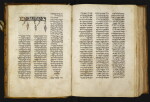
The manuscript’s physical scale is no less remarkable than its textual ambition. Measuring only 167 mm in height (6.57 in), it accommodates the vast text of the Semag in a minute yet exceptionally accomplished hand, written in two columns of forty-four lines to the page. The compact dimensions, dense but highly sophisticated layout, and fine scribal execution constitute an extraordinary feat of manuscript production, bringing one of the most extensive legal works of medieval Ashkenaz into a comparatively portable format.
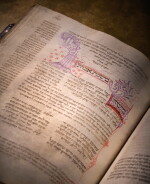
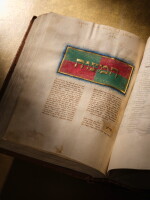
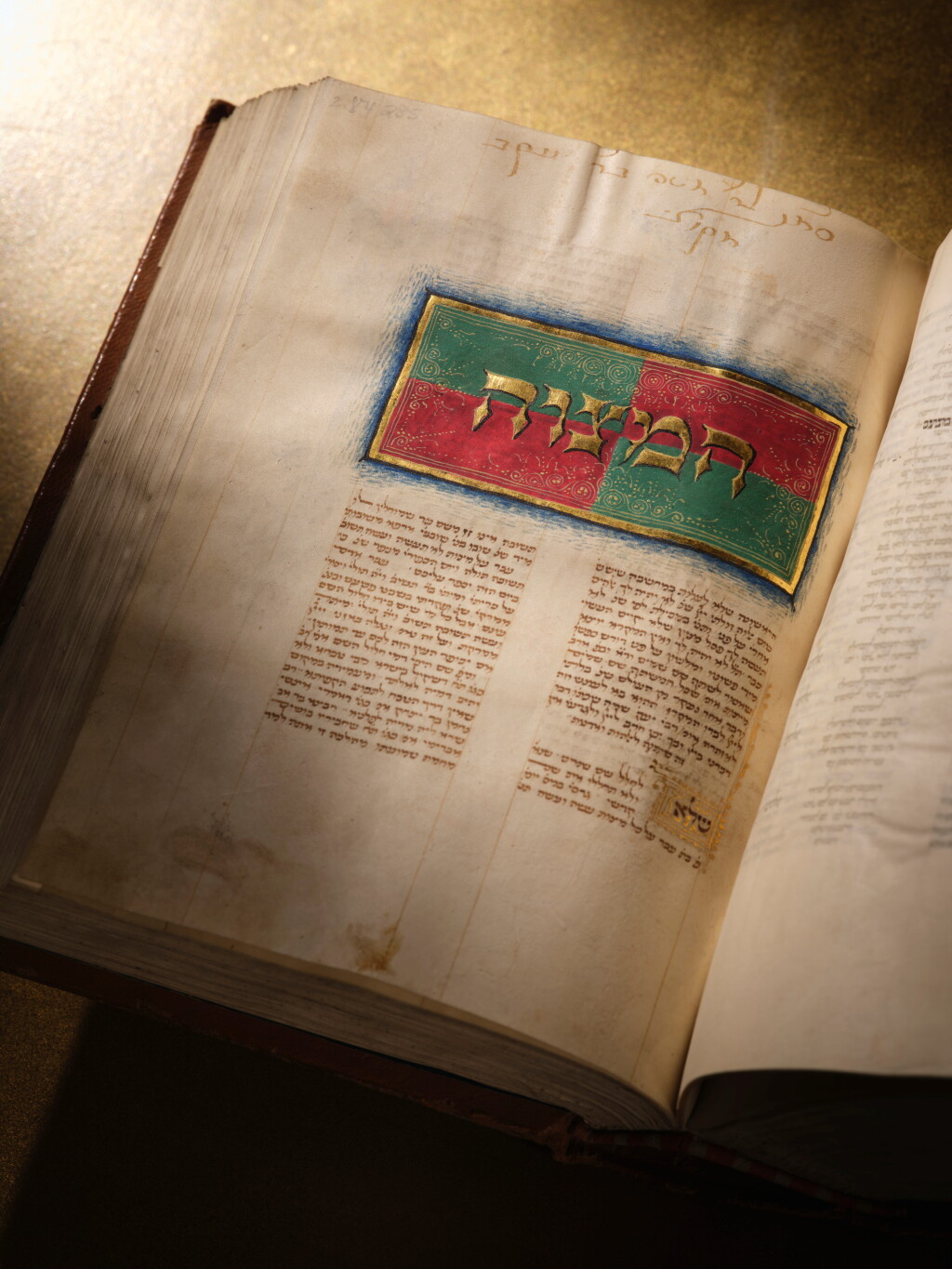
The manuscript is equally distinguished by its striking visual character. Only three other surviving copies of the Semag preserving both divisions feature extensive decoration or illustration. The principal divisions of the present manuscript are announced by large gold letters set on painted fields of blue, red, or green and framed by narrow bands of gold and color. Smaller textual sections are marked by rectangular penwork frames and colored penwork flourishes in blue and red, including delicately drawn foliate forms.
Throughout the manuscript, words on the final lines frequently terminate in long descending pen flourishes, a number of which are elaborated into floral designs. Two detailed diagrams illustrating the laws of kilayim (forbidden mixed plantings) serve to explain the text (f. 415r).
In the later portions of each of the manuscript’s two divisions, spaces remain that appear to have been reserved for ornament but were never filled. The unfinished areas provide an insight into the process by which the volume was planned, copied, and decorated. At several points, the Hebrew name Isaac is singled out by decorative treatment, indicating the name of the otherwise unidentified scribe (ff. 37r, 38v–40r, 42v, 58r, 69r, 299v, and 423v).
The closing portion of the codex preserves an unusually intimate record of the volume’s continued use in Italy. One folio contains family entries recording births (with dates in the 1550s and 1560s) of the children of a sixteenth-century owner, Joseph Corinaldo, and his wife Sapienza (f. 437v). Two further leaves contain medical remedies. The first, a remedy for sciatica on f. 438v is dated [5]313 (1552–53) and attributed to Rabbi Abraham Zarfati of Ferrara, likely identified with Abraham ben Solomon Treves (Zarfati), author of Birkat Avraham. A second remedy, apparently for sciatica (f. 439r), is followed by two remedies for ailments of the eyes and a bill of sale with the identifying names and places scraped away. Together, these records reveal the codex as a treasured family possession, and a repository of practical medical knowledge, in addition to its primary role as an important medieval compendium of Jewish law.
The manuscript also preserves direct evidence of Christian censorship. The expurgations are concentrated in Negative Commandment 45, concerning the prohibition against deriving benefit from an idol or any of its appurtenances (f. 290r–v). The suppressed passages refer to Christian feast days, rites, ritual objects, and ecclesiastical functionaries. Signed by the censor Laurentius Franguellus in 1575: Revisus per me Laurentium Franguellum, 1575 (“Reviewed by me, Laurentius Franguellus, 1575”) on f. 437r.
Physical Description
439 leaves on exceptionally fine, thin parchment, 167 × 122 mm. Hebrew in a minute and highly regular Italian cursive book hand, two columns of 44 lines, with headings and principal opening words in square script. Vertical ruling visible throughout.
Painted opening-word panels mark the principal divisions; subsidiary divisions have rectangular penwork frames and red-and-blue fleuronnée decoration, especially in the earlier portions of the two divisions. Spaces reserved for further decoration were left unfinished. Scattered marginal annotations contain corrections and variant readings. Two diagrams on f. 415r illustrate the laws of kilayim. Passages in Negative Commandment 45 referring to Christian feast days, rites, ritual objects, and ecclesiastical functionaries have been expurgated. A later cursive hand added the title and attribution (“Semag, by Rabbi Moses son of Rabbi Jacob of Coucy”) at the beginning of the negative commandments (f. 285r).
Clipped catalog description from the catalog of the Merzbacher Library pasted to the front pastedown, and a red printed exhibition label inscribed “Ausst. 7” to the rear pastedown. A folded printed manuscript-consultation sheet of the Stadtbibliothek Frankfurt am Main, likewise marked “Ausst. 7” and pasted to the rear flyleaf, bears signed entries recording use by Dr. Rosy Schilling, in 1928 for catalog work, and by Dr. Fritz Zschaeck of Frankfurt am Main in 1941. Dr. Zschaeck was a medievalist attached to the Institut zur Erforschung der Judenfrage (Institute for the Research of the Jewish Question). The institute supported the Nazi persecution of the Jews in Europe by collecting information about the Jewish people and providing a method of gathering looted Hebrew manuscripts. An unused printed German library loan slip is loosely inserted.
Collation: 17 gatherings of 12 leaves (ff. 1–204); 3 gatherings of 18 leaves (ff. 205–258); 1 gathering of 14 leaves (ff. 259–272); 13 gatherings of 12 leaves (ff. 273–428); and a final original gathering of 12 leaves, lacking 3 leaves and now comprising 9 leaves (ff. 429–437); followed by two apparently later-added leaves (ff. 438–439). The three absent leaves did not carry text of the Semag and were probably blank; their loss creates no textual lacuna. Catchwords survive at the ends of gatherings.
Condition: A few instances of staining, soiling, and light toning, mostly at the beginning and end of the volume and on f. 215. Discoloration on ff. 215–217; fading of the ink on a few leaves; ff. 265–266 are loose. An ink stain affects some of the text on ff. 417v–418r. The volume was slightly trimmed when rebound.
Binding: Sixteenth-century Italian binding, brown calf with a central panel and blind-stamped and tooled decoration. Three later gilt-leather spine labels and a small paper label numbered 72, corresponding to the manuscript’s number in Rabbinovicz’s Ohel Avraham, the catalog of Merzbacher’s collection. Wear to extremities; scuffing to the boards, with a few surface abrasions to the calf; restorations at the joints. The binding was likely refurbished in the nineteenth century.
Provenance
- Joseph Corinaldo and his wife Sapienza, whose children’s births are recorded on f. 437v, mid-sixteenth century.
- Abraham Merzbacher, a celebrated Munich collector and patron of Hebrew scholarship (1812–1885). His ownership stamp, Bibliotheca Merzbachiana Monacensis, appears on a front flyleaf; described as no. 72 in Rabbinovicz’s Ohel Avraham, the catalog of Merzbacher’s collection.
- Stadtbibliothek Frankfurt am Main, acquired with the Merzbacher collection in 1903; (library stamps on ff. 1v, 11r, and 439v). Exhibited as no. 7 in the library’s permanent exhibition (exhibition label “Ausst. 7” on the rear pastedown) and cataloged by Sarnow (1920), no. 7; described by Schilling (1929), p. 252, no. 229.
- Transferred post-World War II by the City of Frankfurt, as compensation for expropriated property owned in Frankfurt; thence by descent within the family to the present owners.
Literature
Judah D. Galinsky, “The Significance of Form: R. Moses of Coucy’s Reading Audience and His Sefer ha-Mizvot,” AJS Review 35, no. 2 (November 2011), pp. 293–321.
Avraham Ya‘akov Goldmintz, “Sefer Mitzvot Gadol—Mahadurot ve-nusha’ot hadashot: Hilkhot kiddush ha-hodesh (aseh 46), ibbur ha-shanah (aseh 47), ve-od,” Yode‘ei Binah 5 (2010), pp. 9–39.
Raphael Nathan Nata Rabbinovicz, Ohel Avraham: Reshimat ha-sefarim asher asaf ve-kibbets ha-rav ha-muflag, ha-gevir ha-yashar ba-adam, moharar Avraham Merzbacher z”l (Munich: E. Huber, K. Hofbuchdrucker, 1888), no. 72.
Emil Sarnow, Handschriften, Einbände, Formschnitte und Kupferstiche des 15. Jahrhunderts, Druckwerke und Einblattdrucke des 15. bis 20. Jahrhunderts: Katalog der Ständigen Ausstellung (Frankfurt am Main: Joseph Baer & Co., 1920), no. 7.
Rosy Schilling, Die illuminierten Handschriften und Einzelminiaturen des Mittelalters und der Renaissance in Frankfurter Besitz, ed. Georg Swarzenski (Frankfurt am Main: Joseph Baer & Co., 1929), no. 229.
Israel M. Ta-Shma, “Devarim al ha-Semag, al Kitzur ha-Semag ve-al Sifrut ha-Kitzurim,” in Abraham ben Ephraim, Kitzur Sefer Mitzvot Gadol, ed. Yehoshua Horowitz (Jerusalem: Mekize Nirdamim, 2004), pp. 13–21.
Ephraim E. Urbach, Ba‘ale ha-Tosafot: Toldotehem, Hiburehem, Shitatam, 4th expanded ed., 2 vols. (Jerusalem: Mosad Bialik, 1980), vol. 1, pp. 465–479.
Jeffrey R. Woolf, “Maimonides Revised: The Case of the Sefer Miswot Gadol,” Harvard Theological Review 90, no. 2 (April 1997), pp. 175–203.
Jeffrey R. Woolf, “Some Polemical Emphases in the Sefer Miswot Gadol of Rabbi Moses of Coucy,” The Jewish Quarterly Review 89, nos. 1–2 (July–October 1998), pp. 81–100.
Photographs courtesy of Ardon Bar-Hama
You May Also Like