
George Barbier | François-Louis Schmied
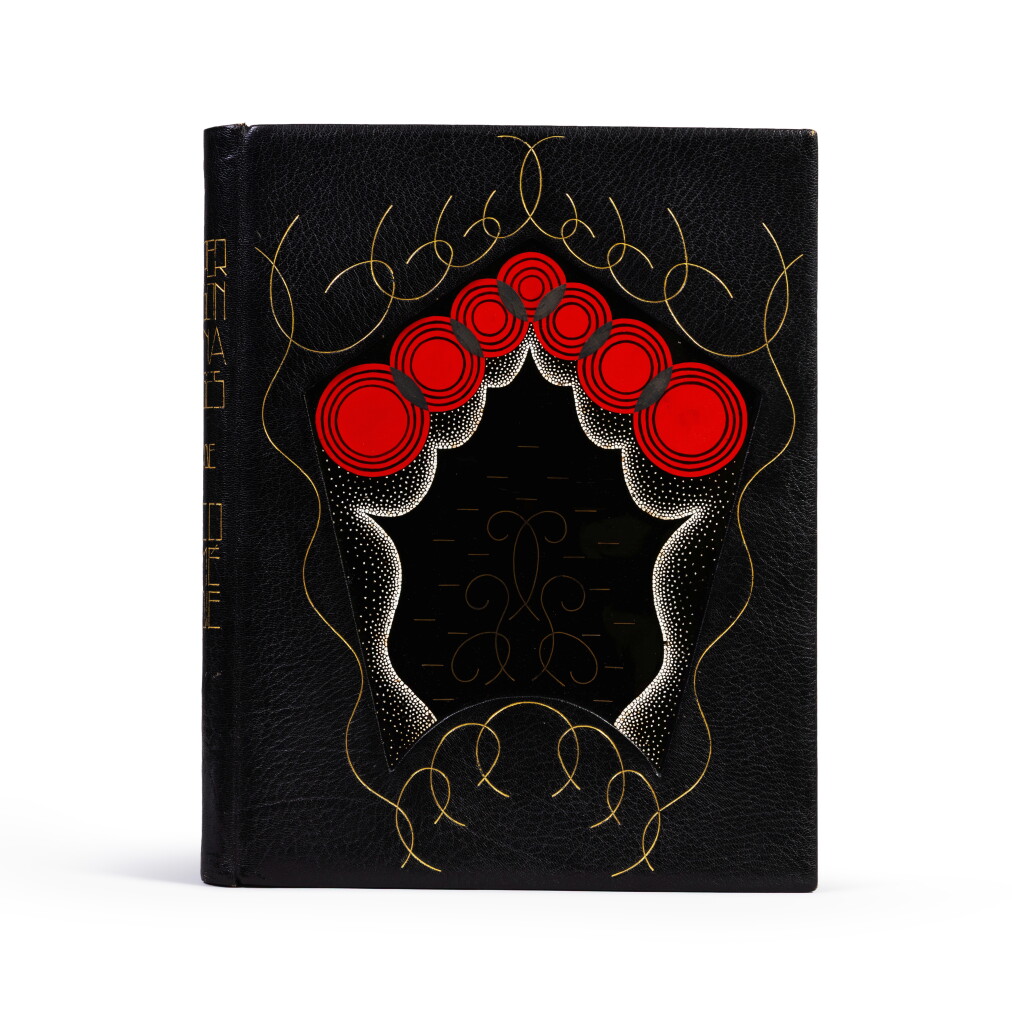
Personnages de Comédie. 1922. Reliure avec 2 laques décorés de coquille d'œuf de Paul Bonet. Enrichi de suites et d'un dessin original. Des bibliothèques Marty et Scherrer.
Estimate
15,000 - 20,000 EUR
Lot Details
Description
George Barbier ─ F.L. Schmied ─ Albert Flament
Personnages de Comédie.
Paris, Meynial, 1922.
Folio (368 x 288 mm). Black morocco, the covers decorated with a black and red lacquer panel incorporating eggshell, framed with an arrangement of curved and interlacing gilt fillets, black morocco doublures decorated with a large polylobed red morocco shape outlined with gilt fillets, black silk doublures lamé with gold; illustrated original wrappers, chemise and slipcase (Paul Bonet, [1928]). Untrimmed.
With two lacquer panels decorated with eggshell.
From the libraries of Marty and Scherrer, two of Paul Bonet’s greatest patrons.
First edition. Text printed in green and black.
12 full-page plates, 2 headpieces, tailpieces, and 22 initials by George Barbier, all engraved on wood by F. L. Schmied, in colour and heightened with gold and silver.
Limited edition of 150 copies on vellum (n° 129), signed by Barbier at the colophon.
This copy is extra-illustrated with:
- an original drawing signed by Barbier (on a leaf mounted at the beginning);
- a black-and-white illustration of Romeo and Juliet on Japan paper;
- 3 black-and-white illustrations on Japan paper.
One of Schmied’s earliest books. Before becoming his own publisher, he worked as an engraver. His collaboration on Les Chansons de Bilitis probably brought him into contact with Barbier; the two works were published in 1922. They would later collaborate again on the illustrations for Guérin’s Poèmes en prose (1928) and Schwob’s Vies imaginaires (1929).
For this binding, executed in 1928, Paul Bonet used lacquer and eggshell, two materials rarely employed in his work, but very much in vogue among Art Deco designers. Jean Dunand had adapted his lacquer technique to decorate bindings for his friend Schmied; he was the first to introduce eggshell into his lacquer work, in order to bring white into his compositions, a shade that could not be achieved with plant-based pigments (A. Duncan and G. de Bartha, La Reliure en France Art nouveau-Art déco, 1880–1940, Paris, L’Amateur, 1989, p. 190). For this lacquer decoration, Bonet called upon the lacquer artist Damg-Bui, who had come from Indochina in response to the growing demand for decorative lacquer work in Europe.
This binding was executed for Bonet’s first major patron, R. Marty. The bibliophile first noticed Bonet’s early bindings at the Salon d’Automne in 1926, at a time when the craftsman was considering giving up the profession. In 1930, the sale of the Marty library marked a decisive moment in Bonet’s career: it established his reputation among the leading booksellers and bibliophiles of the day.
The book subsequently belonged to Paul Bonet’s other major patron of the 1930s, the Argentine bibliophile Carlos R. Scherrer. The catalogue of this important library, Bibliothèque reliée par Paul Bonet, was published by Blaizot in 1963. Blaizot acquired the present book directly from Mrs. Scherrer in 1956. It later formed part of the important Art Deco collection of Steven A. Greenberg, which was sold in New York in 2012.
Bibliothèque R. Marty (vente 10-13 février 1930, lot 235) ;
Bibliothèque Carlos R. Scherrer (selon Bonet, Carnets) ;
Auguste Blaizot (acheté à l'épouse de Scherrer en 1956) ;
Steven A. Greenberg (New York, Christie's, 13 décembre 2012, lot 166).
P. Bonet, Carnets, n° 55, reproduced pl. 10.
Carteret : "L'une des meilleures productions de Barbier et de Schmied, qui a supérieurement gravé".