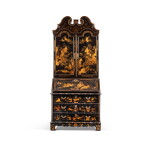
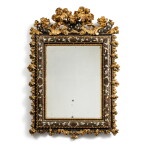
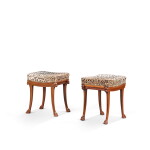
A pair of Italian yellow-lacquered and parcel-gilt consoles, Venice, circa 1750-1760
Auction Closed
November 27, 04:27 PM GMT
Estimate
80,000 - 120,000 EUR
Lot Details
Description
the frieze decorated with pierced rococo shells, resting on shaped- feet with medalions, with a purple brèche marble top
(2)
Height. 34 1/4 in, width. 61 ¾ in, depth. 28 in ; Haut. 87 cm, larg. 157 cm, prof. 71 cm
A console was exhibited at Lacche veneziane del Settecento, Ca' Rezzonicoo, Venice, 1938, illustrated in the catalogue, pl. XXIV, fig. 33.
E. Baccheschi, Il mobile veneziano del Settecento, Milan, 1962, p.53.
RELATED LITERATURE
E. Colle, Il mobile Roccocò in Italia, Arredi e decorazioni di interni dal 1738 al 1775, Milan, 2003, fig. 346.
G. Morazzoni, Mobili Veneziani Laccati, Gli ingressi, le sale, le sedie, i divani, Milan, 1927, fig LXV, LXIX.
G. Lorenzetti, Lacche Veneziane del Settecento, Venise, 1938, p XXIV, fig 33.
C. Santini, Le Lacche dei Veneziani, Modène, 2003, fig. 44.
S. Levy, Lacche veneziane settecentesche, Vol.l, Milan, 1967.
C. Alberici, Il mobile veneto, Milan, 1980.
The Portego, situated in the centre of the Piano Nobile was symbolic as it denoted status and displayed all forms of Venetian art together: from architectural sculpture, stucco decoration, and furniture to the fresco paintings and the portraits of illustrious ancestors. The function of the Portego served as a room where the Venetian aristocracy could show off and impress their visitors and guests, who were often gathered there for a reception on the occasion of a marriage, or during the time of great festivals, showcasing the exquisite taste, political influence and economic wealth of the family within the hierarchical system of the Serenissima. The aesthetically decorated Portego would furthermore have been enhanced by the light reflecting off the waters of the Grand Canal through the windows, creating a gentle liquescent fusion of the shapes and colours in a chiaroscuro effect.
The present pair of console tables is a very fine example of the high degree of craftmanship by the Venetian carvers and furthermore by their original lacquered decoration. From the 16th century onwards, lacquerware inspired by Oriental models has been produced in Venice and was first recorded by Maximilian Mission (c.1650-1722), a Huguenot traveller, who visited the city in 1688 and noted that there was a lively business in lacquerware, at all prices.
The taste for lacquered furniture reached its zenith in the 18th century, with Venice being pre-eminent in its production. The cosmopolitan Venetian Republic rivalled Paris at that time becoming the new capital of taste, fashion and every kind of luxury. Aristocrats from all over the continent descended on the city during their Grand Tour and for the Carnival, which exposed these Venetian lacquerwares to the fashionable society, resulting in a surge in the demand for lacquerware throughout Europe.
Noble families in Venice maintained small, richly decorated rooms known as casini, which were furnished with commodes, console tables, and chairs and where they hosted conversazioni after official functions or festive events. A prime example of this room is in the striking and elegant interior of the Grand Salon of Palazzo Ca’ Rezzonico, now the Museum of Decorative Arts in Venice. The Venetians wholeheartedly embraced the French Rococo, adding their own flair by making the bombé commode even more dramatically enlarged thereby establishing it as a universally recognized trademark of Venice.
The lacquer technique comprised of a meticulous process, starting with sanding down the wooden carcass, then applying a thin layer of gesso mixed with glue for the preparation of the ground. After the background colour and details were painted, up to twenty layers of varnish was carefully applied to avoid brush strokes being evident. The Venetians loosely adapted the style of Far Eastern models, but added their own inimitable twist which was without parallel in Europe. This pair con consoles is a rare example showcasing the careful application of this intricate method.
You May Also Like