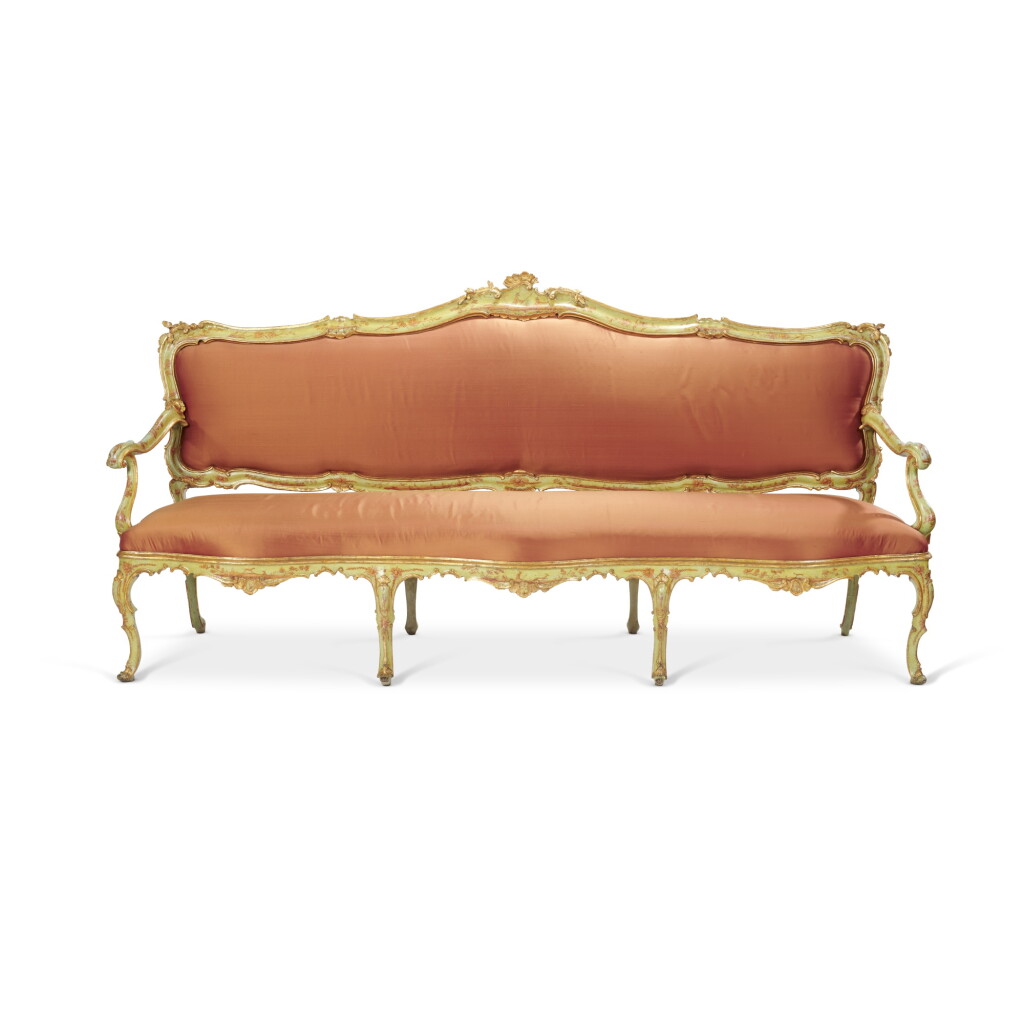
An Italian giltwood and green-lacquered canapé à châssis, Venice, circa 1760
Auction Closed
November 27, 04:27 PM GMT
Estimate
24,000 - 35,000 EUR
Lot Details
Description
decorated with chinoiserie scenes, with an orange-red silk upholstery
Height. 43 ¾ in, width. 90 ½ in, depth. 22 7/8 in ; Haut. 111 cm, larg. 230 cm, prof. 58 cm
C. Santini, Mille mobili veneti, Vol. III, Modène, 2002, p.213, fig.343.
RELATED LITERATURE
S. Levy, Lacche veneziane settecentesche, Vol.I, Milan, 1967, pl. 191-195.
C. Santini, Mille mobili veneti, Vol. III, Modène, 2002, p.214, fig.344.
C. Steiner -R. Del Puglia, Mobili e ambienti dal gotico al floreale, Vol. II, Milan, 1963, fig.203-302.
Benefitting from its long mercantile history and economically remaining stronger than other Italian cities that were on the decline, Venice in the eighteenth century was a centre of splendour, art and luxury to rival even refined, courtly Paris. Much of the glamour of Venice derived from its bustling international trade, which brought to Europe many wonders from the East – for example, the availability of strong dyes from across the world is one of the main reasons for the preference for vibrant, jewel-like colours in Venetian painting. Venetian connoisseurs and craftsmen alike would therefore have seen the glossy, sparkling and all-but-indestructible lacquer that was produced in Japan and China to a secret recipe that remained shrouded in mystery. The Venetians were the first to attempt to imitate this in Europe, with records from the mid-sixteenth century indicating that Venetians were copying Persian lacquered book-bindings.1
The suite to which the present sofa belongs, of which four chairs sold at Sotheby’s London, 16th December 1998, lot 66 and two sold at Semenzato, 31 March 1985, lot 498, are typical in bringing this Venetian taste for lacquer surfaces beyond objects and onto furniture. Venetian aristocrats would typically have had smaller apartments known as casini that were more informally furnished than their grand canalside palazzi, with their casini providing spaces for rest and relaxed entertaining that were well-suited to lacquer furniture. This was always in the Rococo style, which remained popular in Venice long after the fashion had moved on elsewhere; the taste for Venetian lacquer would fade as Neoclassicism established itself in Venice. These lacquer pieces would often draw on chinoiserie motifs, a logical choice for a technique that evokes the exotic Far East: pagodas can be spotted on the back splats of the chairs in the Rossi collection sold at Sotheby’s London, 10-12 March 1999, lot 139, and an armchair from the Palazzo Calbo-Cotta sold at Christie’s London, 2 December 1998, lot 132, with green and gilt lacquer incorporating chinoiseries. The present lot is rare in its almost exclusive focus on chinoiserie ornament though, since it was more typical for Venetian lacquer work to be in a more exuberant and westernised interpretation of the aesthetics of lacquer, generally with a proliferation of European flowers, birds, insects and tendrils.
The closest match for the present sofa at auction, both in carving style and colour palette, is the banquette sold at Sotheby's London, 2010, lot 115, but a contemporary lacquer suite of notable richness was sold at Christie’s London, 14th December 2000, lots 332 and 333. A console table in this chinoiserie style is also pictured in S. Levy’s publication on Venetian lacquer.2 Consistent throughout, though, is the Venetian penchant for bright colours, with a far greater array of pinks, greens, blues and creams employed than in European lacquer found elsewhere. By far the best public collection to view Venetian furniture in this style is the Ca’ Rezzonico, a palazzo on the Grand Canal that houses the Museum of Eighteenth-Century Venice and features numerous rooms furnished with mid-eighteenth-century lacquer furniture, including examples in the Room of the Parlatory that have the same pistachio-green background as the present lot.3
1 J. Bourne, A. Christie et al, Lacquer: An International History and Collector’s Guide, Marlborough, 1984, p.173.
2 S. Levy, Lacche Veneziane Settecentesche, Milan, 1967, vol I, pl. 191-193.
3 For the green suite, see G. Mariacher, Ca’ Rezzonico: An Illustrated Guide, Venice, 1967, pl.190, 193, 194, 195 and 196, and the page for the Room of the Parlatory on the website of the Ca’ Rezzonico, available at: https://carezzonico.visitmuve.it/en/il-museo/percorsi-e-collezioni/second-floor/room-of-the-parlatory/
You May Also Like