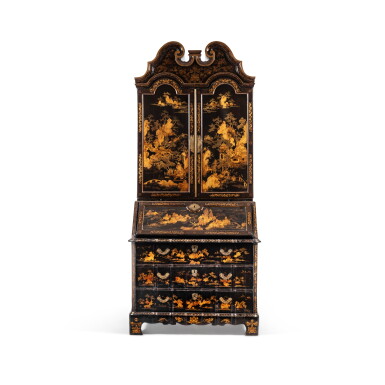
A Chinese export gilt-bronze mounted lacquer bureau cabinet, Canton, Yongzheng period, circa 1730
Estimate
40,000 - 60,000 EUR
We may charge or debit your saved payment method subject to the terms set out in our Conditions of Business for Buyers.
Read more.Lot Details
Description
the upper part opening with two doors revealing an interior decorated with temple scenes and twenty-eight drawers, with side handles, the lower part opening with three drawers, and a fall-front writing compartment fitted with eleven drawers, a door and six pigeonholes
Height 94 1/2 in., width 42 in., depth 25 1/2 in. ; Haut. 240 cm, larg. 107 cm, prof. 65 cm
RELATED LITERATURE:
T. Clemmensen, « Some Furniture Made in China in the English Style, Exported from Canton to Denmark, 1735, 1737 and 1738 », in Furniture History, vol. XXI, 1985, p. 174-180
The bureau-cabinet presented here is a classic example of the furniture produced in Canton during the 1730s for the European market. It represents an early instance of Chinese cabinetmakers creating furniture directly inspired by Western models. Local workshops received European drawings, scale models, and actual furniture via the East India Company, enabling them to replicate European designs. These pieces, in turn, inspired the development of European furniture featuring varnish finishes designed to imitate lacquer. While the exterior of the piece evokes European architectural furniture interpreted in an Asian style, the interior recalls the cabinets of Japanese Buddhist shrines.
This piece is among the most elaborate examples produced during that period, distinguished by its elegant scrolled pediment and curved façade. It invites comparison with the bureau-cabinet brought to Denmark in 1735, 1737 and 1738 by Captain Guillaume de Brouwer, commander of the Sleswig, and sold to Christian VI; that piece is now held at Fredensborg Castle (illustrated in T. Clemmensen, Some Furniture Made in China in the English Style, Exported from Canton to Denmark, 1735, 1737 and 1738, Furniture History, vol. XXI, 1985, pp. 174–180). Other notable examples include the bureau-cabinet held by the Victoria & Albert Museum (W.28-1935) and the one sold at Christie's, New York, in the Le Goût Steinitz sale, 19 October 2007, lot 30.
You May Also Like