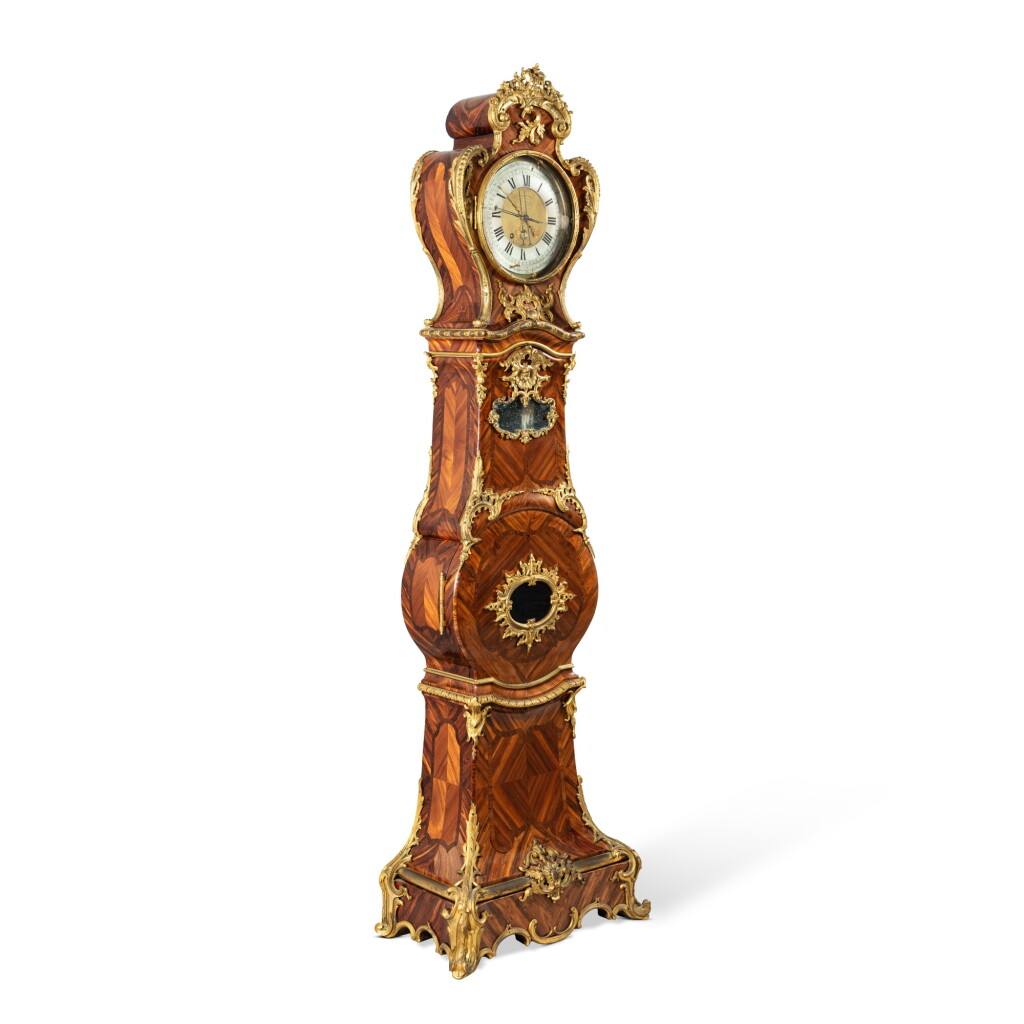
A Louis XV gilt-bronze mounted tulipwood, amaranth and holly-strung marquetry astronomical longcase clock, with C crowned, the dial signed Julien Leroy, circa 1750, attributed to Jean-Pierre Latz
Lot Closed
September 29, 12:30 PM GMT
Estimate
25,000 - 40,000 EUR
We may charge or debit your saved payment method subject to the terms set out in our Conditions of Business for Buyers.
Read more.Lot Details
Description
with a geometric marquetry, the mounts with scrolling foliage, the dial with rotating outer calendar ring to indicate the equation of time and enclosing the time dial with every minute numbered, steel hands for mean time and centre seconds and gilt hands for solar time, the dial centre with a date aperture, signed Julien Le Roy A Paris and inscribed "les aiguilles dorées marquent letems vray et celles qui sont bleues letemps moyen" (The gold hands indicate true time, and the blue ones indicate mean time), the similarly signed movement with weight-driven going train and deadbeat escapement, the striking train with spring barrel, outside count wheel and striking on a bell
Height 83 in., width 24 1/2 in., depth 13 in. ; Haut. 211 cm, larg. 62 cm, prof. 33 cm
Ader Picard Tajan, Paris, 16 June 1987, lot 223 ;
Private collection, Belgium.
La dynastie des Leroy, horloger du roi, musée des Beaux-Arts, Tours, 11 avril-14 juin 1987
Drouot, L'art des enchères en France, 1986-87, ill. p. 262
C. Cardinal et J.-C. Sabrier, La Dynastie des Leroy, horlogers du Roi, catalogue d'exposition, musée des Beaux-Arts, Tours, 1987, p. 65
Julien Le Roy, clockmaker, received master in 1713.
Jean-Pierre Latz, appointed ébéniste privilégié du Roi in 1741.
The movement and dial of this longcase regulator bear the name of one of the most renowned clockmakers of the first half of the 18th century. Born in Tours, Julien Le Roy served his apprenticeship in Paris under the clockmaker Le Bon. Admitted as a master clockmaker in 1713, he subsequently became a warden of the guild. He achieved great renown, eventually becoming Clockmaker to the King in 1731 and Valet de Chambre in 1739. He was responsible for maintaining the royal clock collections and pioneered numerous innovations, including the refinement of monumental clocks capable of displaying both mean time and true solar time.
Among the most sought-after complications of the 18th century was the equation of time, found on the era's most prestigious timepieces, most notably the Gudin regulator held at the Musée des Arts et Métiers in Paris. This complication allows the dial to display both mean time and the solar time indicated by a sundial. This discrepancy arises from the tilt of the Earth's axis and could range from 14 minutes fast in February to 16 minutes slow in November. The use of a dual-hand display for the equation of time, with both hands rotating simultaneously on the same dial, is a highly original feature of this regulator.
You May Also Like


