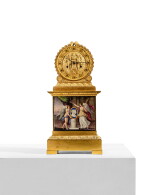
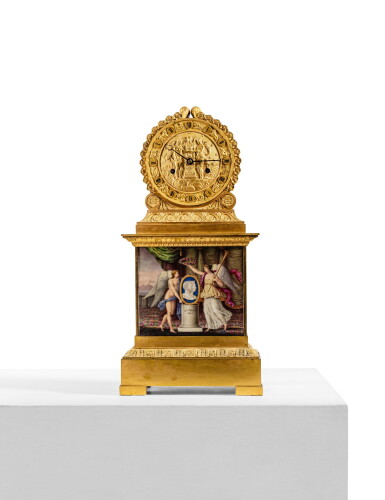
A Royal French gilt-bronze and Italian porcelain mantel clock, given by King Francis I of the Two Sicilies to his wife, Queen Maria-Isabella of Bourbon, the clock Paris, circa 1825-1829, the porcelain probably painted by Raffaele Giovine, Naples, circa 1829
Estimate
20,000 - 30,000 EUR
We may charge or debit your saved payment method subject to the terms set out in our Conditions of Business for Buyers.
Read more.Lot Details
Description
on a square base, decorated with a porcelain plaque depicting a double portrait of King Francis I of the Two Sicilies anf his wife, Queen Maria-Isabella of Bourbon, within a blue medallion with a gilt border, on a column dated '4 Ottobre 1802' flanked by a figure of Victory and Cupid within a landscape with Vesuvius in the background, the gilt-bronze dial depicting the union of Cupid and Psyche surrounded by zodiacal symbols, the bell-striking movement signed FS
Height 18 1/2 in., width 8 7/8 in., depth 5 1/8 in. ; Haut. 47 cm, larg. 22,5 cm, prof. 13 cm
Cited in the Archivio di Stato di Napoli, Casa Reale Amministrativa, III inventory, Tapestry series, bundle 51, Notamento degli oggetti appartenenti a S.M. la Regina, doc. undated, after 1826: October 1829, "two packages [...] containing a gilt-bronze clock with two matching vases [...]";
Delivered to the Royal Palace from Marseille on 17 October 1829;
Presented by King Francis I of the Two Sicilies in 1829 to his wife, Queen Maria Isabella of Bourbon, on the occasion of their wedding anniversary, 4 October 1829;
Placed in the Queen's study at the Royal Palace of Naples;
Probably taken by the Queen, after the King's death in 1830, to the Villa della Regina, Capodimonte;
Possibly the clock recorded in the inventory taken after the Queen's death in 1849, a clock "of gilt bronze with a porcelain figure, on a mahogany base with gilt-bronze mounts similar to those of the desk, striking the hours and half-hours, and with a crystal globe," valued at thirty ducats (ASN, Casa Reale Amministrativa, III inventario, serie inventari, fascio 200, Inventario della eredità di SM l'augusta defunta regina D. Maria Isabella di Borbone, 1848-1849, cited in note 16, p. 332);
Count Francesco del Balzo (1804-1882), morganatic husband of Queen Maria Isabella, married 1839;
Thence by descent.
D. Di Castro, in exh. cat. Civiltà dell'Ottocento. Le arti a Napoli dai Borbone ai Savoia, III, Le arti figurative, Giancarlo Alisio (ed.), Palazzo Reale, Naples, 1997-1998, Naples, 1997, p. 177
This mantel clock was a wedding anniversary gift from King Francis I of the Two Sicilies (1777-1830), King of Naples, to his second wife, Maria Isabella of Bourbon-Spain (1789-1848), whom he married in 1802. Francis I of the Two Sicilies grew up in Naples and first married Maria Clementina of Austria, with whom he had a daughter, Marie-Caroline, the future Duchess of Berry, and a son. Widowed early, he married his cousin Maria Isabella, and the couple had twelve children. Succeeding his father, Francis I ascended the throne in 1825 and attempted to pursue a progressive policy, though he held little real power, the kingdom being occupied by Austrian troops. He died in 1830, leaving power to his wife and his son, Ferdinand II.
Our clock features symbolic decoration, with the double cameo portrait of the royal couple flanked by figures of Victory and Cupid, a symbol of the love between the two sovereigns, commemorating their marriage, celebrated on 4 October 1802.
This clock reflects the fashion for clocks decorated with large Sèvres plaques, prevalent during the first half of the 19th century. True technical and artistic feats, such clocks are typically rectangular in form to showcase the large porcelain plaques. Their decorative themes vary widely, ranging from historicist and mythological scenes to portraits and landscapes. Among the many known examples is the clock acquired by the Duke of Orléans in 1826, decorated with neo-Gothic scenes, sold as part of the Hubert Guerrand-Hermès collection, Autour de la duchesse de Berry, Sotheby's, Paris, 15 December 2023, lot 616.
Our clock, slightly later in date, circa 1829, is particularly distinctive in that the plaques were not painted at the Sèvres manufactory but in Italy, in Naples, by the great painter Raffaele Giovine. The Italian sovereign thus commissioned a clock model executed in France but decorated with Italian porcelain.
Two other French clocks by the house of Bréguet, decorated with Naples porcelain, are recorded in the royal collections and preserved in the collections of the Museo di Capodimonte (inv. 1907 and inv. 1550). A third clock, its porcelain dial decorated with a portrait of the Duchess of Berry, daughter-in-law of Queen Maria Isabella of Bourbon-Spain, is recorded in 1828 in the Music Room of the Royal Palace of Naples, and subsequently in Queen Maria Isabella's villa at Capodimonte (A.S.N., Casa Reale Amministrativa, III inv., Inventories, f. 58, Inventario del Quarto delle Loro Maestà, anno 1826, additions of 1828, Music Room: "Gilt-bronze table clock, with music beneath, four tunes housed in the exotic wood pedestal; on the front of the said clock, on porcelain, is the portrait of H.R.H. the Duchess of Berry." This clock can be traced through the Queen's collections until her death. See A.S.N., Casa Reale Amministrativa, Inventario della eredità di SM l'augusta defunta regina D. Maria Isabella di Borbone).
This practice was not an isolated one, as several comparable pieces are known, including an inkstand of gilt bronze and French porcelain, painted by Raffaele Giovine for King Ferdinand I of Naples (1751-1825), circa 1800-1825 (Giordano collection, Une vision muséale, Sotheby's, Paris, 26 November 2024, lot 59). This combination reflects the sovereigns' wish to showcase the Italian decorative arts while following the fashions of the day.
Raffaele Giovine was a miniaturist painter appointed by King Francis I, who held him in particular esteem, to oversee the Court's tableware and collections of precious metalwork. He decorated numerous porcelains and plaques adorning items of furniture, such as our clock and the inkstand. A further example is a large pair of French porcelain vases decorated with portraits of Francis I and Queen Maria Isabella, attributed to Raffaele Giovine, Royal & Noble sale, Sotheby's, London, 17 January 2019, lot 24.
You May Also Like