
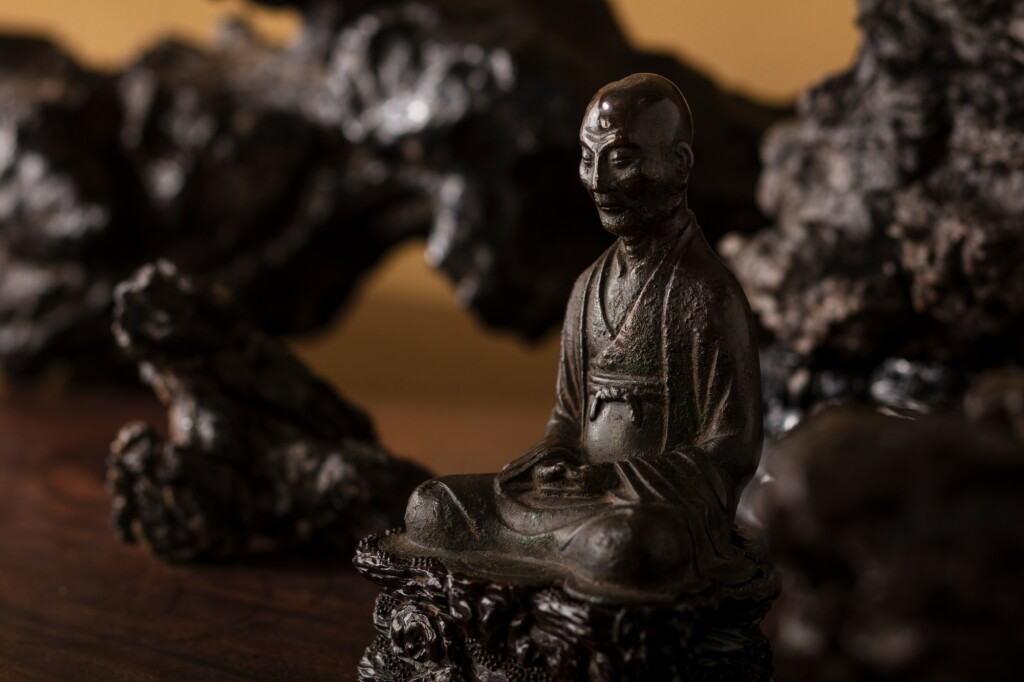
A bronze figure of a seated Buddhist master, Song dynasty | 宋 銅祖師坐像
Auction Closed
October 29, 08:30 AM GMT
Estimate
100,000 - 300,000 HKD
Lot Details
Description
A bronze figure of a seated Buddhist master,
Song dynasty
宋 銅祖師坐像
cast seated cross-legged with the hands held in dhyana mudra and the head tilted downwards with the eyes closed, the figure portrayed with prominent cheekbones and dressed in loose robes flowing over the knees, zitan stand
13.5 cm
The Song dynasty acted as a bridge between the earlier and later dynasties in the history of Chinese Buddhism. It was during the Song dynasty that ideas of engaging with the world and serving the nation were introduced into the religion, which gradually opened Buddhism to secularisation. As Chan Buddhist practice became more popular, a range of sects and schools proliferated and founding masters (zushi) were revered fervently for their enlightenment and religious authority, resulting in an increased production of figures of Buddhist masters and related luohan in the Song dynasty. From the Southern Song dynasty onward, such figures were particularly popular in southern China and profoundly influenced Ming and Qing sculpture.
The secularisation of Buddhist thought and sculpture coincided with a shift in sculpting technique from the overstatement in the Tang dynasty to a more realist style in the Song dynasty. Buddhist masters were real Buddhist figures of character and prestige who would guide mass practice, and were therefore depicted as real people. The sculptures of these masters, including the present lot, often reflect a realist artistic approach, which was frequently used in similar sculptures in various materials made around the same time.
The present figure depicts a Buddhist monk with a prominent forehead and cheekbones, and his eyes are downcast. Wearing a collared monk’s robe tied with a cord, topped with an open kasaya, he sits cross-legged with his hands resting palms face up in the meditation mudra. He has the elegant features and dignified manner of an eminent monk. The folds in his garment are depicted simplistically yet with great tactility, much like those on the Song figural sculptures on the base of the Dongxi Pagoda at Quanzhou’s Kaiyuan Temple.
Both Song imperial courts banned the use of copper in sculpture, because large amounts of copper were used to mint coins. As a result, sculptures were often made of wood, stone, or clay, and metal sculptures were mostly cast iron. Gilt-bronze sculptures from this period are particularly rare. This current figure is cast from a refined alloy, strong yet delicate, with a lovely reddish-purple hue. The back of the figure is smoothly rounded, and the master's facial features are notably realistically portrayed, testifying to the sculptor's superb skills. Veiled with a lustrous patina, the current figure ranks among the most masterfully created works of art.
Comparable contemporaneous figures include the Song wooden luohan sculptures in the Nanhua Temple in Qujiang[1] and the Song clay luohan sculptures at Zijin’an in Wu County.[2]
[1] Li Jingjie and Tian Jun, eds., Ni yinggai zhidao de 200 jian foxiang (Two Hundred Buddhist Images You Should Know), Beijing, 2007, pp. 208-214, figs 141-147.
[2] Zheng Minzhong and Hu Guoqiang, eds., Mingke yu Diaosu (Inscriptions and Sculptures), Shanghai, 2008, pp. 194-195, figs. 187-188.
宋代是漢傳佛教發展中承前啟後的時期,因著宣導入世報國思想,遂開啟佛教世俗化的進程。禪宗教義的修習蔚為風尚,形成「五家七宗」的繁盛局面。各派均重視祖師的教化與宗教地位,祖師崇拜氛圍濃郁,是故有「祖師禪」之統稱。祖師及其相近的羅漢造像頻繁出現,構成此時佛教造像的時代特色。南宋以後更流行於南方地區,並深刻影響到明清時期的造像。
與佛教思想及造像題材世俗化相呼應,造像表現的手法也從唐代超現實的誇張主義向宋代的寫實風格轉變。祖師作為德高望重,引領大眾修行的現實佛教人物,在形象塑造上遵循如真人的標準,是最能體現寫實特點的造像類型,常見於包括本拍品在內的同時期各種材質的造像實例。
祖師像呈比丘相,顱顴隆突,雙目低垂。內著交領僧衣,外罩下垂式袈裟,腰間束帶。雙掌朝上交搭置於股間持定印,跏趺端坐作禪思狀,骨骼清奇,儼然具深厚修為之高僧形象。衣袍褶痕簡省,質感突出,與典型宋代人物雕像、泉州開元寺東西塔基座上之人物衣紋如出一轍。
兩宋時期朝廷實行禁銅令,銅料大量用於鑄錢,造像常選材木石泥塑,金屬材質多改以鐵鑄,金銅造像尤為罕見。祖師造像以精煉合金銅鑄就,銅質堅致,胎色紫紅。後背渾圓起伏,神態逼肖,宛然如生,可謂絕技。外表歷經歲月洗禮,寶光內蘊下洋溢出鑒賞家所孜孜以求的斑斕古色,璀璨典雅,洵為清供之無上妙品。
類比參照的宋代造像實例,可參考吳縣紫金庵宋代泥塑羅漢[1]。
[1] 鄭瑉中、胡國強主編,《銘刻與雕塑》(上海:上海科技出版社、香港:商務印書館,2008),圖188,頁195。
You May Also Like


