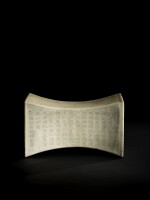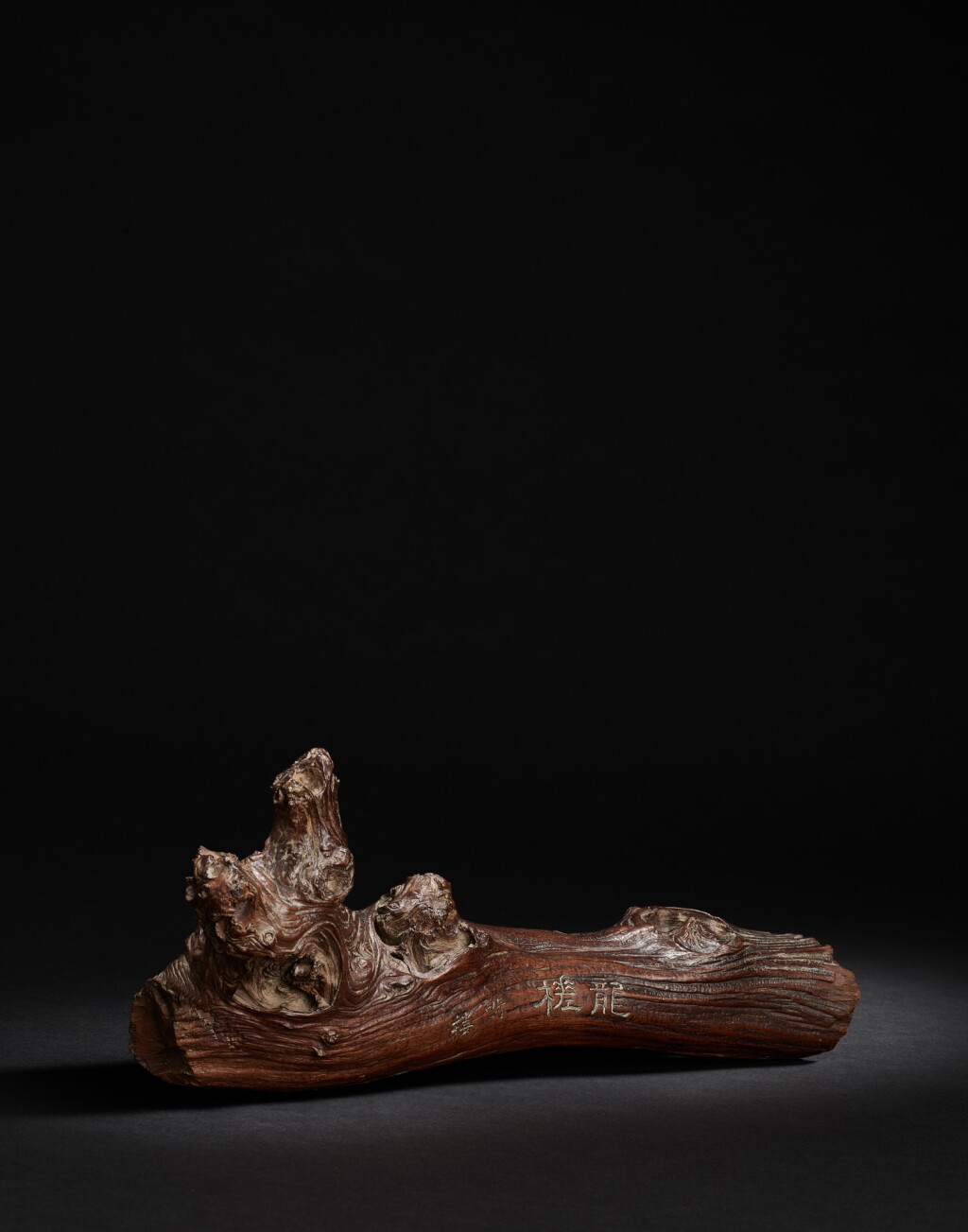
An extremely rare inscribed 'shanmu' 'dragon' raft, inscription by Du Meigen, Qing dynasty, Guangxu period | 清光緒 杉木刻詩龍槎 《梅根》款
Live auction begins on:
October 30, 02:00 AM GMT
Estimate
1,200,000 - 2,500,000 HKD
Lot Details
Description
31.7 cm
Water, Pine and Stone Retreat Collection.
Sotheby's Hong Kong, 2th October 2017, lot 3007.
Gerald Tsang and Hugh Moss, Arts from the Scholar's Studio, Fung Ping Shan Museum, University of Hong Kong, Hong Kong, 1986, cat. no. 62.
Jean de Loisy and Alain Thuleau, La Beauté, Avignon, 2000, p. 238.
Nicolas Chow, The Literati Aesthetic, Hong Kong, 2018, no. 55.
來源
水松石山房收藏
香港蘇富比2017年10月2日,編號3007
展覽
曾柱昭及莫士撝,《文玩萃珍》,香港大學馮平山博物館,香港,1986年,編號62
Jean de Loisy 及 Alain Thuleau,《La Beauté》,亞維農,2000年,頁238
出版
仇國仕,《無盡意》,香港,2018年,編號55
Naturally gnarled and wrinkled and of pleasing vivacious form, the ‘dragon’ raft encapsulates a story. It was reputedly once a section of a towering shan tree in front of the temple of the legendary Emperor Shun that, having witnessed the passage of time and the change of seasons, was crudely severed when the local official destroyed the woods. Having been saved by a scholar and later cherished by a monk who decorated it with an inscription, the present log manifests its erstwhile owner’s reverence for the ancient ruler, his resentment over the destruction of the woods and his innocent pleasure derived from scholarly objects. Having been transformed from a guardian tree to a poetic object perfect for a scholar’s desk, the ‘dragon’ raft recalls ancient tales and provides inspiration.
The log is incised in clerical script with a long inscription, which can be translated as:
The whereabouts of Shun’s tomb on the Nine Doubts Mountain has been uncertain for ages, but shan trees in front of the Temple of Shun presented a magnificent towering sight, cloaking the place with a sense of the mysterious and divine. Woodcutting was thus prohibited, so there they flourished like sweet pear trees providing a place to stop and rest. During the Guangxu period of our present dynasty the district magistrate, on the pretext that wind would topple them, had all the trees cut down—becoming like Cavalry Commander Huan in doing so.1 And they, whose heads had once reached into the clouds so that they made one rest one’s staff and become stirred to strong emotion, chanced to leave behind a few small fragments of branches, which all in the world treasured. Liu Zhun, a retired scholar from Lingdao, gave me one such fragment that he had saved. Its shape is so irregular and knobby, curving like a dragon at play, that it deserves to be elegantly embellished with a title and inscription. Now today as my thoughts float free on the sea and my spirit roams along Yu’s tour routes of inspection, I make this clear to future generations: spoil not my intention and rashly ridicule this object of enjoyment. The inscription states: Was this cut down to serve as a chronological record? Or was it done to provide something on which to ride up to Heaven? Aha! Aha! Or was it because Shun really is immortal?
It has long been believed that the burial place of Emperor Shun, who supposedly ruled in the later part of the third millennium BC, is located on Jiuyishan (‘Nine doubts mountain’) in the south of Hunan province. This legend has been well recorded long before the first dynasty. One early text is Shanhaijing [Classic of mountains and sea] compiled between the early Warring States period (475-221 BC) and the early Han dynasty (475 BC-9 AD); see section Haijing [Classic of sea], juan 13: Haineijing. According to a later classic, Shuijing zhu [Commentary on the Water Classic] by Li Daoyuan in the late Northern Wei dynasty, Jiuyishan is surrounded by nine similar peaks, all craggy and crooked, confusing the visitors, and hence the name ‘Nine doubts’. It is said that there were temples with stone stelae devoted to Emperor Shun on Jiuyishan, for it is where he was said to be buried.
Under ‘Shunmiao [Temple of Shun]’ in the 1796 version of Jiuyishan ji [Record of Nine Doubt Mountain], it is mentioned that the shan trees outside of the Temple of Shun appeared to have lived for centuries, and poets from Tang and Ming dynasty have written repeatedly about the shan trees in the area. The author says in a later chapter that 15 shan trees flanked the Temple of Shun, and adds “They are the oldest and the largest, with thick green branches and leaves. At night, lights can be seen on these trees, echoing the saying that they emit ‘heavenly lamps’ in the evening.” The present log was once part of an old tall tree, probably similar to those mentioned in the ancient literature, and beamed ‘heavenly lamps’ through the darkness of the nights.
According to the signature, the inscription was written by Du Meigen, a late-Qing dynasty monk. He was a calligrapher, painter and seal carver, native of Hezhou (present-day Hexian, Anhui), and lived in the Sanmei’an (‘Samādhi [Total Absorption] Hermitage’) in Wuhu, Anhui (see Hezhou ji [Record of Hezhou], included in Yu Jianhua, Zhongguo Meishujia Renming Cidian [Encyclopedia of Chinese artists], Shanghai, 1987, p. 904). Named after the Buddhist teaching of meditative absorption, Sanmei’an was built as early as the Ming dynasty. Poet Shi Runzhang (1618-1683) from Xuancheng, who had lived in Wuhu, wrote a poem on the hermitage, mentioning the monks residing there. Despite a lack of historical documentation on Du Meigen and the lack of any other surviving works, the inscription on the present piece is a literal portrait of the monk, giving us a glimpse to his love of nature, appreciation of scholarly objects and boundless imagination.
1 Huan Sima [Cavalry Commander Huan] features in the story behind the proverbial saying yan ji chiyu (‘Disaster reaches fish in the pond’ or ‘Disaster is visited on innocent people’). It is believed that Cavalry Commander Huan of the state of Song possessed a precious pearl. He committed a serious offense and fled the state. When the king dispatched someone to ask where the pearl was, Huan said, ‘I threw it into the pond’. On hearing this, the king had the pond drained to find it, but it was not recovered, and the fish all died as a result”. Just as the fish died because of Huan (who in his greed, had surely lied and kept the pearl), the trees died because of the greedy magistrate, who lied about his reason for cutting them down. For details, see Lü Buwei (290-236 BC), Lüshi chunqiu [Spring and Autumn Annals of Master Lü].
題識:
九疑舜陵,世或疑之。祠檆巋𡘾,迺著神異。樵采有禁,昌止憩棠。國朝光緒,邑宰藉風仆而盡伐之,為桓司馬焉。翹首雲際,安杖興慨。偶遺寸枝,舉國皆寳。泠道劉肫,走隱君子也,藏一節貽余。其形槎枒,宛若遊龍。雅飾名銘,居今之日,思浮海乎,神遊虞巡。昭示來者,無損吾志,昌譏玩物,銘曰:伐以紀年邪,乘以通天邪。嗟乎!嗟乎!舜亦仙邪。梅根。
畸樓。龍槎。
釋文:
傳說舜帝墳陵,居九嶷山(今湖南寧遠)上,但世人或懷疑其真確性。祠前巨木高峻,彌漫神異之氣,砍伐受禁,是以繁密成蔭,路人可駐足木下,稍憩休息。光緒年間,強風歪樹,縣令藉詞全數砍伐,無異於宋朝桓司馬竭池取珠,殃及池魚。曾經頂立仰首,高及雲際,讓人倚其手杖,感興軫慨,如今僅遺寸枝寥寥,國人偶獲片木,無不寶惜珍存。劉肫,籍貫泠道(今湖南寧遠,九嶷山所在地之舊稱),乃退職隱居之君子,將所藏佳木一節饋贈予我,其木形參差,猶如遊龍,堪為其命名書銘,以雅飾良木。如今,我思緒若浮海上,神遊虞朝,巡覽昔日舜帝所建國度,向後來者昭示,儘管譏諷我只顧玩物,也無損我的壯志。銘文道:「此木被伐,是為了紀年,或是讓人乘槎飛天?呀!是因為舜帝也是神仙嗎?」
一節古杉,一段故事。曾頂立九嶷山上舜帝祠前,見證春秋更迭,本欲長伴舜陵,卻遭稗官藉詞誅滅,所遺片木殘枝,難得倖存,轉折入佛門,清僧命名鐫銘,以逾百字,記載古人對賢君之崇敬、對樹伐之惋惜、對同好之情誼、對罕物之鍾愛,流傳至此,誠為緣也。昔時巨杉,今日龍槎,清供案上,古雅引思,讓人不禁神遊天地,遙想古今韻事。
湖南南面九嶷山,傳說為舜帝古陵,先秦典籍早有記載。《山海經.海經.海內經》道:「南方蒼梧之丘,蒼梧之淵,其中有九嶷山,舜之所葬,在長沙零陵界中。」至北魏晚期,酈道元著《水經注》云:「蒼梧之野,峰秀數邵之間,羅岩九峰,各導一溪、岫壑負阻,異嶺同勢。遊者疑焉,故曰:九嶷山。大舜窆其陽商,均葬其隂,山南有舜廟,前有石碑,文字缺落,不可復識,自廟仰山,極髙直上,可百餘里,古老相傳,言未有登其峰者。山之東北,泠道縣界,又有舜廟,縣南有舜碑,碑是零陵,太守徐儉立營,水又西逕營道縣。」可知九嶷山一帶,自古建有舜廟,並立石碑,以祀古帝。
據嘉慶元年(1796年)鐫退思齋藏版《九疑山志》中〈舜廟〉註:「廟在舜源峰下,想自三代時已然,觀廟左右古杉、廟門內古櫧,絕非僅僅數百年,遂能勁至此,唐李郃已有舜廟古杉之詠,明周子恭有古杉記,鄧雲霄遊九疑記亦云:志所稱夜吐天燈者,真數千年物也,其擁護聖宮之林,既歷年久遠如此,武初年始遷可知?」前人以廟前杉古,對舜廟三代初立、後朝屢遷、至洪武四年(1371年)才於舜源峰下修廟之說存疑。在〈煔〉一題下又記:「舜廟兩旁杉十五株最古最高大,枝葉鬱葱,其上夜嘗有光,志所謂夜吐天燈者也。」龍槎或曾如典籍所述,亙古高峻,夜吐天燈。
據銘可推鐫文乃由晚清僧人杜梅根所寫。梅根袓籍和州(今安徽和縣),居蕪湖三昧庵(同處安徽)。工書畫、善篆刻,名載於《和州志》,見俞劍華,《中國美術家人名辭典》,上海,1987年,頁904,惜就其生平,典籍所記有限,也未見其他作品傳世。所居三昧庵,明代已有,取佛語善心一處不動、正定等持之意。宣城詩人施閏章(1618-1683年)曾寓居蕪湖,作有五律詩〈江口三昧庵〉曰:「日日旅愁新,尋幽及暮春。老僧留過客,芳草伴閒人。戰艦徵兵日,文園抱病身。江山連杖履,不厭往來頻。」並註:「時泊兵艘,僧皆閉門。」雖無梅根他作可資參考,但其銘文詳錄他對舜陵古杉之痛惜,又以名銘化殘木為龍槎,設想舜帝若仙乘木升天,所遺文人幽情,將長寄此木。
You May Also Like